Bass Fishing Techniques for Beginners
Feeling overwhelmed by all the fancy gear, secret spots, and jargon when you just want to catch your first bass? You're not alone. Many new anglers get discouraged before they even wet a line because bass fishing seems complicated, but it doesn't have to be. This comprehensive guide will break down the essentials of bass fishing in Illinois, giving you the confidence, knowledge, and techniques to start reeling in those exciting fighters, whether you're targeting largemouth in a local pond or smallmouth in a winding river.
Understanding Illinois Bass Species
Before you even think about casting, it helps to know what you're chasing. Illinois waters are home to three main types of bass, each with its own preferred habitats and behaviors. Understanding these differences can significantly improve your chances of success.
Largemouth Bass: The Illinois Favorite
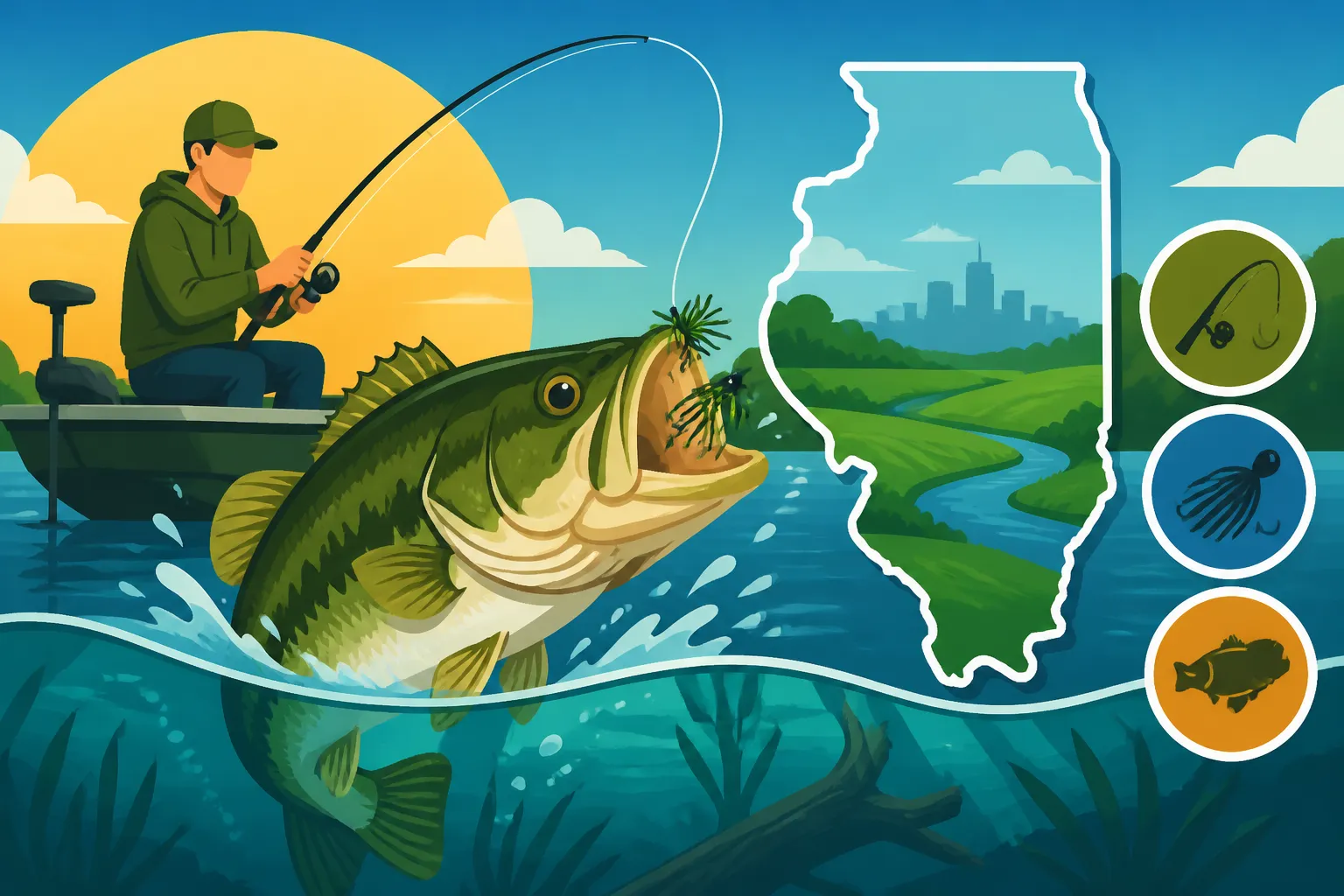
The largemouth bass is arguably the most popular sport fish in Illinois, and for good reason. They're aggressive, grow to impressive sizes, and are found in nearly every lake, pond, and slow-moving river throughout the state. You can easily spot a largemouth by its distinctive dark, horizontal stripe running along its sides, and its jaw extends beyond the back of its eye when its mouth is closed.
These opportunistic predators love to ambush their prey, which means they prefer areas with plenty of cover. Think fallen trees, submerged brush piles, weed beds, lily pads, and docks. If you see a thick mat of vegetation or a dark shadow under an old log, chances are a largemouth is lurking there, waiting for an unsuspecting meal to swim by. They're not particularly picky eaters, consuming everything from smaller fish and crawfish to frogs and even small birds or rodents that fall into the water. For a deep dive into these popular fish, check out our guide on Largemouth Bass Fishing in Illinois: The Complete Guide.
Smallmouth Bass: River and Lake Fighters
While largemouth bass prefer still or slow water, smallmouth bass are true river rats, though you can find them in some of Illinois's deeper, clearer lakes. They're often called "bronze backs" because of their coppery-brown coloration, and unlike their largemouth cousins, their jaw typically doesn't extend past the middle of their eye. They also have vertical bars rather than a horizontal stripe.
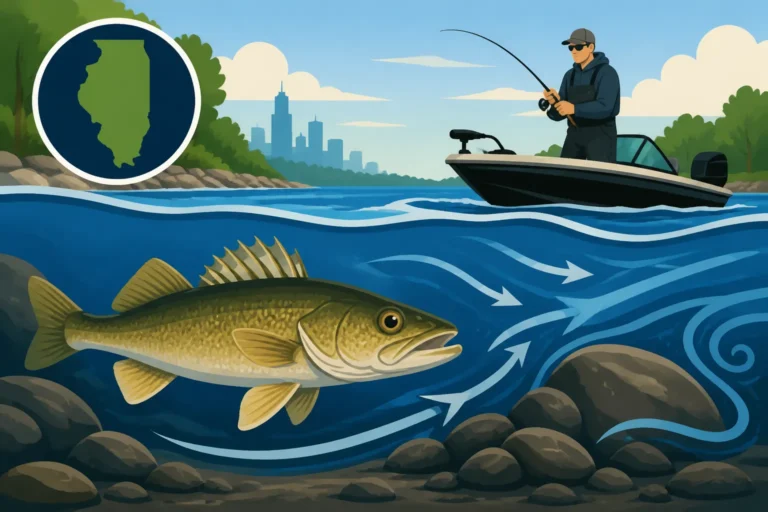
Smallmouth bass thrive in cooler, clearer water with rocky bottoms, gravel beds, and moderate current. In rivers like the Kankakee or Rock, you'll find them holding near eddies, riffles, rock piles, and bridge abutments where they can dart out to snatch passing baitfish or crawfish. On lakes like Lake Michigan, they'll congregate around rocky points, ledges, and offshore humps. They're known for their powerful fights, often leaping out of the water multiple times when hooked, which makes them a thrilling catch for any angler. If you're looking to target these river gladiators, our article on Smallmouth Bass Fishing in Illinois: The Complete Guide offers excellent starting points.
Spotted Bass: A Lesser-Known Gem
The spotted bass is less common in Illinois compared to largemouth and smallmouth, but they do exist in certain southern and central Illinois waters, particularly in larger reservoirs and some river systems. They're often mistaken for largemouth bass due to their similar appearance, but there are key differences. Spotted bass have a row of small, dark spots below their lateral line (the horizontal stripe), and their jaw does not extend past the eye. They also have a rough patch of teeth on their tongue, which largemouths lack.
These bass exhibit characteristics of both largemouth and smallmouth. They often prefer slightly deeper, clearer water than largemouth, but they can still be found around submerged timber and rocky structure. They are known to school up more than largemouth bass, which means if you catch one, there's a good chance more are in the vicinity. While not as widespread, finding and identifying a spotted bass can be a fun challenge and a great addition to your angling experience. Their fighting style is often described as a blend of both other species, pulling hard like a smallmouth but without as many aerial acrobatics.
Essential Gear for Beginner Bass Anglers
Getting into bass fishing doesn't mean you need to break the bank on high-end equipment. For beginners, the goal is reliable, easy-to-use gear that helps you learn the ropes without frustration.
Rods and Reels: Your Primary Tools
The rod and reel are the foundation of your bass fishing setup. For beginners, a spinning combo is almost always the best starting point. They are much easier to cast, especially with lighter lures, and are less prone to the dreaded "bird's nest" tangles that baitcasting reels can produce.
- Spinning Rod: Look for a medium to medium-heavy power rod, typically between 6'6" and 7' long. This length and power are versatile enough to handle a wide range of bass lures and give you good casting distance and control. Graphite rods are lightweight and sensitive, allowing you to feel subtle bites, while fiberglass rods are more durable and forgiving for beginners. Many reputable brands offer excellent entry-level spinning rods that you can find on Amazon or at local sporting goods stores like Cabela's or Bass Pro Shops.
- Spinning Reel: Pair your rod with a spinning reel in the 2500 to 3000 size range. This size provides a good balance of line capacity and retrieve speed. Ensure the reel has a smooth drag system, which is crucial for fighting larger fish without breaking your line. A good retrieve ratio (e.g., 6.2:1) allows you to work a variety of lures effectively. When you're just starting, prioritize smoothness and durability over fancy features.
Choosing the right combination is about balance. The reel should feel comfortable in your hand and not make the rod feel tip-heavy or butt-heavy. Many manufacturers sell pre-matched rod and reel combos, which are often a fantastic value for beginners and take the guesswork out of pairing components.
Fishing Line: The Connection to Your Catch
Your fishing line is the critical link between you and the fish, so understanding your options is important. For beginners, two types of line stand out: monofilament and fluorocarbon.
- Monofilament (Mono): This is the most forgiving line for beginners. It's inexpensive, stretches, and is easy to tie knots with. The stretch provides a buffer against sudden pulls from a fish, helping prevent hooks from tearing out or lines from snapping. It's also quite visible in the water, which can be a downside in clear conditions, but its ease of use often outweighs this for new anglers. For most beginner bass applications, a 8-12 lb test monofilament line is a great choice. You can find large spools of good quality mono, like Berkley Trilene XL, on Amazon.
- Fluorocarbon (Fluoro): This line is nearly invisible underwater, making it excellent for clear water conditions or finicky fish. It has less stretch than monofilament, offering increased sensitivity to detect bites and better hook-setting power. However, fluorocarbon is generally more expensive, can be stiffer, and some anglers find it trickier to tie knots correctly. For beginners, it might be best used as a leader attached to a main line of braided fishing line (which is less beginner-friendly on its own).
For your first setup, spool your spinning reel with 10 lb test monofilament. It's a versatile choice that will allow you to learn casting and feel bites without the added complexities of other line types. As you gain experience, you can experiment with fluorocarbon or even braided line, which offers superior strength and no stretch, often preferred by seasoned anglers.
Basic Tackle Box Essentials
You don't need a huge, overflowing tackle box to start catching bass. Focus on a few proven lures and essential tools. A small tackle bag or a compact utility box will suffice.
- Hooks: A variety pack of worm hooks (Offset EWG hooks in sizes 2/0, 3/0, 4/0) and some basic J-hooks are good to have.
- Weights: Bullet weights (1/8 oz to 3/8 oz) for Texas rigging soft plastics, and a few split shot weights for subtle presentations.
- Swivels & Snaps: Not always necessary for bass, but handy for quickly changing lures or preventing line twist.
- Pliers: Essential for removing hooks safely and cutting line.
- Line Clippers/Scissors: For clean cuts.
- Soft Plastics: These are incredibly versatile. Start with a pack of 5-inch Senkos (or similar stick baits) in green pumpkin or black/blue, and some creature baits or plastic worms.
- Spinnerbait: A 3/8 oz or 1/2 oz spinnerbait in white, chartreuse, or a natural baitfish color is a fantastic search bait.
- Crankbait: A medium-diving crankbait (diving 5-10 feet) in a shad or crawfish pattern is a great all-around choice.
- Topwater Lure: A small popper or walking bait can be incredibly exciting in low light conditions.
This starter kit will allow you to present a variety of lures and adapt to different fishing situations without being overwhelmed. Remember, quality over quantity is key when you're just starting. You can easily find these basic items and more advanced gear on Amazon.
Fundamental Bass Fishing Techniques
Now that you've got your gear, it's time to learn how to use it. Bass fishing involves more than just casting and reeling; it's about presenting your lure in a way that entices a strike.
Mastering the Basic Cast and Retrieve
Learning to cast accurately and retrieve effectively are the most important skills for a beginner bass angler. Practice makes perfect, so don't be afraid to spend time in your backyard or a local park honing your casting technique before hitting the water.
-
The Overhead Cast: This is the most common and easiest cast to learn with a spinning rod.
- Grip: Hold the rod with your dominant hand, thumb on the reel foot, and fingers wrapped around the handle.
- Open Bail: Use your index finger to pick up the line and hold it against the rod handle, then flip open the bail on your spinning reel.
- Position: Turn so your target is directly in front of you. Let about 6-12 inches of line hang from the rod tip to the lure.
- Backswing: Bring the rod straight back, over your shoulder, to about a 10 o'clock position. The rod should flex slightly.
- Forward Cast: In one smooth motion, bring the rod forward, aiming the tip at your target. As the rod passes the 12 o'clock position, release your index finger, allowing the line to fly freely.
- Close Bail: As your lure approaches the water, or once it lands, flip the bail closed with your free hand or by turning the reel handle. This prevents more line from spooling out.
-
The Retrieve: How you reel in your lure depends on the type of lure and what you're trying to imitate.
- Constant Retrieve: For spinnerbaits and crankbaits, a steady, moderate retrieve works well. This keeps the lure moving and allows it to do its job.
- Stop-and-Go: With soft plastics like a Senko, cast it out and let it sink on a slack line. Then, give the rod a slight twitch, reel up the slack, and let it sink again. This mimics a dying baitfish or crawfish.
- Jerking/Twitching: For jerkbaits or some topwater lures, you'll use short, sharp jerks of the rod tip, followed by pauses, to create an erratic, wounded action.
The key is to pay attention to your lure and how it moves. If you can feel the blades of your spinnerbait turning or the wobble of your crankbait, you're doing it right. If you want to refine your technique, consider exploring how to rig a Texas rig for bass, a fundamental technique for soft plastic fishing.
Understanding Lure Presentation
Beyond simply casting and retrieving, lure presentation is about how you make your lure behave in the water to trigger a bass's predatory instincts. Bass are highly visual and sensitive to vibrations, so your presentation needs to be natural and enticing.
- Matching the Hatch: This means using lures that resemble the baitfish or crawfish that bass are naturally feeding on in that particular body of water. If you see shad jumping, try a shad-colored crankbait. If you see crawfish in the shallows, use a brown or green pumpkin creature bait. While it might seem advanced, this concept is straightforward: show the bass something they recognize as food.
- Depth Control: Bass will hold at different depths depending on water temperature, light conditions, and available cover. If you're fishing shallow, use topwater lures, shallow crankbaits, or weightless soft plastics. In deeper water, use heavier jig heads, deep-diving crankbaits, or Texas-rigged worms that can reach the bottom. Learning to present your lure at the correct depth where bass are holding is crucial.
- Speed and Action: Sometimes bass want a fast-moving, aggressive presentation, while other times they prefer a slow, subtle approach. Experiment with your retrieve speed. If you're not getting bites on a fast retrieve, slow it down. If that doesn't work, try speeding it up or adding more pauses and jerks. The action you impart on your lure—the twitching, jerking, or pausing—can mimic injured prey, making your lure irresistible.
A common mistake for beginners is to retrieve too fast or too consistently. Often, slowing down and adding pauses, especially with soft plastics, can make all the difference. Remember, most bites happen on the pause as the lure falls naturally.
Setting the Hook and Fighting Bass
Once you feel that thrilling tug on your line, knowing how to set the hook and properly fight the fish is essential to bring it to the boat or shore.
-
Setting the Hook: This is a crucial moment. When you feel a bite, don't just gently pull. You need a strong, swift hookset to drive the hook firmly into the bass's mouth.
- Spinning Rod Hookset: When you feel a bite, immediately point your rod tip down towards the water. Then, reel up any slack until you feel the weight of the fish. Once you feel pressure, sweep the rod up over your head and to the side in one powerful motion, pulling sharply upwards and across your body. This ensures a solid hookset.
- Timing: Sometimes a bass will "tap" the lure, then fully commit. Wait until you feel a definitive pull or the line starts moving purposefully before setting the hook. With soft plastics, this might mean a subtle "thump" or your line just "feeling heavy."
-
Fighting the Bass: Once hooked, bass are known for their powerful runs and aerial acrobatics.
- Keep the Rod Tip Up: This creates an arc in your rod, allowing the rod's flex to absorb the shocks of the fish's dives and jumps, preventing line breaks.
- Maintain Line Tension: Never give the fish slack line. If there's slack, the hook can easily come dislodged. Keep constant pressure, but don't just winch the fish in. Let your drag do its job.
- Use Your Drag: Your reel's drag system is designed to release line under pressure, preventing your line from snapping. Adjust it so that line comes off the spool when the fish makes a strong run, but not so loose that you can't control the fish.
- Steering the Fish: Try to keep the fish's head turned towards you. If a bass jumps, quickly lower your rod tip towards the water. This prevents the fish from getting leverage to throw the hook.
Bringing a bass to hand is a satisfying feeling. When the fish is near, grab it gently by the lower jaw (the "lip") with your thumb inside and fingers outside. This paralyzes the fish and allows you to safely remove the hook.
Reading the Water and Locating Bass
Successful bass fishing isn't just about good casts; it's about knowing where to cast. Learning to "read the water" and understand bass behavior will drastically improve your catch rates.
Identifying Productive Cover and Structure
Bass are ambush predators, and they love to hide. They'll position themselves near anything that offers shade, concealment, or a good vantage point to ambush prey. These areas are called "cover" and "structure."
-
Cover: This refers to objects in the water, like fallen trees (laydowns), brush piles, weed beds (lily pads, submerged grass), docks, rocks, and even man-made debris.
- Woody Cover: Logs, stumps, and submerged trees are bass magnets. They offer shade, protection, and attract baitfish. Cast your lure right into the densest part of the cover, or along its edges.
- Vegetation: Thick mats of weeds, lily pads, and submerged grass provide oxygen, cover, and a hunting ground for bass. Fish the edges, pockets, and openings within these mats. Bass will often hide just under the surface or deeper within the vegetation.
- Rocks & Riprap: Rocky shorelines, riprap around bridges or dams, and large boulders provide excellent habitat for crawfish and small baitfish, making them prime feeding grounds for smallmouth and largemouth alike.
- Docks & Piers: Docks provide shade and structure, attracting baitfish and bass. Cast under and around the dock pilings, especially on sunny days.
-
Structure: This refers to changes in the lake or river bottom itself, such as points, humps, ledges, channels, and drop-offs. These aren't always visible from the surface but are critical holding areas for bass.
- Points: Landmasses that extend out into the water are classic bass holding areas. Bass will cruise the sides of points, moving up into the shallows to feed and retreating to deeper water quickly.
- Ledges & Drop-offs: Abrupt changes in depth, like a sharp drop-off from a shallow flat to a deep channel, are highways for baitfish and bass. Bass will often position themselves along these edges, waiting for prey to pass by.
- Humps: Underwater hills or mounds are magnets for bass, especially in deeper lakes. They act as offshore cover and feeding stations.
Learning to identify these spots, both visible and invisible, will help you decide where to focus your casts. A good pair of polarized sunglasses can help you spot submerged cover from the surface.
Seasonal Movements and Patterns
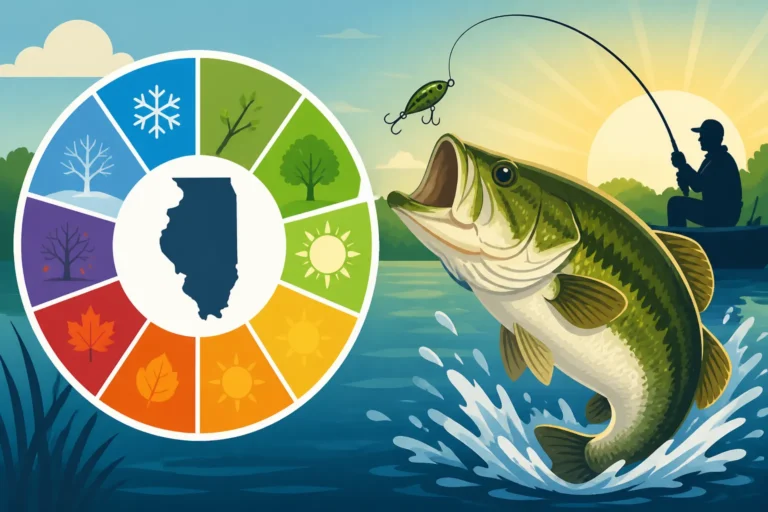
Bass don't stay in the same place all year. Their behavior and location are heavily influenced by water temperature, which changes dramatically with the seasons in Illinois. Understanding these seasonal patterns is key to year-round success. Our guide to Illinois Fishing Seasons Guide provides a broad overview, but let's dive into bass specifics.
- Spring (Pre-Spawn & Spawn): As water temperatures rise into the 50s and 60s Fahrenheit, bass move from their deeper wintering holes into shallower, warmer water to feed heavily before spawning. This is known as the pre-spawn period, and fish are often aggressive. Once water temperatures hit the mid-60s, bass begin to spawn, building nests (beds) in shallow, protected areas. They become very defensive of these nests, making them easier to catch, though responsible catch-and-release is encouraged during this time. For more in-depth information, you can read about Illinois Bass Pre-Spawn Fishing Patterns and our Illinois Bass Spawn Timing Guide.
- Summer (Post-Spawn & Summer Deep): After spawning, bass often retreat to slightly deeper water or seek out dense cover to recover. As summer progresses and water temperatures climb into the 70s and 80s, bass will move to cooler, oxygen-rich areas. This might mean deeper humps and ledges, areas with current, or dense overhead cover that provides shade. Early mornings, late evenings, and even night fishing can be highly productive during this period, as bass become more active when the sun isn't directly overhead. Our Summer Bass Fishing Patterns guide expands on these strategies.
- Fall (Feeding Frenzy): As water temperatures start to drop in the fall (into the 60s and 50s), bass go on a major feeding binge to put on weight for winter. They often move shallower again, chasing schools of baitfish that are also fattening up. This is often considered one of the best times to catch big bass, as they are actively hunting and aggressive. Look for them around points, creek channels, and the backs of coves where baitfish are abundant. Check out our detailed guide on Fall Bass Fishing Patterns for more insight.
- Winter (Deep & Slow): When water temperatures dip below 50 degrees, bass become much less active. They'll typically move to the deepest, most stable water available, often congregating in large schools in offshore channels, deep holes, or near warm water discharges (if available). Your presentation needs to be incredibly slow and subtle during winter. Jigs and slow-rolled crankbaits are often effective. While challenging, catching a bass in winter can be very rewarding. For specific tips, see Winter Bass Fishing Tips.
Using Electronics: A Beginner's Introduction
While not strictly "essential" for a beginner, modern electronics like fish finders can significantly aid in locating bass, especially in larger or unfamiliar waters. You don't need the most expensive unit, but understanding the basics can help.
- Sonar (2D Sonar): This is the fundamental technology in most fish finders. It sends sound waves into the water and interprets the echoes to show you what's beneath your boat – bottom contours, submerged structures, and fish. Fish often appear as "arches" on the screen. For beginners, a basic color unit from a brand like Humminbird or Lowrance (often available on Amazon) can make a huge difference in identifying depth changes and potential fish targets.
- Down Imaging/Side Imaging: More advanced units offer these features. Down imaging gives you a photo-like view directly beneath your boat, making it easier to identify specific submerged objects like trees or rock piles. Side imaging extends this view out to the sides of your boat, allowing you to scan large areas quickly for structure and schooling fish. While great tools, these can be complex for newcomers and might be an upgrade for later.
- GPS & Mapping: Many fish finders include GPS capabilities and pre-loaded maps of lakes. This allows you to mark waypoints for productive spots, navigate safely, and understand the contours of the lake bottom even when you can't see them. This is incredibly useful for finding those invisible humps or ledges.
For a beginner, a simple 2D sonar unit with basic GPS can help you identify depth changes, distinguish hard bottoms from soft, and even spot baitfish schools, which are often indicators of bass nearby. Don't rely solely on your electronics; use them in conjunction with your knowledge of cover and structure.
Best Baits and Lures for Illinois Bass
The world of bass baits and lures is vast, but as a beginner, you want to start with a few versatile, confidence-building options that consistently catch fish in Illinois.
Soft Plastics: Versatile and Effective
Soft plastic lures are perhaps the most versatile and effective category for bass fishing. They come in countless shapes, sizes, and colors, mimicking everything from worms and crawfish to baitfish.
- Stick Baits (e.g., Senko): These simple, cylindrical worms are deadly effective, especially for largemouth bass. Cast them weightless or with a small weight, let them sink slowly, and twitch them occasionally. Most bites occur as the bait slowly shimmers and falls. Green pumpkin, black, and junebug are popular colors. They are incredibly easy to fish and consistently produce bites.
- Creature Baits & Lizards: These baits have appendages that flap and move, creating a lot of action and vibration in the water. They mimic crawfish, frogs, or other small critters that bass love to eat. Rig them on a Texas rig (more on that below) and pitch them into heavy cover. Darker colors like black/blue or green pumpkin with orange fleck work well.
- Plastic Worms: The classic plastic worm remains a staple. Curly-tail worms, straight-tail worms, and ribbon-tail worms all have their place. They can be fished on a Texas rig, Carolina rig, or even wacky rigged. Experiment with sizes (4-10 inches) and colors.
Texas Rig: This is a fundamental way to rig soft plastics, especially worms and creature baits, making them weedless.
- Take an offset worm hook (e.g., 3/0 or 4/0).
- Thread the hook point into the nose of the worm about a quarter-inch, then push it out the bottom.
- Slide the worm up the hook shank until the eye of the hook is hidden in the nose of the worm.
- Rotate the hook 180 degrees so the point faces the worm's body.
- Bend the worm slightly to find where the hook point will lie naturally. Push the hook point back into the worm's body, ensuring the point is buried but not piercing through the other side. This makes it weedless.
You can then add a bullet weight (with the pointed end facing the worm) above the hook, held in place by a small bobber stop, or fish it weightless. Learning How to rig a Texas rig for bass is a vital skill for any serious bass angler.
Crankbaits and Spinnerbaits: Covering Water
These lures are excellent for covering a lot of water quickly and are great for searching for active bass. They create a lot of flash and vibration, mimicking fleeing baitfish.
- Crankbaits: These hard-bodied lures have a lip (bill) that causes them to dive when retrieved. They come in various shapes and sizes, diving to different depths (shallow, medium, deep).
- Shallow Divers: Dive 1-5 feet, great for shallow flats, over submerged grass, or around laydowns.
- Medium Divers: Dive 5-12 feet, versatile for most situations, especially around points and ledges.
- Deep Divers: Dive 12+ feet, used for targeting bass holding deep in open water or along significant drop-offs.
Choose colors that imitate local baitfish (shad, bluegill) or crawfish (browns, reds). The key is to "crank" them down to their maximum depth and maintain contact with the bottom or structure, deflecting off objects to trigger reaction strikes.
- Spinnerbaits: Characterized by one or more metal blades (Willow, Colorado, Indiana) that spin when retrieved, creating flash and vibration. They're highly weedless and excellent for fishing through thick cover like brush, weeds, and stumps.
- Colors: White and chartreuse are classic colors, especially in stained or murky water. More natural colors (like greens, browns) work in clearer water.
- Retrieves: A steady, medium retrieve works well. You can also vary your speed, or "slow roll" them along the bottom. Try to "pump" the rod tip to make the blades flash and flutter erratically. Spinnerbaits are especially effective in windy conditions or when fishing in stained water.
For insights into choosing the right lure for specific water clarity, check out our guides on Best Bass Lures for Clear Water and Best Bass Lures for Murky Water.
Topwater Lures: Exciting Surface Strikes
There's nothing quite like the explosive strike of a bass on a topwater lure. These lures float on the surface, creating commotion that draws bass up from below. They are most effective in low light conditions (dawn and dusk) or on overcast days, typically when water temperatures are warmer.
- Poppers: These lures have a cupped face that "pops" and sprays water when twitched, mimicking a struggling baitfish or frog. Cast them near cover and retrieve with a "pop-pause-pop-pause" rhythm.
- Walking Baits (e.g., Zara Spook): These lures require a specific "walk-the-dog" retrieve, where you twitch your rod tip and reel in slack rhythmically, causing the lure to zig-zag across the surface. This creates a very enticing side-to-side action.
- Frogs: Soft plastic frog imitations, often rigged weedless, are perfect for fishing over dense lily pads or thick mats of vegetation where other lures would snag. Twitch them slowly across the cover, allowing them to fall into open pockets.
Topwater fishing is incredibly exciting because every strike is visible and often violent. It requires patience but offers immense rewards when bass are looking up to feed.
Live Bait for Bass: A Reliable Option
While artificial lures are often preferred by sport anglers, live bait remains an incredibly effective way to catch bass, especially for beginners or when fish are finicky.
- Minnows/Shiners: Live minnows, especially shiners, are excellent bait for both largemouth and smallmouth bass. Hook them lightly through the lip or back and fish them under a bobber or free-lined near cover. Their natural swimming action is irresistible to bass. You can buy these at most local bait shops.
- Crawfish: Bass absolutely love crawfish, especially smallmouth. Hook a live crawfish through the tail and let it drift naturally near rocky bottoms or current. They are a natural and highly effective bait.
- Worms (Nightcrawlers): While often associated with panfish, a big juicy nightcrawler can definitely tempt a bass, especially a smaller one. Rigged on a hook with a small split shot and fished near cover, they provide a strong scent and natural movement.
Using live bait is often a more passive form of fishing, allowing the bait to do the work. It's a great way to introduce new anglers to the feel of a bite without the complexities of lure presentation.
| Lure Type | Best Use Case | Retrieval Method | Pros | Cons |
|---|---|---|---|---|
| Soft Plastics | Versatile, heavy cover, subtle presentation | Slow, twitch, pause; bottom bouncing | Very natural, weedless (Texas rig), good for finicky fish | Can be slow, harder to cover water quickly |
| Crankbaits | Covering water, targeting specific depths | Steady retrieve, varying speed, "deflecting" | Great for active fish, easily covers large areas | Can get snagged easily, specific depth for each lure |
| Spinnerbaits | Wind, stained water, heavy cover | Steady retrieve, slow roll, "pumping" | Very weedless, good vibration/flash, attracts aggressive fish | Less natural profile, can be ignored by lethargic fish |
| Topwater Lures | Low light, calm water, exciting strikes | Pop, pause; "walk-the-dog"; twitch across cover | Highly visible strikes, exciting, great for shallow water | Only effective in specific conditions, requires patience |
| Live Bait | Beginners, finicky fish, natural presentation | Free-lined, under bobber, bottom rig | Most natural presentation, strong scent, always tempting | Can be messy, less active fishing, have to buy/catch bait |
Year-Round Bass Fishing in Illinois
As we touched on earlier, bass behavior changes significantly throughout the year. Adapting your techniques to the season is paramount for consistent success.
Spring Bass: Pre-Spawn and Spawn Tactics
Spring is often hailed as one of the best times to catch big bass in Illinois, particularly during the pre-spawn period. As ice melts and water temperatures begin to climb into the 50s, bass shake off their winter lethargy and start moving towards shallower waters to feed aggressively.
- Pre-Spawn: Look for bass in transition areas: secondary points, the mouths of creeks, and shallow flats adjacent to deeper channels. They're bulking up for the upcoming spawn. Lipless crankbaits, spinnerbaits, and medium-diving crankbaits are excellent for covering these areas quickly. As the water warms further into the low 60s, a jerkbait or a slow-rolled jig can be incredibly effective around submerged timber and rock piles. Remember, these fish are hungry and eager to bite.
- Spawn: Once water temperatures reach the mid-60s (typically late April through May in central Illinois, varying by region), bass move into the extreme shallows to create spawning beds. Look for them in protected coves, on sandy or gravelly bottoms, and around fallen trees or stumps. You might even see them on their beds in clear water. While on beds, bass are aggressive and territorial. Soft plastics like Senkos or creature baits pitched onto a bed will often elicit a strike. However, consider the ethics of "bed fishing" and practice immediate, careful release to protect the reproductive cycle. For more detail on this critical period, refer to our Spring Bass Fishing Patterns guide.
Summer Bass: Deep Water and Night Fishing
Summer in Illinois means hot weather and often, hot water. Bass typically move away from the baking shallows to seek cooler, more oxygenated water. This means adapting your approach to target deeper zones or low-light periods.
- Deep Water: During the day, bass will retreat to offshore structure like deep humps, ledges, brush piles in deeper water, or submerged roadbeds. Use deep-diving crankbaits, heavy jigs, or drop shot rigs to present your lure at these depths. Look for schools of baitfish on your fish finder, as bass won't be far behind. Often, a slow, methodical approach is necessary.
- Dense Cover: In lakes with abundant vegetation, bass might bury themselves deep within thick lily pads or grass mats to escape the sun. Flipping and pitching heavy Texas-rigged soft plastics or punching jigs through these mats can be very effective. This is a close-quarters, power fishing technique.
- Night Fishing: One of the best-kept secrets for summer bass fishing in Illinois is going out after dark. As the sun sets and temperatures drop, bass move shallower to feed. Black or dark-colored spinnerbaits, bladed jigs, and topwater lures (like Jitterbugs or buzzbaits) can be incredibly productive. The key is to fish slowly and use lures that create a strong silhouette or vibration. Our Night Fishing Techniques article offers some great advice if you're looking to explore this option.
Fall Bass: The Feeding Frenzy
Fall is another fantastic time for bass fishing in Illinois, often matching or even surpassing spring in terms of action. As water temperatures begin to drop from the summer highs, bass sense the approaching winter and go on an aggressive feeding binge, chasing baitfish schools.
- Following the Bait: Bass will follow schools of shad and other baitfish into the backs of creeks and coves. Look for active baitfish flicking on the surface, or even bass schooling and busting bait.
- Productive Lures: Fast-moving baits are often king during the fall. Crankbaits (shallow to medium divers), spinnerbaits, and topwater lures (especially walking baits and poppers during warmer stretches) can be highly effective for covering water and triggering strikes from aggressive fish. Jerkbaits also shine during fall, especially as water cools further, mimicking dying baitfish.
- Location: Target points, creek channels, and areas where baitfish are congregating. As autumn progresses, bass will start to relate more to deeper structure adjacent to these feeding areas, preparing for their winter retreat. This "fall turnover" can briefly make fishing tough, but once it stabilizes, the bite can be incredible. Many anglers consider this the time to catch the biggest bass of the year. Our guide on Fall Bass Fishing Patterns dives into these specific scenarios.
Winter Bass: Slow and Subtle Approaches
Winter bass fishing in Illinois can be challenging, but it's not impossible, and often, the fish you do catch are quality ones. When water temperatures drop below 50 degrees Fahrenheit, bass become lethargic and less willing to chase fast-moving lures.
- Deep Water Holds: Bass will generally congregate in the deepest, most stable water available. Look for them in deep channels, major lake basins, and near thermal discharges from power plants (if applicable and legal to fish). They often school tightly together.
- Slow Presentations: Speed is the enemy in winter. Your lures need to be presented very slowly, almost painfully slow. Vertical jigging spoons, blade baits, small jigs (like football jigs or hair jigs), and finesse worms (on a shaky head or drop shot rig) are top choices. The goal is to put the bait right in front of the bass's nose and let it sit.
- Subtle Bites: Winter bites are often very subtle. It might just feel like a slight "tick" on the line, or simply added weight. Pay close attention to your line for any unusual movement.
- Timing: Mid-day, when the sun has had a chance to warm the surface water a degree or two, can often be the most productive time. Overcast days can also be surprisingly good. While less common, our Winter Bass Fishing Tips article provides a wealth of knowledge on how to approach these cold-weather conditions.
Safety and Etiquette for Bass Fishing
Fishing is about enjoyment, but it's also about responsibility. As a beginner, understanding basic safety and etiquette is crucial for a positive experience for yourself and others.
Personal Safety and On-Water Awareness
Safety should always be your top priority, whether you're fishing from the bank or a boat.
- Wear a Life Jacket: If you're fishing from a boat, especially a small one or kayak, always wear a U.S. Coast Guard-approved life jacket. Accidents happen quickly, and a life jacket can save your life. For state-specific rules, check Illinois Life Jacket and PFD Rules. Even from the bank, if you're near deep or fast-moving water, consider it.
- Watch Your Step: Shorelines can be slippery, uneven, or have hidden obstacles. Pay attention to where you're walking.
- Sun Protection: Illinois summers can be brutal. Wear sunscreen, a wide-brimmed hat, and polarized sunglasses to protect yourself from the sun's harmful rays. Polarized sunglasses also help you see into the water, spotting cover and fish.
- Hydration: Bring plenty of water, especially on hot days, to avoid dehydration.
- Know the Weather: Check the forecast before you go. Don't go out during thunderstorms, high winds, or other dangerous conditions. If you're on the water and weather turns, get to shore immediately.
- First Aid Kit: A basic first aid kit for cuts, scrapes, and hook punctures is always a good idea to have on hand.
- Hook Safety: Always be careful when casting and handling lures. Avoid casting near others, and use pliers for hook removal whenever possible to protect your fingers.
Being aware of your surroundings and planning for potential issues will make your fishing trips much safer and more enjoyable.
Conservation and Responsible Angling Practices
As anglers, we are stewards of the environment. Practicing good conservation habits ensures healthy fish populations and enjoyable fishing for years to come.
- Know the Regulations: Before you even cast a line, understand the local fishing regulations for Illinois. This includes size limits, daily catch limits, and any special restrictions for the specific body of water you're fishing. For example, knowing the Illinois Statewide Bass Daily Catch Limit of Six Fish is critical. Also, ensure you have a valid Illinois Fishing License Guide for 2026. Ignorance of the law is not an excuse for violations.
- Practice Catch and Release: While keeping some fish for dinner is perfectly fine within legal limits, practicing catch and release, especially for larger breeding-size bass, helps sustain fish populations. If you plan to release a fish, handle it gently, minimize its time out of water, and release it quickly.
- Proper Fish Handling: When handling bass you intend to release:
- Wet your hands before touching the fish to avoid removing their protective slime coat.
- Support the fish horizontally, especially larger ones, to avoid damaging internal organs.
- Use needle-nose pliers or a hook remover to quickly and carefully extract the hook.
- If a fish is deeply hooked, it may be better to cut the line and leave the hook in, as removing it could do more harm.
- Leave No Trace: Pack out everything you pack in. This includes old fishing line, bait containers, food wrappers, and anything else you brought with you. Never leave trash on the shoreline or in the water.
- Respect Other Anglers: Give other anglers plenty of space. Don't crowd someone's fishing spot or cast over their lines. Be mindful of noise levels, especially if you're using a boat near shore anglers.
- Respect Private Property: Always get permission before fishing on private land.
By following these guidelines, you'll not only have a more enjoyable experience but also contribute to the health of Illinois's fisheries for future generations of anglers. Happy fishing!
Disclaimer
Please note: Fishing regulations, license requirements, and seasonal patterns can change. Always consult the latest Illinois Department of Natural Resources (IDNR) fishing guide or website before heading out to ensure you have the most current information. This guide is for informational purposes only and does not constitute legal advice.