Blue Catfish vs Channel Catfish: How to Tell Them Apart
It's incredibly common for anglers, whether you're a seasoned pro or just getting your feet wet, to stare at a catfish on the bank or in the boat and wonder, "Is this a blue or a channel?" The truth is, these two species, while both fantastic fighters and delicious table fare, have some subtle but important differences that can impact everything from your fishing strategy to understanding local regulations. This guide is going to walk you through exactly how to tell blue catfish and channel catfish apart, making sure you know precisely what you've landed in Illinois waters.
The Catfish Family Tree: What Makes a Catfish a Catfish?
Before we dive into the nitty-gritty of distinguishing between blue and channel catfish, let's just appreciate what makes a catfish, well, a catfish! Illinois is home to several species of these whiskered wonders, and they all share some fundamental traits that set them apart from other freshwater fish.
General Catfish Characteristics You'll See in Illinois
When you hook into any catfish in Illinois, you're almost guaranteed to notice a few things right away. First and foremost, those distinctive barbels around their mouths are unmistakable. These aren't just for show; they're packed with taste buds and act like super-sensitive feelers, helping the fish locate food in murky water or low light conditions. Unlike most other fish you'll encounter, catfish lack scales, giving them a smooth, almost leathery skin that's unique.
Another key feature is their dorsal fin and pectoral fins, which each have a sharp, bony spine at the leading edge. These spines can lock into place, making them a formidable defense against predators – and a good reason to handle your catch with care! Many an angler has learned this lesson the hard way. While some catfish species might prefer slower, muddier bottoms and others thrive in swift currents, these general characteristics are consistent across the board. They’re built for sensing, finding, and devouring, often in places where other fish struggle.
Why Identification Matters for Anglers
You might be thinking, "A catfish is a catfish, right? Who cares what kind it is?" But for us dedicated Illinois anglers, knowing the difference between a blue cat and a channel cat can be surprisingly important. For starters, regulations can vary. On some of our larger river systems, there might be different size or daily catch limits depending on the species. You don't want to get a citation simply because you misidentified your catch!
Beyond legalities, identification also plays a huge role in your fishing strategy. If you're specifically targeting one species, understanding their preferred habitats and feeding behaviors can make all the difference. For example, if you're chasing after those legendary, monstrous blue catfish that can push triple-digit weights, you'll employ very different tactics than if you're looking for a cooler full of eater-sized channel catfish. Knowing what you've caught, or what you're trying to catch, helps you refine your approach, choose the right gear (maybe even pick up a heavier rod from Amazon!), and ultimately have a more successful and rewarding day on the water.
Deciphering the Differences: Blue Catfish Specifics
Okay, let's get down to business and talk about the majestic blue catfish. These are the true giants of Illinois's catfish world, known for their incredible size and powerful fights. When you're trying to identify one, there are a few telltale signs that will usually give them away.
Key Physical Traits of Blue Catfish
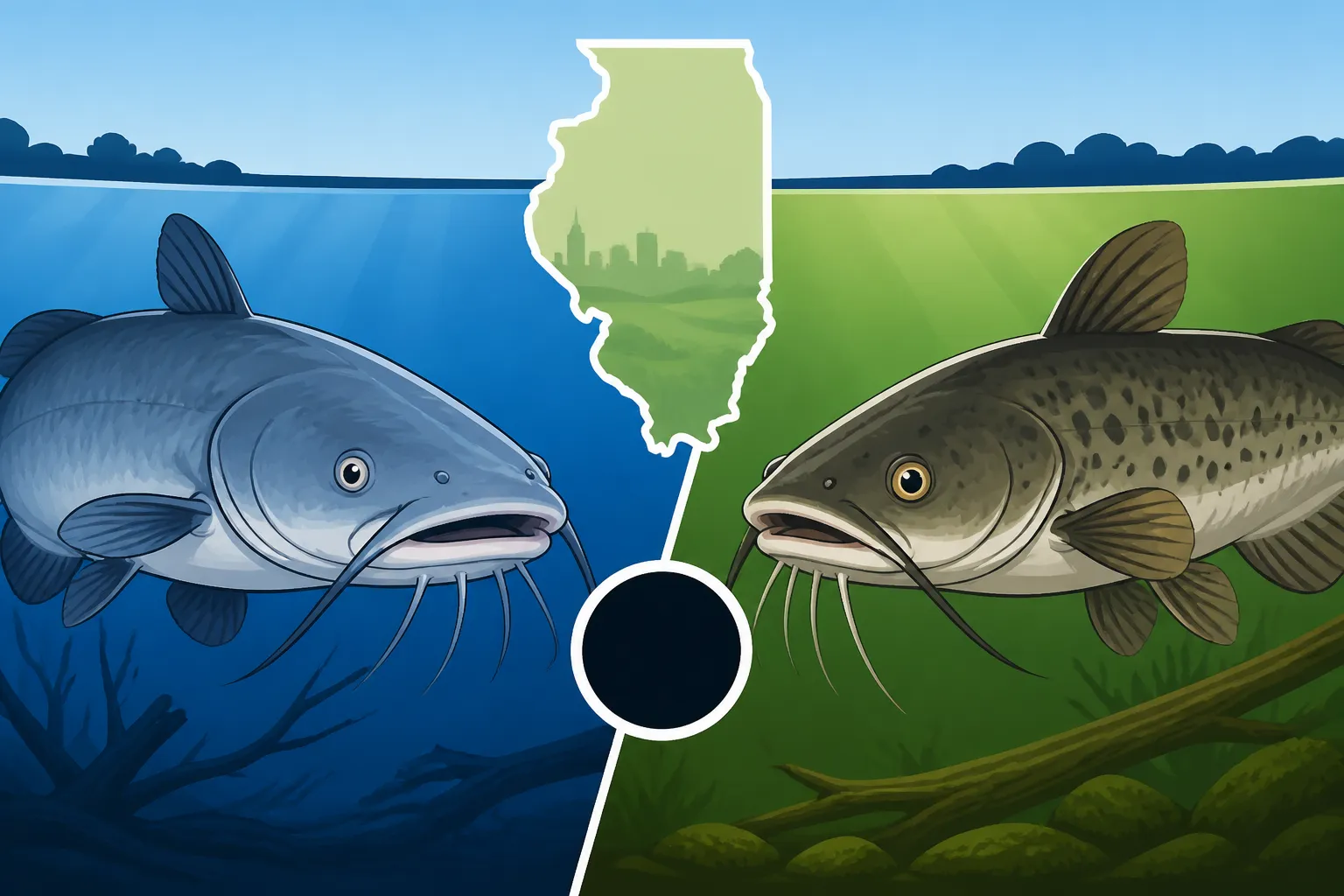
The most striking feature for many anglers is the color. While not always a brilliant azure, blue catfish typically exhibit a bluish-gray to slate-gray coloration on their backs and sides, fading to a white belly. They generally lack the distinct spots that often adorn their channel cat cousins, especially when they reach larger sizes.
Perhaps the most reliable identification point, however, is their anal fin. If you spread it out, you'll notice that the leading edge is remarkably straight, almost like it's been cut with a ruler. Count the rays (those bony supports within the fin), and you'll typically find a higher number on a blue cat—usually between 29 and 35 rays. This straight-edged, high-count anal fin is a dead giveaway.
Their head and body shape also offer clues. Blue catfish tend to have a more streamlined, somewhat slender body for their length, often developing a noticeable hump on their back just in front of the dorsal fin, particularly in larger specimens. The dorsal fin itself is usually smooth and lacks any serrations or bumps on its leading edge. And like all true catfish, they possess a deeply forked tail, but on a blue cat, this fork often appears a bit more pronounced and symmetrical compared to a channel cat.
Where You'll Find Big Blues in Illinois
If you're dreaming of tangling with a true monster catfish in Illinois, your best bet is to focus on the blue cat. These behemoths are predominantly found in the state's largest river systems, particularly the Mississippi River and the Ohio River. While they can occasionally show up in some larger reservoirs, their true kingdom lies in these big, sprawling waterways.
Blue catfish have a strong preference for deep water, swift currents, and areas with hard bottom or structure like rock piles, deep holes, or submerged timber. They're often found near river bends, current breaks, and confluence points where smaller rivers meet larger ones. If you're planning a trip to these areas with the specific goal of landing a trophy, make sure you check out resources like Illinois Blue Catfish: Where the Biggest Fish Are Caught to pinpoint the best locations and tactics. These fish don't get massive by being easy to find, so a bit of homework goes a long way!
Spotting a Channel Catfish: Distinctive Features
Now, let's pivot to the channel catfish. These are by far the most widespread and commonly caught catfish in Illinois, beloved by anglers for their aggressive bite and delicious meat. While they might not reach the sheer gargantuan sizes of a blue cat, they're fantastic sport and a staple of many fishing trips.
Identifying Marks of a Channel Catfish
When you're looking at a channel catfish, the color is often a primary indicator. They typically range from an olive-brown to a grayish-brown on their backs and sides, lightening to a cream or white belly. What really sets them apart, especially the younger and medium-sized fish, are the dark, irregular spots scattered across their sides. As they age and grow larger, these spots can fade, sometimes almost disappearing, which can lead to some of that confusion with blue cats.
The anal fin is another crucial differentiator. Unlike the blue cat's straight-edged fin, the channel catfish's anal fin has a distinctly rounded or convex leading edge. If you count the rays, you'll typically find fewer than on a blue cat, usually between 24 and 29 rays. This rounded, lower-count anal fin is your most reliable clue when the spots aren't prominent.
In terms of head and body shape, channel catfish tend to have a more rounded, robust body, especially when compared to the sleeker blue cat. They don't usually develop that pronounced hump on their back. Their heads are generally smaller and more pointed than a blue cat's of comparable size. Like their blue cousins, they have a forked tail, but the fork on a channel cat is often described as moderately forked, perhaps not as deep or symmetrical as what you'd see on a blue. It's a subtle difference, but one that experienced anglers pick up on.
Common Habitats for Channel Cats in Illinois
One of the reasons channel catfish are so popular is their sheer abundance and adaptability. You can find them almost anywhere there's water in Illinois! Lakes, rivers, ponds, streams, even some of the smaller creeks – if it holds fish, there's a good chance it holds channel cats. They are much more tolerant of varied water conditions than blue catfish, comfortable in everything from clear, rocky streams to muddy, slow-moving rivers.
They're often found near some sort of cover or structure, whether it's submerged logs, brush piles, rock formations, or even just deeper pockets within a weed bed. They're opportunistic feeders, constantly on the prowl for anything from insects and crustaceans to smaller fish and even decaying organic matter. Their widespread distribution means that whether you're bank fishing a local pond or drifting down a major river, a channel cat is a very likely catch. Just remember to be mindful of regulations like the Illinois Channel Catfish Daily Limit Explained for your specific fishing location!
Side-by-Side Comparison: Putting It All Together
So, we've gone through the individual characteristics, but how do you quickly tell them apart when you've got a feisty fish on the line? It really comes down to a few key visual cues and understanding their typical environments.
Visual Cues at a Glance
Let's break it down into a quick reference table. When you're trying to decide if it's a blue or a channel, run through these points in your head. It becomes second nature after a while!
| Feature | Blue Catfish | Channel Catfish |
|---|---|---|
| Color | Bluish-gray to slate-gray, no spots (adults) | Olive-brown to grayish, often with dark spots (younger) |
| Anal Fin Edge | Straight leading edge | Rounded or convex leading edge |
| Anal Fin Rays | 29-35 rays | 24-29 rays |
| Body Shape | Streamlined, often a dorsal hump (large fish) | More rounded/robust, less prominent hump |
| Head Shape | Larger, broader head (can appear flatter) | Smaller, more pointed head |
| Tail Fork | Deeply forked, often symmetrical | Moderately forked |
| Max Size | Can reach well over 100 lbs | Rarely exceeds 40-50 lbs |
When you pull a fish out of the water, the first thing many anglers look for are those spots. If you see distinct dark spots, especially on a smaller or medium-sized catfish, it's almost certainly a channel cat. If the fish is a uniform bluish-gray and lacks spots, then you move to the anal fin. If that fin is long and perfectly straight along its bottom edge, you're looking at a blue. If it's noticeably rounded, it's a channel. This quick mental checklist will serve you well. For a broader comparison of Illinois's catfish species, including Flatheads, you might find Catfish Species Comparison: Channel vs Blue vs Flathead Size and Taste to be an interesting read.
Behavioral Clues and Fishing Implications
Beyond the physical appearance, knowing the typical behaviors and preferences of each species can also help you with identification and, more importantly, with your overall fishing strategy.
Blue catfish are primarily piscivores, meaning they prefer to eat other fish. This is why cut bait – chunks of shad, carp, or drum – is so effective for them. They're often found in areas with strong current, waiting for an easy meal to drift by. If you're fishing a deep hole in the Mississippi River with heavy current, using large pieces of cut bait on a stout rod (something you might find on Amazon if you're gearing up for serious trophy hunting), and you hook into something that pulls like a freight train, there's a very good chance it's a blue cat. Their fight is often characterized by long, powerful runs in the current.
Channel catfish, on the other hand, are much more omnivorous and opportunistic. While they'll certainly eat smaller fish, they're just as happy to munch on crayfish, insects, worms, and various prepared baits often called "stink baits." They're found in a wider variety of habitats and aren't as dependent on strong current. If you're fishing a quieter backwater slough on the Mississippi, a calm section of the Illinois River, or a small pond, and you're getting bites on chicken livers or nightcrawlers, you're likely dealing with channel cats. Their fight tends to be more erratic, with powerful head shakes and short, strong bursts.
Understanding these behavioral patterns means that if you're landing a lot of spotted, smaller catfish on worms in a calm pond, you can confidently say they're channels. If you're consistently hooking massive, unspotted, straight-finned fish on cut bait in heavy river current, you're in blue cat territory.
Why It Matters: Regulations and Fishing Strategy
This isn't just an academic exercise in fish biology. For anyone serious about fishing in Illinois, correctly identifying your catch has real-world implications, particularly concerning regulations and how you approach your time on the water.
Understanding Illinois Catfish Regulations
While many general statewide regulations apply, specific waters or river systems in Illinois can have varying rules for different catfish species. This is especially true for the larger, more productive rivers like the Mississippi and Ohio. For instance, the daily creel limits for blue catfish might differ from those for channel catfish. Imagine the frustration of having a fantastic day, only to realize you've accidentally exceeded the limit for one species because you mistook it for another.
It's crucial to always consult the current Illinois Fishing Information Guide for the specific body of water you're fishing. This guide will clearly lay out any length or bag limits that apply to blue catfish, channel catfish, and even flathead catfish. Ignorance of the law is no excuse, and wardens will check. You'll find specific details on topics like Illinois Blue Catfish Daily Limit: What You Need to Know and Illinois Channel Catfish Daily Limit Explained, which are invaluable resources to ensure you're fishing legally and responsibly.
Tailoring Your Approach for Each Species
Once you can confidently distinguish between a blue and a channel, your fishing strategy can become much more refined and effective. If your goal is to land a true trophy fish, something that could rival the state record, you'll be dedicating your efforts to targeting blue catfish in their preferred deep-water, high-current environments. This means heavier gear, like a robust rod and reel combo that can handle immense strain, sturdy line, and large cut baits. You'll likely be spending time studying river maps and current breaks, using a good fish finder (also available on Amazon) to locate those deep holes where the big blues lie in wait.
On the other hand, if you're looking for a relaxed day on the water, aiming to catch a good number of pan-sized catfish for a fish fry, then focusing on channel catfish is your best bet. They are far more abundant across the state and more readily take a variety of baits. You can use lighter tackle, fish from the bank of almost any pond or lake, and still have a high likelihood of consistent action. This distinction allows you to match your expectations, gear, and location choices perfectly to the species you want to pursue. Whether it's the thrill of a giant blue cat or the steady action of channel cats, knowing the difference unlocks a whole new level of angling precision.
Disclaimer
This article is for general informational purposes only and does not constitute professional advice. Laws, prices and regulations vary by location and change over time. Consult a qualified professional for guidance on your specific situation.