How to Identify a Largemouth Bass in Illinois Waters
Finding yourself on the water in Illinois, pulling in a beautiful bass, and then scratching your head, wondering if it's a largemouth, a smallmouth, or even a spotted bass, is a super common experience. It happens to the best of us, especially when they're all vying for the same lure! Knowing exactly what you've got on the end of your line isn't just about bragging rights (though that's a nice bonus); it's crucial for understanding regulations, ensuring you're following catch limits, and simply appreciating the incredible diversity of fish in our Illinois waters. This guide is all about helping you confidently identify a largemouth bass, breaking down the specific features that set it apart.
The Basics of Largemouth Bass Identification
When you first pull a bass out of the water, there are some immediate, tell-tale signs that can point you towards a largemouth. They have a certain look, a certain feel, that once you get familiar with it, becomes second nature. It's about looking at the whole picture first, and then zeroing in on the details.
Overall Body Shape and Coloration
Largemouth bass typically sport a robust, somewhat elongated body that's a bit compressed side-to-side, but still has a good amount of girth, especially if they've been feasting well. Think of them as being built for power and sudden bursts of speed to ambush prey in dense cover. Their back and sides are usually a dark green, often fading into a lighter green or even an olive hue, and sometimes even a yellowish-white on their belly. This coloring can vary quite a bit depending on the water they live in – fish from clearer, vegetated lakes might be much darker and more vibrant than those from turbid, open water, which tend to be paler.
One of the most defining characteristics of a largemouth is the prominent, irregular dark horizontal band or blotchy stripe that runs along each side of its body, from the gill plate right back to the tail. This stripe isn't always perfectly solid; it can look like a series of connected dark blotches or even be somewhat broken up, especially in larger, older fish. But it's almost always there, a signature mark that helps them camouflage beautifully in shady, weedy areas. Getting a good look at this overall pattern is your first big clue.
The Distinctive Lateral Line
The lateral line itself is a fascinating sensory organ that fish use to detect vibrations and pressure changes in the water. For us anglers, it's also a crucial identification marker. On a largemouth bass, this lateral line is usually quite visible, running from just behind the gill plate all the way to the base of the tail fin. What's important here is how it interacts with that dark horizontal stripe we just talked about. The dark stripe almost always follows this lateral line, often directly over or intersecting it, making the lateral line stand out even more as part of that camouflage pattern.
Sometimes, especially in very young or stressed fish, the coloration can be a bit muted, and that lateral line might not seem as distinct. But if you look closely, you can often feel a slight ridge or see individual perforated scales that make up this line. This connection between the lateral line and the dark stripe is a key visual cue that separates the largemouth from its cousins, particularly the smallmouth, which tends to have more vertical bars or splotches that don't always align with a prominent lateral line.
Size and Weight Expectations in Illinois
Illinois is home to some fantastic largemouth bass fishing, and these fish can grow to impressive sizes. While a typical keeper-sized largemouth might be anywhere from 12 to 18 inches, trophy fish certainly aren't unheard of. The state record largemouth bass, for instance, weighed in at a whopping 13 pounds, 1 ounce! So, while most of what you catch might be smaller, it's good to know their potential. Illinois State Record Largemouth Bass: How Big Was It? delves into some truly impressive catches from our state.
The size and weight can definitely give you a hint, but it's not a definitive identifier on its own. A small largemouth might be mistaken for another species if you're not paying attention to the other physical traits. However, if you pull in a chunky, green fish pushing five pounds or more, chances are you've got a largemouth, especially if it came out of a weedy lake or pond. Remember that certain lakes and management practices can influence average fish size, so always check Illinois Largemouth Bass Length Limit and Daily Catch Rules for the specific water body you're fishing.
Key Head and Mouth Features
Once you've got the whole fish in view, it's time to zoom in on the head. The mouth and jaw are often the most reliable "ID cards" for a largemouth bass. These features are why they're called "largemouth" in the first place, and they're incredibly distinct.
The Iconic Jawline Rule
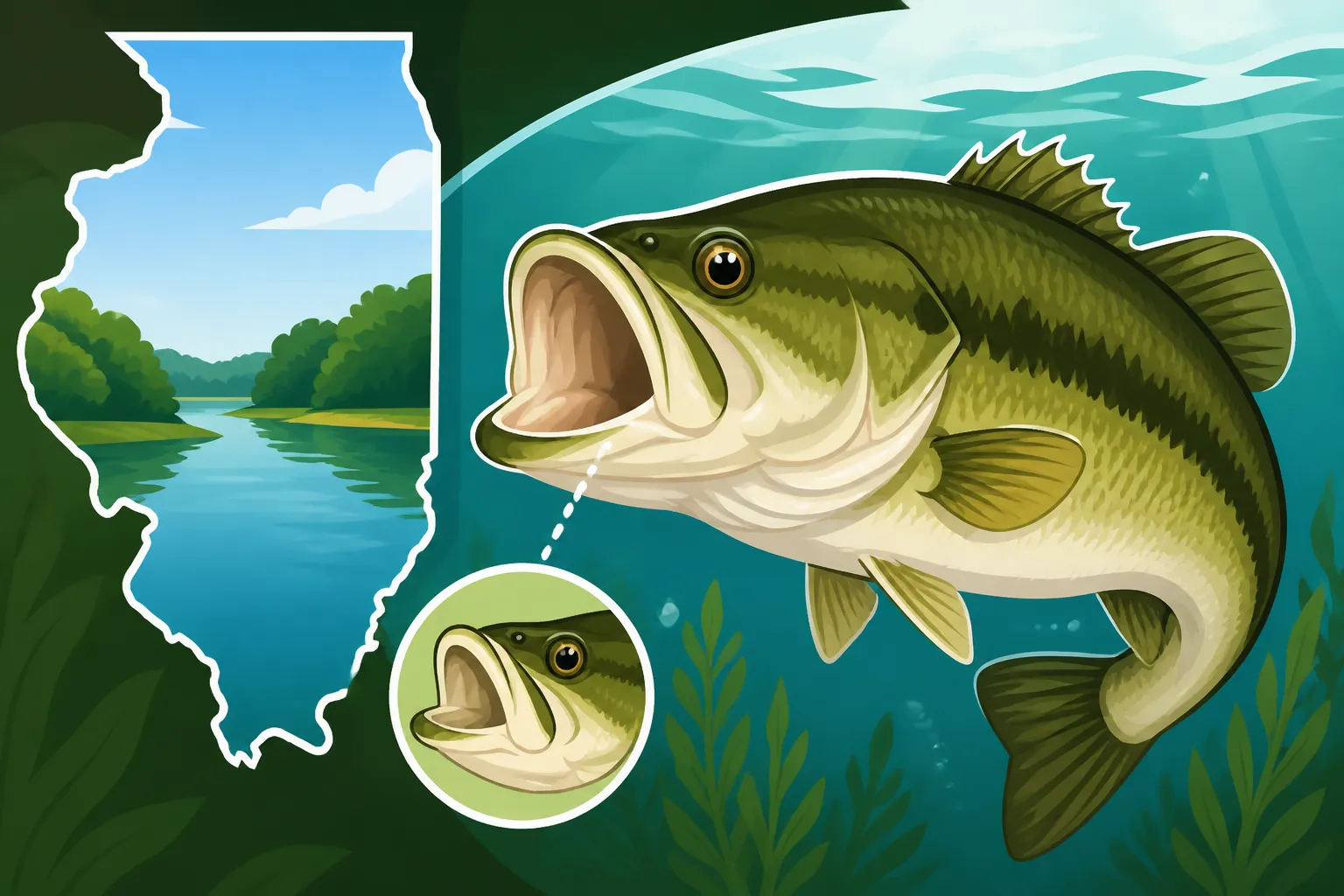
This is probably the single most important and easiest way to identify a largemouth bass. Imagine you're holding the fish and looking at its head from the side. Now, look at the corner of its mouth – specifically, the maxillary bone, which is the rearmost part of the upper jaw. For a largemouth bass, this jawline extends well past the back of its eye. If you draw an imaginary vertical line down from the back edge of the eye, the mouth will extend beyond that line.
This feature is so pronounced that once you see it, you can't unsee it. It's like a defining signature. It's also the primary characteristic that immediately differentiates it from a smallmouth bass, whose jaw typically doesn't extend past the middle of the eye. Even if the fish is small, this jaw extension is usually apparent. Many anglers even carry a small ruler or use a finger as a mental guide to quickly check this "jawline rule."
Eye Placement and Color
The eyes of a largemouth bass are generally a medium size, proportional to its head. Their color can vary a bit, but they often have a yellowish or golden hue, sometimes with a dark pupil surrounded by a lighter iris. They are set fairly forward on the head, giving the fish good forward vision, which is essential for ambushing prey in thick cover.
While eye placement isn't as critical for identification as the jawline, it does contribute to the overall impression of the fish. Unlike some deep-dwelling or nocturnal species with unusually large eyes, the largemouth's eyes appear well-suited for a predator that relies on sight in varying light conditions, from bright sun on the surface to dappled light under lily pads. It's another piece of the puzzle that, when combined with other features, reinforces the identification.
Differences in Tongue Patches (vs. Spotted Bass)
Here's where things get a little more specific, but it's crucial if you're fishing in waters where spotted bass also reside, as they can look remarkably similar to largemouths. To check this, you'll need to gently open the fish's mouth. Look at the tongue, right in the center. A largemouth bass does not have a patch of teeth on its tongue. Its tongue will be smooth.
In contrast, a spotted bass will have a distinct, rough patch of small teeth, often feeling a bit like sandpaper, right in the middle of its tongue. This is an absolutely definitive characteristic for telling these two species apart. If you're ever in doubt after checking the jawline and body markings, this "tongue patch test" is your ultimate tie-breaker. It's a subtle detail, but an incredibly reliable one, and one that often catches anglers off guard when they first learn about it. You might even find a good fishing gloves on Amazon to help you handle fish safely and check these features.
Fin Characteristics and Markings
The fins of a largemouth bass, while not always as flashy as their coloration or jawline, also hold critical clues for identification. Paying attention to their structure and where they begin and end can confirm what you're holding.
Dorsal Fin Separation
One of the most defining characteristics of any black bass (which includes largemouth, smallmouth, and spotted bass) is their dorsal fin. It's actually two fins that are connected, but to varying degrees. For a largemouth bass, the dorsal fin is distinctly notched, almost appearing like two separate fins joined at the base by a very low membrane. The spiny front portion and the soft-rayed rear portion are clearly distinguishable, with a deep indentation or "dip" between them.
This separation is often more pronounced than in a smallmouth bass, where the two dorsal fins are typically more continuously connected with a less dramatic notch. When you run your finger along the top of the fish, you'll feel the abrupt transition from the sharp, rigid spines of the front dorsal fin to the softer rays of the back fin. This distinct dip is a great visual cue, especially when comparing it to other bass species.
Pectoral and Pelvic Fin Colors
The pectoral fins (located just behind the gill covers, like "arms") and the pelvic fins (located on the belly, further back, often appearing as a pair) of a largemouth bass usually reflect the overall body coloration. They might be somewhat translucent, or have a slightly yellowish or greenish tint, often with a subtle dusky or dark mottling. They typically lack any strong, distinct markings or spots, unlike some other fish species where fin coloration can be quite vivid or patterned.
It's not uncommon for the tips of these fins to be slightly darker, especially as the fish ages. While not a primary identification feature like the jaw or lateral line, consistent fin coloration that blends with the body rather than standing out helps confirm you're looking at a largemouth. They are functional fins, designed for subtle maneuvering in cover, and their coloration contributes to the fish's overall camouflage.
Caudal Fin (Tail) Appearance
The caudal fin, or tail fin, of a largemouth bass is generally broad and slightly forked, though the fork isn't as deep as you might see on some open-water species like a white bass. The edges are typically rounded or softly pointed, and the fin is powerful, allowing for those quick bursts of speed the largemouth is famous for.
In terms of color, the tail fin often matches the darker green or olive tones of the back and sides of the fish, sometimes with a darker margin. It will usually have the same mottled or blotchy appearance as the body, contributing to the fish's ability to blend into its environment. There aren't usually any distinct bands, spots, or vibrant colors on the tail of a largemouth, making it a fairly straightforward part of its overall subdued camouflage.
Distinguishing Largemouth from Similar Species
This is where many anglers, both new and experienced, often get stumped. Illinois waters hold several types of bass and bass-like fish that can look very similar at a glance. Knowing the subtle (and sometimes not-so-subtle) differences is key.
Largemouth vs. Smallmouth Bass
These two are the classic rivals in the bass world, and telling them apart is a fundamental skill for any Illinois angler. While both are "black bass," their features tell a very different story. The most obvious difference, as we touched on earlier, is the jawline: the largemouth's jaw extends beyond the back of the eye, while the smallmouth's jaw typically ends before or directly under the middle of the eye. This is your number one differentiator.
Beyond the jaw, look at the body shape and coloration. Smallmouth bass tend to be more bronze or brown in color, with vertical bars or blotches on their sides, rather than the largemouth's distinct horizontal stripe. They're also often more streamlined and football-shaped, built for fighting current in rivers and rocky lakes, while largemouths are a bit more stout. The dorsal fin on a smallmouth usually has a less pronounced notch between the spiny and soft-rayed sections. Their eyes can also appear larger in proportion to their heads. You can find more detail on their differences in Largemouth Bass vs Smallmouth Bass vs Spotted Bass: How to Tell Them Apart.
Largemouth vs. Spotted Bass
Now this is where things can get truly tricky, as spotted bass often look like a hybrid between a largemouth and a smallmouth. Many anglers confuse them, especially if they haven't caught many spotted bass before. The jawline can be less definitive than with a smallmouth, sometimes extending just to the back of the eye, but usually not far past it like a true largemouth. So, what's the trick?
The spotted bass gets its name from rows of small, dark spots below the lateral line, especially noticeable on its lower sides and belly. Largemouths rarely have these distinct spots; their belly is usually clean and white. But the absolute, 100% reliable way to differentiate them, as mentioned before, is that rough patch of teeth on the tongue of a spotted bass. If you gently open the mouth and feel for that "sandpaper" patch, you'll know instantly. If it's smooth, it's a largemouth. If it's rough, it's a spotted bass.
Largemouth vs. White Bass and Other Look-alikes
Sometimes, especially in low light or when a fish is thrashing, you might momentarily confuse a largemouth with other species. White bass, for example, are common in many Illinois lakes and rivers and are often confused by newer anglers. However, white bass are typically silver in color, with distinct, darker horizontal stripes running across their bodies that are much more uniform and solid than the broken lateral line of a largemouth. They also have a much smaller mouth that does not extend past the eye.
Another fish that might cause a fleeting moment of confusion is the crappie, especially a very dark black crappie. However, crappie have very deep, thin, disc-shaped bodies, much flatter than a largemouth, and their patterns are more mottled and speckled, lacking that clear horizontal band. Their mouth is also much smaller and upturned. The "black bass" family (largemouth, smallmouth, spotted) are generally thicker-bodied and share a more pronounced predatory mouth structure.
Here's a quick comparison table to help you keep things straight:
| Feature | Largemouth Bass | Smallmouth Bass | Spotted Bass | White Bass |
|---|---|---|---|---|
| Jawline | Extends past the back of the eye | Ends under or before the middle of the eye | Ends under or slightly past the back of the eye | Much shorter, does not extend past middle of eye |
| Body Coloration | Dark green, olive, often with a distinct horizontal stripe of blotches | Bronze, brown, with vertical bars or mottling | Greenish-bronze, horizontal stripe, often with distinct spots below lateral line | Silvery, with distinct, solid horizontal stripes (often 5-7) |
| Dorsal Fin | Deeply notched, nearly separated | Less deeply notched, more continuous | Deeply notched, similar to largemouth | Very distinct, separate dorsal fins |
| Tongue Patch | No teeth patch on tongue (smooth) | No teeth patch on tongue (smooth) | Distinct patch of teeth on tongue (rough) | No teeth patch on tongue (smooth) |
| Body Shape | Robust, somewhat stout, slightly compressed | More streamlined, football-shaped | Intermediate between largemouth and smallmouth | Deep, thin, compressed body |
| Typical Habitat | Weedy areas, submerged structure, quiet coves | Rocky areas, clear water, current, deeper lakes | Rivers, clear lakes, sometimes deeper than largemouth | Open water, schooling fish, current breaks |
Habitat Clues for Identification
While physical characteristics are the gold standard for identifying a largemouth, understanding where you caught the fish can also provide strong supporting evidence. Largemouth bass are habitat specialists, and knowing their preferences can make you a better angler and identifier.
Preferred Cover and Structure
Largemouth bass are notorious for their love of cover. If you caught a fish near thick lily pads, a dense patch of submerged hydrilla, a fallen tree limb extending into the water, or around a dock, chances are it's a largemouth. These fish use such structures for ambush points, lying in wait to strike at unsuspecting baitfish or crayfish. They thrive in environments where they can hide and surprise their prey. This preference for heavy cover is a key behavioral trait.
Think about the environment: Is it a shallow, weedy lake? A sluggish river backwater with plenty of brush? A pond with abundant submerged timber? These are prime largemouth territories. Unlike smallmouths, which prefer rocky bottoms and open water with current, largemouths gravitate towards the "junk" and the edges where cover meets open water. This strong association with specific types of structure is a powerful clue.
Water Clarity and Location
Largemouth bass are highly adaptable, but they generally prefer water that isn't crystal clear and isn't overly turbid either. They do quite well in stained or slightly murky water where their camouflage can really shine, allowing them to disappear into the background. While they can certainly be found in clear lakes, they'll usually hug the shadier, deeper edges of cover or suspend over structure.
In Illinois, you'll find them in a vast array of water bodies: farm ponds, state park lakes like Rend Lake Fishing Guide for Illinois Anglers or Lake Shelbyville Fishing Guide, slow-moving rivers, and backwater areas of larger rivers like the Mississippi. If you're fishing a small, private pond or a lake known for its heavy vegetation, the odds are overwhelmingly in favor of catching a largemouth. This geographical and environmental context provides a valuable layer to your identification process.
Seasonal Movements
Just like us, fish change their habits and locations throughout the year. Understanding these seasonal movements can also help you anticipate what species you might encounter. During the spring spawn, largemouth bass will move into shallow, protected coves and flats, often near weed beds or submerged brush, to build their nests. Catching a bass in these shallow, sheltered areas during spring is a strong indicator of a largemouth. Illinois Bass Spawn Timing Guide offers a deep dive into this crucial period.
In the summer, they might move slightly deeper to find cooler water and oxygen, but they'll still relate closely to cover, whether it's deep weed lines, submerged timber, or shaded areas. Fall sees them feeding heavily in preparation for winter, often moving into creek channels or staging areas before retreating to deeper haunts for the colder months. Winter fishing for largemouths often means targeting them slowly on deep structure. Knowing these patterns means you can often predict what kind of bass you're likely to catch at different times of the year and in different areas of a lake.
Ultimately, confidently identifying a largemouth bass in Illinois waters comes down to a combination of keen observation and understanding their natural tendencies. By focusing on their distinctive jawline, the horizontal stripe, the deeply notched dorsal fin, and their preference for weedy, structured habitats, you'll soon be able to tell a largemouth from its cousins with ease. This knowledge not only deepens your appreciation for these incredible fish but also ensures you're a responsible and informed angler every time you hit the water. It’s worth checking out some of the detailed guides on Amazon for Largemouth Bass Fishing in Illinois: The Complete Guide if you want to become a true expert!
Disclaimer
This article is for general informational purposes only and does not constitute professional advice. Laws, prices and regulations vary by location and change over time. Consult a qualified professional for guidance on your specific situation.