How to Find Walleye in Current
Trying to find walleye in a river or a current-laden lake can feel like searching for a needle in a haystack, especially when the water is moving fast and you're not sure where these elusive fish like to hold. It’s a common frustration for many anglers who know walleye are there but just can’t seem to pinpoint them. This guide is designed to cut through that confusion, helping you understand precisely where walleye hide out in moving water and how to effectively target them in Illinois' diverse fishing environments.
Understanding Walleye Behavior in Current
Walleye are fascinating fish, and their behavior shifts significantly when they're in moving water compared to still lakes. The current isn't just a force they have to contend with; it's a strategic element they exploit to their advantage, particularly when it comes to feeding and conserving energy. Many anglers overlook the subtle cues that indicate a prime walleye spot in current, often casting aimlessly when a deeper understanding of their hydrodynamics could make all the difference.
Why Walleye Love Current
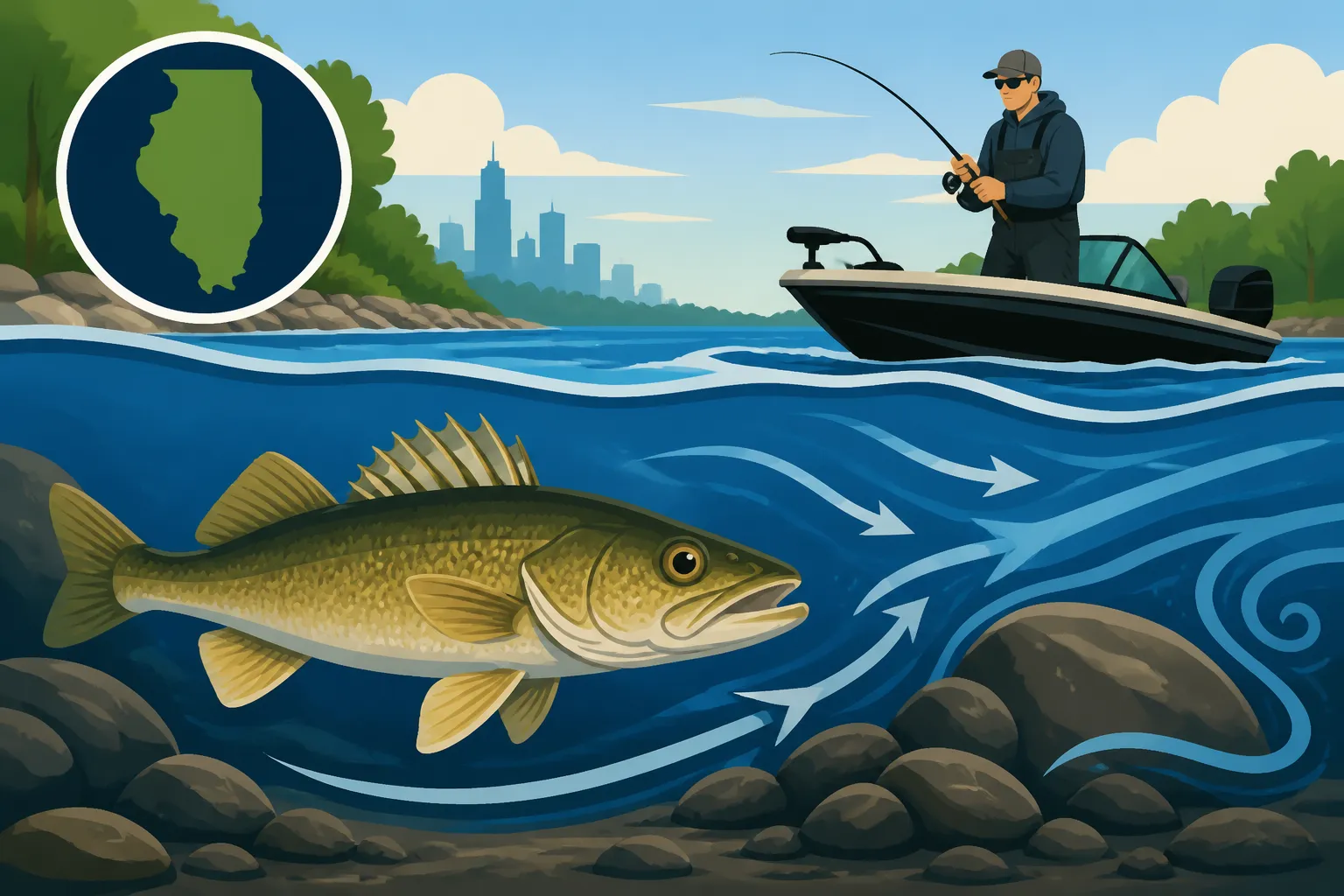
First off, let's talk about why walleye are drawn to current in the first place. It's not because they enjoy a good workout! Instead, current brings them a constant conveyor belt of food. Small baitfish, insects, and other organisms get swept along, creating easy meal opportunities. Walleye are ambush predators, and current provides the perfect conditions for them to lie in wait. They'll position themselves just out of the main flow, in what we call a "current seam" or "eddy," where they can dart out to grab passing prey without expending too much energy.
Think of it like a buffet line. The food comes to them, and they don't have to chase it far. This energy conservation is a huge factor, especially in colder water or during high-flow periods when they need to be efficient. Rivers like the Illinois River Fishing Guide or the Mississippi, which has incredible walleye and sauger populations, offer countless examples of this behavior. Understanding this fundamental preference is the first step to unlocking consistent success.
How Current Affects Walleye Feeding
The speed and direction of the current directly impact how and when walleye feed. In faster currents, walleye will often hug the bottom or position themselves behind large structures (like rocks, logs, or bridge pilings) to break the flow. This gives them a calm spot to rest while still being close enough to ambush prey that gets swept past their hideout. Their feeding windows can be shorter and more intense in these conditions, as they need to strike quickly before the food item is carried away.
Conversely, in slower currents, walleye might be more spread out, and their feeding behavior can be a bit more relaxed. They might move further from cover, exploring broader areas as they hunt. The key is that the current dictates the presentation of your bait. A jig or a crankbait presented naturally with the current is far more effective than one fighting against it, as it mimics the natural drift of food. This is why techniques like drifting and jigging are so effective when targeting these fish in moving water.
Seasonal Adjustments to Current Fishing
Walleye behavior in current isn't static; it changes with the seasons. In spring, especially during the pre-spawn and spawn, walleye will often move upstream into rivers and tributaries, using the current to migrate and stage. They'll hold in slightly deeper, slower pockets near faster water, ready to move onto spawning grounds. Post-spawn, they might disperse but will still seek out areas where current delivers food.
Summer often finds them deeper, seeking cooler water and consistent current breaks where baitfish congregate. During fall, as water temperatures drop, walleye become very aggressive, feeding heavily in current seams and near deep-water structure to pack on weight for winter. Even in winter, when ice fishing is popular on many Illinois lakes, if you find areas of moving water beneath the ice (like river stretches or below dams), walleye will still be there, albeit lethargic, often holding tight to the bottom or structure. Always remember to check Illinois Fishing Season and Catch Limit Rules as seasonal regulations can vary.
Key Locations to Target Walleye in Current
Now that we understand why walleye love current, let's get down to the brass tacks: where exactly do you find them? The beauty of current fishing is that the water itself creates predictable holding patterns. By learning to "read the water" and identify key structural elements, you can significantly narrow down your search and increase your chances of finding a hungry walleye.
Current Breaks and Seams
These are perhaps the most critical locations for finding walleye in moving water. A "current break" is anything that disrupts the flow of water, creating a calmer zone directly downstream. This could be a large rock, a fallen tree (logjam), a bridge piling, or even a subtle contour change on the riverbed. Walleye will position themselves in these calmer pockets, conserving energy while waiting for food to drift by in the faster current adjacent to them. The line where the fast water meets the slow water is called a "current seam." This is your prime target zone.
Anglers often make the mistake of casting directly into the fastest current. While some active fish might be there, the majority will be just on the edge. Focus your casts and drifts so your bait passes right along these seams, allowing it to tumble naturally from the fast water into the slower eddy. This presentation mimics a stunned baitfish and is incredibly enticing to walleye. Finding these subtle changes in flow, especially in a wide river like the Mississippi River Walleye and Sauger: Illinois' Northern Stretch Explained, is crucial for success.
River Bends and Eddies
River bends are natural current accelerators and decelerators, making them highly productive walleye spots. As water rushes around an outside bend, it typically cuts a deeper channel, creating faster current. On the inside bend, the current slows down, often depositing sediment and forming shallower flats or sandbars. Walleye will use both sides of the bend, depending on current speed and depth.
The outside bends, with their deeper water and faster current, often have large eddies forming behind points or major structures. An eddy is a circular current that swirls contrary to the main flow. These are fantastic ambush points, acting like a natural collection zone for baitfish and nutrients. On the inside bends, where the current is slower, you might find walleye staging on the edge of the main current or in smaller pockets of slack water, particularly if there's submerged structure or deeper troughs. Learning to identify and fish these complex current patterns is a skill that comes with practice.
Structure in the Current (Holes, Rocks, Logjams)
Beyond current breaks, specific structures within or adjacent to the current are magnets for walleye. Deep holes carved out by strong currents offer refuge and a staging area, especially in cold or high-water conditions. Large rock piles or boulders scattered along a river bottom create numerous small current breaks and hidey-holes. Walleye will wedge themselves into these crevices, perfectly camouflaged and ready to strike.
Logjams and fallen trees present excellent cover and current breaks. While they can be a nightmare for snagging lures, they are undeniably productive. Approach these cautiously, perhaps by drifting a jig or a weighted live bait rig just upstream and letting the current carry it naturally alongside the structure. Remember, walleye aren't usually in the densest part of the logjam, but rather on the current-protected side or just downstream, where they can see incoming prey. Submerged bridge pilings also create prime current breaks and scour holes that attract walleye.
Dams and Tailwaters
Dams are absolute walleye magnets, especially the tailwaters directly below them. The churning, oxygen-rich water below a dam is a constant source of baitfish, which get disoriented or stunned by the turbulence. Walleye will congregate in massive numbers in these areas, particularly during migration periods. However, fishing here requires extreme caution due to powerful currents and potential debris.
Walleye won't usually sit in the most violent boils. Instead, they'll be found in the calmer seams and eddies just outside the main discharge, or in the deeper scour holes that the current carves out directly downstream. These tailwater areas can be incredibly productive for anglers using jigs, crankbaits, or live bait rigs, especially during spring and fall runs. Always be aware of specific regulations, as Illinois Fishing License Guide for 2026 and special rules often apply near dams and spillways.
Effective Techniques and Baits for Current Walleye
Now that you know where to look, let's talk about how to catch them. Fishing in current requires specific techniques and bait presentations to be effective. It’s not simply about throwing a lure out; it’s about understanding how the current interacts with your bait and making it look as natural and appealing as possible to a waiting walleye.
Jigging and Drifting with Jigs
Jigging is perhaps the most iconic and effective technique for walleye in current. Whether you're vertical jigging from a boat, casting and retrieving, or drifting, the goal is to keep your jig near the bottom where walleye are holding. For vertical jigging, position your boat slightly upstream of your target area and use your trolling motor or the current to drift slowly downstream, keeping your line as vertical as possible. Bounce a jig, perhaps tipped with a minnow or a soft plastic, along the bottom. This is where a sensitive rod, often found on sites like Amazon, really shines, allowing you to feel every subtle tap.
When casting from shore or a boat, cast slightly upstream and across the current, letting the jig sink and "walk" along the bottom as it drifts downstream. Use enough weight to maintain bottom contact without snagging excessively. For soft plastics, paddle tails or grub tails can add enticing action in the current. Learn more about effective jig presentations by checking out our guide on Walleye Jigging Techniques.
Trolling with Crankbaits
Trolling is another highly effective method for covering water and finding walleye in current, particularly in wider river sections or large reservoirs with current. Deep-diving crankbaits are ideal for this, as they can reach the depths where walleye hold and maintain their action in the flow. The key is to troll upstream or downstream, allowing the current to enhance the lure's action.
When trolling upstream, your boat speed combined with the current will determine your actual lure speed, which can be surprisingly fast even with a slow boat speed. When trolling downstream, you'll need to maintain a faster boat speed to keep your lure running effectively. Experiment with different crankbait colors and sizes, paying attention to water clarity and light conditions. Many anglers stock a variety of crankbaits, often ordering them online from retailers like Amazon, to ensure they have the right presentation for any given day. For more on this, see Walleye Trolling Techniques.
Bottom Bouncing and Live Bait Rigs
For a more natural presentation, especially when walleye are finicky, bottom bouncers paired with live bait rigs are hard to beat. A bottom bouncer is a weighted wire rig designed to drag along the bottom without snagging, keeping your bait suspended just above. This is fantastic for drifting or slow trolling in current. Attach a snell with a leech, nightcrawler, or minnow to the bottom bouncer, and let it trail behind your boat.
The current will give your live bait a natural, lifelike action, making it irresistible to walleye. This setup is particularly effective when fishing over rocky or uneven bottoms where jigs might snag too easily. It’s also a great way to explore subtle depth changes and cover large areas efficiently. Remember that different baits work better depending on the season and walleye mood, so consider what's on offer when reading Best Walleye Bait for Rivers.
Casting Techniques for Current
Casting in current demands precision. As mentioned with jigging, you generally want to cast upstream and across the current, allowing your lure to drift naturally into the target zone. Whether you're using jigs, crankbaits, or even spinnerbaits, the goal is to let the current assist in the presentation.
For soft plastics or swimbaits, a steady retrieve with occasional pauses can trigger strikes. If you're fishing a specific current break or eddy from shore, focus on making repeated, accurate casts that land your lure precisely in the seam or just inside the calmer water. Don't be afraid to experiment with different angles and retrieve speeds until you find what the walleye are responding to. A medium-heavy rod with a fast action, which you can easily research on Amazon, provides the sensitivity and power needed for these presentations.
Reading the Water: Identifying Prime Walleye Holds
Fishing in current isn't just about the right lure; it's also about keen observation. Learning to "read the water" is an invaluable skill that helps you quickly identify high-percentage walleye holding areas without needing a fish finder or extensive prior knowledge of the specific spot.
Visual Cues: Ripples, Eddies, and Slack Water
The surface of the water can tell you a lot about what's happening underneath. Look for subtle changes in the current flow. Areas of choppy, fast-moving water typically indicate a shallow run or a constriction. Smoother, calmer patches often signify deeper water or an eddy where the current is swirling back upstream. The clearest indicator is a "current seam" – the distinct line where fast water meets slow water. This line often appears as a subtle ripple or a change in the water's texture.
Eddies, those swirling pockets of water, are also easily identifiable by their circular motion. And don't overlook areas of "slack water" – pockets where the current is almost nonexistent, often found behind large obstructions or in deep bends. These visual cues are your roadmap to finding those crucial current breaks and ambush points where walleye will be positioned.
Using Electronics to Find Structure and Fish
While visual cues are great, modern electronics can be a huge advantage. A good fish finder can reveal submerged structure that creates current breaks, such as rock piles, humps, ledges, and deep holes. Side-imaging technology, in particular, allows you to scan wide swaths of the river bottom, pinpointing hidden cover that might be holding fish.
Once you've identified potential structure, use your down-imaging or 2D sonar to locate actual fish arches, often appearing tightly schooled near the bottom, just out of the main current. Pay attention to changes in depth and bottom composition; walleye often relate to transitions from soft to hard bottom, especially where current is present. An accurate GPS on your unit, or a standalone device, is also critical for marking productive spots and navigating safely in moving water. Consider checking reviews for popular fish finder models on Amazon before making a purchase.
Understanding Current Speed and Depth
Walleye will adjust their position based on current speed and depth. In very fast currents, they'll seek the deepest, calmest pockets available, often hunkering down behind the largest structure they can find. As the current slows, they might spread out more or move shallower to feed more actively. The ideal depth for walleye in current can vary wildly based on the river, the time of year, and even time of day, but they often relate to distinct depth changes.
Using a depth finder and paying attention to your bait's contact with the bottom can help you map out these contours. Understanding how current sculpts the riverbed is key. Fast current typically carves deeper channels and scour holes, while slower current deposits sediment, creating flats and bars. By combining your knowledge of current speed with depth contours, you can predict exactly where walleye will be holding, whether it's on a deep breakline in the Illinois Walleye Size and Catch Limits region or in a shallow eddy. You might even want to consult a Water Temperature and Fish Activity Guide to fine-tune your approach as conditions change.
Walleye Locations in a Table
To help visualize where walleye might hold in different current scenarios, here's a quick reference table:
| Current Feature | Description | Walleye Location Strategy | Best Techniques (Illustrative) |
|---|---|---|---|
| Current Seams | Line where fast water meets slow, often visible as a ripple. | Just inside the slow side, facing into the fast water. | Drifting jigs, casting crankbaits along the seam. |
| Eddies | Swirling pocket of water contrary to main flow. | Along the edge of the eddy, near the main current entry/exit points. | Jigging, casting soft plastics, bottom bouncing. |
| Behind Obstructions | Calm water directly downstream of rocks, logs, bridge pilings. | Tucked tight behind the obstruction, very close to cover. | Vertical jigging, precision casting, live bait rigs. |
| Deep Holes | Scoured depressions in the riverbed. | On the edges or bottom of the hole, especially if current passes overhead. | Vertical jigging, heavy bottom bouncing, slow trolling deep crankbaits. |
| Inside Bends | Slower current side of a river bend. | On the edge of the main flow, or in shallow pockets if food present. | Casting jigs, slow trolling shallow crankbaits. |
| Outside Bends | Faster current side of a river bend, often deeper. | In deep scour holes, behind points, or along steep drop-offs. | Trolling deep crankbaits, heavy jigging, bottom bouncing. |
| Tailwaters (Dams) | Turbulent, oxygenated water directly below a dam. | In seams and eddies just outside the most violent boils. | Heavy jigs, lipless crankbaits, live bait rigs with substantial weight. |
Understanding these current dynamics is a huge leap forward in your quest for walleye. By combining the knowledge of why they use current, where they hide, and how to present your baits effectively, you'll be well on your way to consistent success on rivers and current-fed lakes across Illinois. Keep in mind the importance of regulations, such as the Walleye Size Rule That Applies Across the Whole State, to ensure your fishing practices are legal and sustainable for future generations of anglers. Whether you're chasing them in the mighty Mississippi or a smaller tributary, these principles will guide you to where the walleye are holding. Good luck out there!
Disclaimer
This article is for general informational purposes only and does not constitute professional advice. Laws, prices and regulations vary by location and change over time. Consult a qualified professional for guidance on your specific situation.