Catfish Gear for the Big Three Illinois Lakes
Oh, the quest for a trophy catfish on Illinois's legendary Big Three lakes! If you've ever felt overwhelmed staring at rows of rods, reels, and baits at the local tackle shop, wondering if you’re truly equipped for those monster whiskered warriors lurking beneath the surface of Rend, Shelbyville, or Carlyle, you're not alone. It’s a common frustration, because these aren't your grandpa's farm ponds; these are vast, often unpredictable bodies of water that demand specific gear. This guide is here to cut through the confusion and equip you with the exact knowledge and recommendations for the best catfish gear, ensuring your next trip to these iconic Illinois lakes is a resounding success.
Understanding the Big Three: Catfish and Their Habitats
Before we even talk about rods and reels, let's get into the heads of the fish we're chasing. Catfish, whether they're channel, blue, or flathead, behave differently depending on the lake's unique characteristics. The "Big Three" — Rend, Lake Shelbyville, and Carlyle — each offer distinct challenges and opportunities for the serious catfisherman. Knowing where and how these fish typically hold can significantly influence your gear choices.
Rend Lake Catfish Dynamics
Rend Lake, situated in Southern Illinois, is renowned for its excellent channel catfish population, and increasingly, its burgeoning blue catfish. This lake features extensive shallow flats, submerged timber, and a complex system of creeks and backwaters. The average depth is relatively shallow, which means catfish often relate to structure like old creek channels, brush piles, and the abundant standing timber. When the lake levels fluctuate, these fish might push into the flooded vegetation, offering unique opportunities. You'll find channel cats almost everywhere, from riprap banks to open water, while blue cats tend to prefer the deeper main lake channels and points. Flatheads, the ambush predators, will typically be tighter to heavy cover, like log jams or dense brush. Their feeding habits and preferred hiding spots here mean you need gear that can handle snags and strong runs in shallow, cover-laden water, especially if you're targeting the larger blues.
Lake Shelbyville Catfish Habitat
Moving north, Lake Shelbyville offers a completely different challenge. This U.S. Army Corps of Engineers reservoir is deeper and clearer than Rend, with steep bluff banks, defined creek and river channels, and plenty of standing timber. While channel catfish are still abundant, Shelbyville is also home to a healthy population of flatheads, particularly in the deeper, timber-choked arms and the main river channel. Blue catfish are present but less dominant than in some other Illinois waters. The deep, clear water often means catfish relate more to ledges, drop-offs, and deep structure, requiring different presentation methods. You might find them suspended over humps or nestled in submerged timber at considerable depths. The sheer size of this lake and its varied terrain mean versatility in your approach and gear is key. Navigating the timber, for instance, calls for robust lines and powerful rods to pull fish out of snaggy situations. Best Catfish Gear for Illinois's Lake Shelbyville will tell you even more.
Carlyle Lake Catfish Considerations
Carlyle Lake, Illinois's largest man-made lake, presents another unique environment. It's a vast, shallow, and often turbid lake, especially after heavy rains. Like Rend, it has extensive flats, riprap areas, and plenty of standing timber, particularly in its northern reaches. Carlyle is famous for its prolific channel catfish population, which thrive in the nutrient-rich, often muddy waters. Blue catfish are also growing in numbers and size here, often found in the deeper main lake basin or along the river channel that winds through the lake. Flatheads are present, especially around heavy cover near the river channel. The turbid water often means catfish rely more on scent and vibration, influencing bait choices. The vastness of Carlyle also means that covering water, whether by drifting or setting multiple lines, is often necessary to locate active fish. Your gear needs to withstand powerful runs in open water but also be tough enough to extract fish from the occasional submerged snag or brush pile. If you're wondering which lake wins in a head-to-head battle, check out Carlyle Lake Vs Rend Lake for Catfish: Which Wins?.
Rods: The Backbone of Your Catfish Setup
Choosing the right rod for catfish isn't just about bending it in the store; it's about matching its power, action, and length to the specific demands of Illinois's Big Three lakes and the fish you're targeting. These aren't dainty panfish, and your rod needs to be able to handle powerful runs and the occasional tug-of-war with heavy cover.
Heavy-Duty Rods for Channel Catfish
For the abundant channel catfish in lakes like Rend and Carlyle, a medium-heavy to heavy power rod, typically 7 to 8 feet long, is an excellent choice. This power allows you to cast heavier weights (think 2-4 ounces) and gives you the backbone to turn a decent-sized channel cat away from snags. The action, often moderate-fast to fast, provides enough sensitivity to detect subtle bites but still has a good bend into the rod's mid-section to absorb head shakes and surges. Look for rods with strong, durable guides that can handle braided line if you choose to go that route. These rods are robust enough for bank fishing, allowing for longer casts, but also versatile enough for boat fishing, whether you're anchored or drifting. Brands like Ugly Stik and Catfish Hunter offer excellent options that are both durable and affordable, readily available at places like Bass Pro Shops or through Amazon. The goal here isn't just to catch the fish, but to guide it safely to your net, especially if you're dealing with current or heavy brush.
Medium-Heavy Rods for Flathead and Blue Catfish
When you start targeting bigger flatheads and the growing population of blue catfish, especially on Shelbyville and Carlyle, you'll want to step up your rod game. A heavy to extra-heavy power rod, ranging from 7.5 to 10 feet, becomes the standard. These longer rods offer better leverage for fighting large fish and for making those crucial long casts from the bank. The extra-heavy power is non-negotiable when you're trying to pull a 30-pound flathead out of a log jam or battle a hard-running blue cat in open water. Many dedicated catfish rods will have a more moderate action, providing a parabolic bend that distributes the stress evenly across the blank, preventing break-offs when a big fish makes a sudden move. This softer tip, combined with immense backbone, also helps with detecting those tentative bites from larger, more cautious cats, especially when using live bait. For serious trophy hunters, a specialized Best Catfish Rods for Illinois's Big Three Lakes will outline precisely what to look for.
Rod Length and Action for Bank vs. Boat Fishing
The length of your rod isn't just about casting distance; it's about versatility and comfort in your fishing environment. If you're primarily a bank angler on Rend or Carlyle, a longer rod (8-10 feet) is almost always preferable. It allows for longer casts to reach deeper channels or submerged structure further from shore, and the extra length helps keep your line out of shoreline snags or over obstacles. It also provides better leverage when fighting a fish that's trying to run along the bank. However, if you're fishing from a boat, particularly in tight quarters with multiple rods, a shorter rod (7-8 feet) can be more manageable. It's easier to handle in a boat, less likely to get tangled with other lines or hit overhead obstructions, and still provides plenty of power for boat-side fights.
As for action, a fast action rod will have a very sensitive tip that bends mostly at the top, allowing for quick hook sets and excellent bite detection, great for channels and blues in open water. A moderate action rod bends more through the middle section of the blank, providing a more forgiving fight and better shock absorption, which is often preferred for flatheads that hit hard and run deep. Consider your primary target species and fishing style on the Big Three to make the best choice.
Reels: Power and Capacity for Big Illinois Cats
Your reel is just as important as your rod, often serving as the true workhorse of your catfish setup. It needs to be able to hold enough line, have a smooth and powerful drag system, and be built to withstand the brute force of a large catfish. On the Big Three lakes, you’re not just dealing with average-sized fish; you're dealing with the potential for true monsters that will test your gear to its limits.
Spinning Reels for Lighter Tackle and Finesse
While baitcasting reels often get all the glory in heavy catfishing, a robust spinning reel definitely has its place, especially for targeting channel catfish or smaller blue cats on the Big Three. For these situations, a reel in the 6000 to 8000 size range, paired with a medium-heavy rod, can be incredibly effective. Spinning reels excel at casting lighter baits for distance, which can be crucial when trying to reach specific spots from the bank on Rend Lake or when precision casting near structure on Shelbyville. They are also generally easier for beginners to use, with fewer backlashing issues. Look for a spinning reel with a strong, smooth drag system – a must for any catfish, regardless of size – and a high line capacity. Many quality spinning reels from brands like Penn, Shimano, or Daiwa can be found at Bass Pro Shops and will provide the durability and performance you need for regular channel cat excursions. While they might not be your go-to for a 50-pound flathead, they're perfect for the vast majority of catfish encounters.
Baitcasting Reels for Heavy Hauling
When you're serious about battling the big blue cats of Carlyle or the monster flatheads of Lake Shelbyville, a heavy-duty baitcasting reel is king. These reels are designed for power, durability, and superior line capacity, making them ideal for handling massive fish and heavy weights. Look for reels in the 5000 to 7000 series, or even larger for extreme applications. Important features include a strong brass or stainless steel main gear, a robust frame, and a star drag system that can be locked down tight when needed. Level-wind models are convenient for even line lay, but some experienced anglers prefer non-level-wind reels for maximum strength and fewer moving parts. Brands like Abu Garcia, Penn, and Daiwa are trusted names in the catfishing world for good reason. Best Reels for Trophy Catfish on Rend Lake will dive deeper into the specific models that consistently perform under pressure. A good baitcaster gives you the confidence to cast heavy rigs with a substantial chunk of cut bait or a lively sunfish, knowing that when that big take comes, your reel won't be the weak link.
Line Capacity and Drag Systems
No matter which type of reel you choose, two features are paramount for catfishing on the Big Three: line capacity and drag system.
- Line Capacity: Catfish, especially large blue and flathead cats, can make incredibly long and powerful runs. You need a reel that can hold a significant amount of line, typically at least 200-300 yards of your chosen pound test, to prevent being spooled. This is particularly true in open water scenarios on Carlyle Lake or when a large fish decides to head for the main channel on Lake Shelbyville. Having ample line is your insurance policy against losing a fish of a lifetime.
- Drag System: A smooth, consistent, and powerful drag system is absolutely non-negotiable. When a big cat hits, the drag is what absorbs the initial shock and allows the fish to take line without breaking it. A jerky or inconsistent drag will lead to snapped lines and lost fish. Look for reels with multiple carbon fiber drag washers for optimal performance. You should be able to set your drag to a precise tension and have it deliver line smoothly under pressure, without sticking or grabbing. Regularly inspect and maintain your drag washers to ensure they are clean and lubricated for peak performance. This is one area where skimping on quality will almost certainly lead to heartbreak on the water.
Lines: Choosing the Right Strength and Type
Your fishing line is the direct link between you and that hard-fighting catfish, and its importance cannot be overstated, especially when dealing with the potential for powerful fish and abrasive underwater structure on the Big Three lakes. Choosing the right line type and strength is critical for success.
Monofilament for Shock Absorption and Stretch
Monofilament line has been a staple in catfishing for decades, and for good reason. Its inherent stretch acts as a shock absorber, cushioning the violent strikes and powerful runs of big catfish. This stretch can be particularly beneficial when using a softer rod or when fighting fish around snags, as it provides a bit of forgiveness before the line snaps. Monofilament is also generally more abrasion-resistant than many braided lines of comparable diameter, which is a huge advantage when fishing around rocky riprap, submerged timber, or shell beds common in Rend and Carlyle Lakes. For channel catfish and smaller flatheads, a good quality 20-30 lb test monofilament is often sufficient. It's also typically more affordable than braided line, making it a great option for anglers on a budget. However, its larger diameter compared to braid for the same breaking strength means less line capacity on your reel, and its stretch can reduce sensitivity, making it harder to detect subtle bites at long distances.
Braided Line for Sensitivity and Power
Braided line has become increasingly popular in serious catfishing circles, and for good reason. Its near-zero stretch provides incredible sensitivity, allowing you to feel even the most tentative bites, crucial when fishing in deep water on Lake Shelbyville or for finicky flatheads. The thin diameter-to-strength ratio means you can spool significantly more line onto your reel compared to monofilament of the same breaking strength, or use a much heavier pound test without sacrificing capacity. For targeting the larger blue and flathead catfish, braided line in the 50-80 lb test range is common. Its raw power is unmatched, giving you maximum pulling strength to wrench big fish out of heavy cover. However, braided line is less abrasion-resistant against sharp edges like mussel beds or concrete, and it can dig into itself on the spool if not spooled tightly. It also requires specific knots designed for braid. When fishing heavy cover, consider using a braided mainline with a monofilament or fluorocarbon leader to mitigate abrasion issues. Heavy Tackle for Mississippi River Catfish in Illinois can also offer some good insights on line choices, even if it's for a different river system, as the principles of heavy tackle apply across the board.
Fluorocarbon Leaders for Abrasion Resistance
While fluorocarbon isn't typically used as a mainline for catfishing due to its stiffness and cost, it shines as a leader material, especially in situations where abrasion resistance is paramount. Fluorocarbon is incredibly tough and resistant to nicks and cuts, making it ideal for the last few feet of your rig, where it's most likely to encounter sharp teeth, jagged rocks, or abrasive timber. It also has the added benefit of being nearly invisible underwater, which can be an advantage in clearer lakes like Shelbyville, particularly when targeting more wary flatheads. For leader material, a 40-80 lb test fluorocarbon, matched to the strength of your mainline, is a great choice. Connect it to your main line with a strong knot like a FG knot (for braid to fluoro) or a uni-to-uni knot. This combination gives you the best of both worlds: the power and sensitivity of braid or the shock absorption of mono, coupled with the superior abrasion resistance and stealth of fluorocarbon right at the business end of your rig. It's an extra step, but one that can prevent a heartbreaking break-off when a trophy catfish is on the line.
Hooks: Secure Your Catch
The hook is arguably the most crucial piece of terminal tackle, as it's the only thing actually touching the fish. Getting it right ensures a solid hookset, a secure fight, and ultimately, a successful landing. For the diverse catfish species in the Big Three Illinois lakes, you'll want a variety of hooks to match your bait and target.
Circle Hooks: Essential for Catfish Conservation
For ethical catfishing, especially when practicing catch and release or targeting larger fish, circle hooks are simply the best choice. Their design, with the point curving inward towards the shank, makes them incredibly effective at hooking fish in the corner of the mouth, avoiding deep gut hooks that can be fatal. This is particularly important for the rapidly growing populations of blue catfish in Carlyle and Rend, where conservation-minded angling helps sustain the fishery. When a catfish takes the bait, simply let the rod load up, and the hook will set itself as the fish swims away. Resist the urge to yank the rod; just let the fish run with it. For most catfishing applications on the Big Three, a 7/0 to 10/0 circle hook is a versatile size, capable of handling everything from a hefty channel cat to a trophy flathead on a live bluegill. Brands like Gamakatsu, Owner, and Mustad offer excellent quality circle hooks that are sharp, strong, and reliable. Always check your hooks for sharpness after every fish, or if you snag and manage to retrieve your rig.
J-Hooks: When and How to Use Them
Traditional J-hooks still have their place, particularly for certain baits or fishing styles, though many dedicated catfish anglers are making the switch to circles. J-hooks require a more active hookset – you need to feel the bite and then "set the hook" firmly. They are often favored by anglers who prefer a more direct connection and immediate response to a bite. If you're using smaller cut baits or prepared baits for channel catfish, especially if you're holding the rod and actively feeling for bites, a stout J-hook in a 5/0 to 8/0 size can be effective. However, the risk of deep hooking is significantly higher with J-hooks, which can be detrimental to fish you intend to release. If you do choose to use J-hooks, be extra vigilant for bites and try to set the hook quickly to minimize the chance of a gut hook. For trophy-sized fish, the debate of Circle Hooks vs J-Hooks for Illinois Catfishing is a good one to read up on before you head out. Ultimately, the choice depends on your personal preference and your commitment to fish welfare, but circle hooks are widely recommended for catfishing on the Big Three.
Hook Sizes for Different Catfish Species
Matching your hook size to your target species and bait size is critical.
- Channel Catfish: For the abundant channel cats, especially when using cut baits, worms, or stink baits, a 4/0 to 7/0 circle or J-hook is a good starting point. This size allows for enough gap to securely hook the fish without being so large that it deters smaller fish.
- Blue Catfish: As blue cats tend to grow larger and have tougher mouths, stepping up to a 7/0 to 10/0 circle hook is often necessary. This is especially true when using larger chunks of cut bait or whole shad.
- Flathead Catfish: Flatheads are ambush predators that prefer live bait. For these powerful fish, a stout 8/0 to 12/0 circle hook is recommended. When using a live bluegill or shad, you need a hook with a wide enough gap to encompass the bait while still having exposed point for a solid hookset. The larger hook size also provides the strength needed to hold a powerful flathead during a prolonged fight.
Always ensure your hooks are sharp. You can test this by lightly dragging the hook point across your fingernail; if it slides, it's dull and needs sharpening or replacing. Dull hooks lead to missed bites and lost fish, which is the last thing you want after waiting patiently on the banks of Lake Shelbyville.
Terminal Tackle: Weights, Swivels, and Floats
The unsung heroes of your catfishing rig are the weights, swivels, and floats that complete your setup. These small but mighty components dictate how your bait is presented, how well it stays in place, and how effectively you can detect bites. On the Big Three lakes, where currents, wind, and varying depths are common, having the right terminal tackle is paramount.
Sinker Selection for Current and Depth
Sinkers are essential for getting your bait to the strike zone and keeping it there. The type and weight you choose will depend heavily on the conditions of the lake you're fishing.
- Pyramid Sinkers: Excellent for holding bottom in current, such as in the main river channels on Lake Shelbyville or in windy conditions on Carlyle. Their pyramid shape digs into the substrate, resisting rolling.
- No-Roll Sinkers: Perfect for soft bottoms or when you want your bait to stay in one place without burying itself. Common for bank fishing or when fishing relatively still areas.
- Egg Sinkers: Often used in slip-sinker rigs, allowing line to pass freely, which lets catfish pick up the bait without feeling immediate resistance from the weight. This is a go-to for many channel and blue catfish anglers.
- Flat Bank Sinkers: Similar to pyramid sinkers, but their flatter profile can be good for slightly softer bottoms or when you need a little more resistance to current without digging in too deeply.
As for weight, you'll commonly need sinkers ranging from 1 ounce up to 6 ounces or even heavier, depending on the depth, current, and wind. On a windy day on Carlyle, you might need 4 ounces or more to keep your bait from drifting. In a calm cove on Rend, 1-2 ounces might be perfectly fine. Always err on the side of having a variety of weights in your tackle box. Best Catfish Bait Rigs for Carlyle Lake will likely touch on optimal sinker choices for that vast body of water.
Swivels and Snaps for Rigging Efficiency
Swivels prevent line twist, which can be a major headache, especially when using spinning gear or when your bait is prone to spinning in the current. They also create a strong connection point between your main line and your leader.
- Barrel Swivels: Simple, effective, and common for most catfishing rigs. They prevent line twist and create a strong link.
- Crane Swivels: A stronger version of the barrel swivel, often preferred for heavy-duty applications where maximum strength is needed.
- Ball Bearing Swivels: The most advanced type, offering superior anti-twist properties due to their internal ball bearings. They are more expensive but excellent for situations where line twist is a persistent problem, like using spinning baits or fishing in strong currents.
Snaps or interlock snaps can be added to your swivel for quick changes of sinkers or rigs. This saves valuable time, especially when you're trying to adjust to changing conditions. Ensure they are heavy-duty enough to match the strength of your line and capable of handling the pulling power of a large catfish. Size 5 or 7 swivels are typical, but larger for trophy pursuits.
Bobbers and Floats for Suspended Baits
While many catfishing techniques involve fishing on the bottom, there are times when presenting your bait suspended above the bottom, or in specific depths, can be highly effective. This is where bobbers and floats come in handy.
- Slip Bobbers: These are incredibly versatile. They allow you to present your bait at any desired depth by simply adjusting a bobber stop knot on your main line. When cast, the sinker pulls the line through the bobber until the bobber stop hits the bobber, suspending your bait. This is fantastic for targeting fish holding over submerged timber on Shelbyville or suspended in the water column on Rend.
- Fixed Floats (Clip-on Bobbers): Best for shallower water, typically less than 8-10 feet. These are simple to use, just clip them onto your line above your bait. They're great for presenting worms or small cut bait for channel cats in shallower coves or around brush piles.
- Pegged Floats (e.g., Catfish Floats): Some specialized floats are designed specifically for catfishing, often larger and more buoyant to handle bigger baits. They might be pegged directly to the line, offering a balance between slip and fixed.
Using floats can be especially productive during the warmer months when catfish might be cruising higher in the water column or when you want to keep your bait just above a snag-filled bottom. They also provide a visual strike indicator, which is particularly helpful during dawn, dusk, or night fishing sessions.
| Terminal Tackle Type | Purpose | Typical Sizes/Weights | Key Considerations for Big Three Lakes |
|---|---|---|---|
| Pyramid Sinkers | Bottom holding in current | 1 oz – 6 oz | Great for windy Carlyle or Shelbyville channels |
| Egg Sinkers | Slip-rig presentation | 1 oz – 4 oz | Ideal for sensitive bite detection for Channel & Blue Cats |
| No-Roll Sinkers | Stable bottom presentation | 1 oz – 4 oz | Good for soft lake beds, less snagging |
| Barrel Swivels | Prevents line twist | Size 5 – 7 | Essential for most rigs, especially with spinning baits |
| Crane Swivels | Heavy-duty line twist prevention | Size 5 – 7 | Recommended for larger catfish & stronger lines |
| Slip Bobbers | Adjustable depth presentation | 1" – 3" diameter | Versatile for suspended fish over structure on all three lakes |
| Snaps/Interlocks | Quick change of sinkers/rigs | Size 4 – 6 | Saves time when adjusting to changing conditions |
Baits and Attractants: What Catfish Really Want
You can have the best rod, reel, and line, but if you don't have the right bait, your chances of success dwindle. Catfish are opportunistic feeders, but their preferences can vary significantly between species and even throughout the seasons on the Big Three lakes. Understanding what triggers a bite is half the battle. If you want to dive even deeper, check out Best Bait for Illinois Channel Catfish and Best Catfish Bait for Summer River Fishing.
Natural Baits for Channel Catfish
Channel catfish are often the most common catch on Rend and Carlyle Lakes, and they have a notoriously diverse appetite. They are primarily scavengers and will eat almost anything that smells appealing.
- Worms: Nightcrawlers and redworms are classic, go-to baits. They're universally loved by channel cats and easy to acquire. Rig them in a ball or thread them onto your hook.
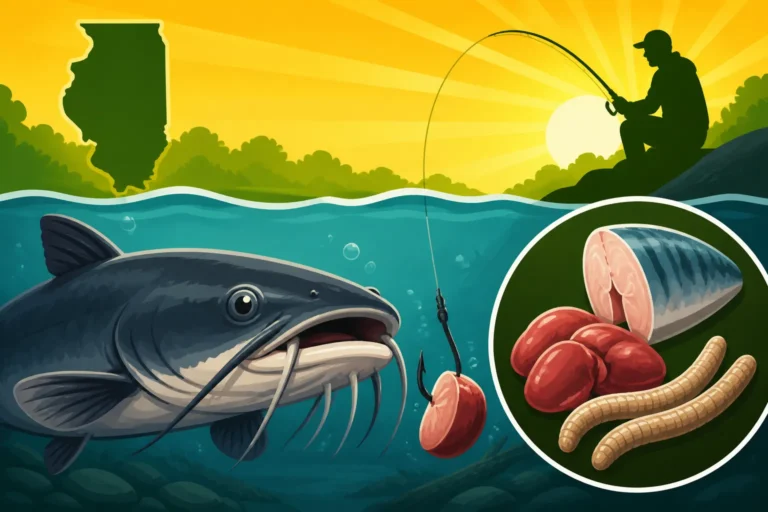
- Chicken Liver: This is a channel cat magnet! The strong scent and soft texture make it irresistible. It's messy but highly effective. Use a bait holder hook or wrap it with a small piece of mesh to keep it on the hook longer.
- Cut Bait: Shad, skipjack, or even strips of carp or bluegill can be fantastic. The oilier the fish, the better. Freshly cut bait releases a strong scent trail that channel cats follow. Experiment with different sizes of chunks.
- Prepared Baits/Stink Baits: There's an entire industry dedicated to stink baits, dip baits, and punch baits specifically formulated for channel catfish. Brands like Catfish Charlie or Sonny's Super Sticky often perform well. These are designed to disperse a potent scent cloud, drawing in fish from a distance. They can be particularly effective in the turbid waters of Carlyle Lake.
When using natural baits, the key is often freshness and scent. Renew your bait regularly, especially chicken liver or cut bait, to ensure maximum attraction.
Live Baits for Flathead Catfish
Flathead catfish are unique among the three species in their preference for live bait. They are ambush predators and prefer to chase down a living meal. If you're targeting big flatheads on Lake Shelbyville or in the timbered areas of Rend, live bait is almost non-negotiable.
- Bluegill/Sunfish: These are arguably the top live bait for flatheads. They are hardy, readily available in most Illinois waters, and flatheads love them. Check local regulations on legal size and catch limits for baitfish. Hook them through the back (careful not to hit the spine) or through the lips to keep them lively.
- Suckers: Another excellent choice, especially for larger flatheads. They are robust and can withstand being fished for extended periods.
- Bullheads: Small bullheads are very hardy and make fantastic flathead bait.
The key to live bait is keeping it alive and active. A good aerated bait bucket is essential. When fishing with live bait, use a slip-sinker rig to allow the flathead to pick up the bait and swim off without feeling resistance, giving them confidence to fully commit to the take. The patience required for flathead fishing is real, but the reward of a powerful fight from a truly massive fish is worth it. Best Live Bait for Flathead Catfish will guide you to even more specific choices.
Cut Baits and Prepared Baits for Blue Catfish
Blue catfish, particularly the larger specimens becoming more prevalent in Carlyle and Rend, share some similarities with channels but lean more towards larger, oilier cut baits. They are voracious eaters and can grow to immense sizes.
- Fresh Cut Shad: This is perhaps the most universally accepted best bait for blue catfish. Fresh, oily shad cut into chunks or strips releases a powerful scent trail that blues can't resist. Larger chunks for larger fish.
- Skipjack Herring: If you can find it, skipjack is another top-tier bait for blue cats. It's incredibly oily and bloody, making it a strong attractant.
- Carp: Strips or chunks of fresh common carp, especially from its belly, are excellent for blue cats. The firm flesh stays on the hook well, and it's a natural food source in many Illinois lakes.
- Perch or Drum: Other local panfish or rough fish, cut into chunks, can also be very effective.
While blues will occasionally hit prepared baits, their preference for fresh, bloody cut bait is very strong, especially when you're looking for bigger fish. The scent trail from these baits in the often-turbid waters of Carlyle Lake or the vast expanses of Rend can be incredibly effective at drawing in schools of hungry blue cats. Always ensure your bait is fresh; rotten bait is less effective than fresh, smelly bait.
Essential Accessories for a Successful Catfish Trip
Having the right rod, reel, line, and bait is crucial, but a truly successful and enjoyable catfishing trip on the Big Three lakes involves a collection of essential accessories. These items make your experience more comfortable, safer, and ultimately more productive, transforming a good day into a great one.
Rod Holders and Bells
Imagine setting out multiple lines, patiently waiting for a bite. Without proper rod holders, you’d be juggling rods, constantly trying to balance them, or worse, risk losing one to a powerful strike.
- Rod Holders: Whether you're bank fishing or boat fishing, sturdy rod holders are invaluable. For bank anglers, spike-style rod holders that push into the ground are perfect. For boat anglers, clamp-on or flush-mount rod holders ensure your rods are secure and properly positioned. Look for holders made of strong metal (stainless steel or heavy-duty aluminum) that can withstand the violent tug of a big catfish. Having multiple rod holders allows you to spread out your baits and cover more water. They also elevate your rods, keeping your line out of shoreline debris and giving you a better view of strike indicators.
- Bells: For passive fishing, especially at night or when running multiple lines, clip-on rod bells are simple yet highly effective strike indicators. The distinct jingle alerts you to a bite, even if you’re momentarily distracted. While not necessary for actively holding your rod, they're a cheap and cheerful addition to any catfishing setup on the Big Three. Many anglers prefer electronic bite alarms these days, but the humble bell still gets the job done reliably.
Landing Gear: Nets and Grippers
Landing a powerful catfish, especially a large blue or flathead, requires more than just arm strength. Proper landing gear ensures the fish is safely brought to hand or boat, minimizing stress on the fish and injury to the angler.
- Large Landing Net: This is perhaps the most crucial piece of landing gear. A net with a deep, wide hoop and a long handle is essential for scooping up big cats. Look for nets with rubberized or knotless mesh, as this is gentler on the fish's slime coat and less likely to tangle hooks. Trying to hoist a heavy catfish out of the water by the line or with a small bass net is a recipe for disaster—snapped lines, lost fish, and potentially broken rods.
- Fish Grippers: For handling fish once they're out of the water, especially the toothy species or those with sharp fins, a pair of heavy-duty fish grippers is a wise investment. They allow you to safely secure the fish's lower jaw without harming it, providing control for hook removal and photos. Brands like BogaGrip or simpler plastic grippers can be found at Bass Pro Shops or online through Amazon. Always have a pair handy, especially for those larger flatheads that can be quite feisty.
Lighting and Storage for Night Fishing
Catfish, particularly flatheads and blue cats, are often most active after dark. If you plan to tackle the Big Three under the stars, adequate lighting and smart storage are non-negotiable.
- Headlamp: A reliable, bright headlamp with a red light option is invaluable. Red light preserves your night vision and is less disruptive to other anglers and the fish. It frees up your hands for rigging, baiting, and unhooking.
- Lantern or Area Light: For setting up camp or illuminating your general fishing area, a battery-powered lantern or area light can be a game-changer. It provides ambient light without being overly harsh.
- Tackle Box/Bag: A well-organized tackle box or bag keeps your hooks, weights, swivels, and tools easily accessible, even in the dark. Opt for models with clear compartments or multiple trays so you can quickly find what you need. A dedicated Tackle Box Essentials for Catfish Trips will ensure you don't forget a thing.
- Cooler: Not just for keeping drinks cold! A large cooler is essential for storing bait (especially live bait if it needs to be kept cool), and for safely keeping any fish you plan to harvest fresh on ice. This is particularly important on warm Illinois summer nights.
- First-Aid Kit: It's always a good idea to have a basic first-aid kit, especially when handling sharp hooks and powerful fish in low light.
Equipping yourself with these accessories isn't about luxury; it's about preparation and maximizing your chances of a comfortable and successful catfishing adventure on Rend, Shelbyville, and Carlyle Lakes.
Disclaimer
This article is for general informational purposes only and does not constitute professional advice. Laws, prices and regulations vary by location and change over time. Consult a qualified professional for guidance on your specific situation.