Muskie vs Northern Pike: How to Tell the Difference
It's a common scenario out on the water: you reel in a long, toothy predator from the depths of an Illinois lake or river, and your first thought is, "Is it a muskie or a northern pike?" For many anglers, the visual distinction can be genuinely puzzling, especially when you're caught up in the excitement of a big catch. This guide is here to clear up that confusion, helping you confidently identify these magnificent, often-mistaken, freshwater giants.
Unpacking the Physical Differences
Distinguishing a muskie from a northern pike often comes down to a few key physical markers that, once you know them, become much clearer. These aren't just subtle nuances for scientists; they're practical identifiers that any angler can learn to spot quickly. Getting it right isn't just about bragging rights; it's crucial for following specific regulations, as catch limits and size restrictions can differ between these two species.
Jaw and Cheek Markings: The Tell-Tale Signs
One of the absolute best ways to tell a muskie from a northern pike is by looking at their cheeks and the undersides of their jaws. Imagine holding the fish gently and turning its head slightly to inspect these areas – it’s where their true identities are often revealed.
Northern pike, those feisty green machines, typically have a fully scaled cheek and a fully scaled upper half of their gill cover. If you run your hand (carefully, those gill plates can be sharp!) along the cheek, it feels uniformly rough with scales. Now, flip that over to a muskie. These elusive beauties have a more distinct pattern: their cheeks and gill covers are usually only scaled on the upper half, with the lower half being bare. It’s like a partial beard versus a full one, if you will. This is a primary differentiator and often the first thing experienced anglers look for. This can be critical when you're trying to quickly identify a fish for catch-and-release, especially if you're targeting one species but hooking the other. Having a laminated identification card, perhaps one you picked up on Amazon, can be a real game-changer here.
When it comes to the jaw, specifically the pores on the underside, this is another huge clue. Northern pike tend to have five or fewer pores on each side of their lower jaw. Muskies, on the other hand, almost always have six to ten pores on each side. These pores are small, but visible, and run in a line along the underside of the jaw. Think of them like tiny polka dots. Counting these pores, combined with the cheek scale pattern, will give you a nearly foolproof identification every time. It’s a little detail, but it makes a world of difference.
Body Shape and Fin Placement: Subtle Structural Clues
Beyond the head, the overall body shape and fin placement also offer some helpful hints, though these can be a bit more subtle and require a keener eye or familiarity with both species. You're looking for proportions and how their fins are set on their body.
Muskies generally have a more elongated, somewhat cylindrical body, almost like a torpedo. They can grow incredibly long and thick, giving them a very powerful, imposing presence in the water. Their dorsal and anal fins are typically set further back on the body, closer to the tail fin, which gives them that characteristic "paddle" shape for sudden bursts of speed. This posterior fin placement is a key adaptation for ambush predators, allowing them to accelerate rapidly from a dead stop. This shape contributes to their formidable fighting power, especially on Illinois Muskie Fishing: Best Lakes to Try.
Northern pike, while also long and streamlined, tend to be a bit more slender and less robust in their overall build compared to a muskie of similar length. Their dorsal and anal fins are also set back, but sometimes not quite as far back as a muskie's, giving them a slightly less exaggerated "paddle" look. Their tails might appear a bit more forked than a muskie's, which often has a more rounded, paddle-like tail. These differences in body and fin structure might seem minor, but they contribute to how the fish moves through the water and how it feels on the end of your line.
Coloration and Patterns: The Camouflage Code
The skin patterns and coloration are often what first catches an angler's eye, but they can also be the most deceiving. Both species utilize stripes, spots, and bars for camouflage, but they do it in subtly different ways. It’s not always black and white, or rather, green and brown, but there are some general rules to follow.
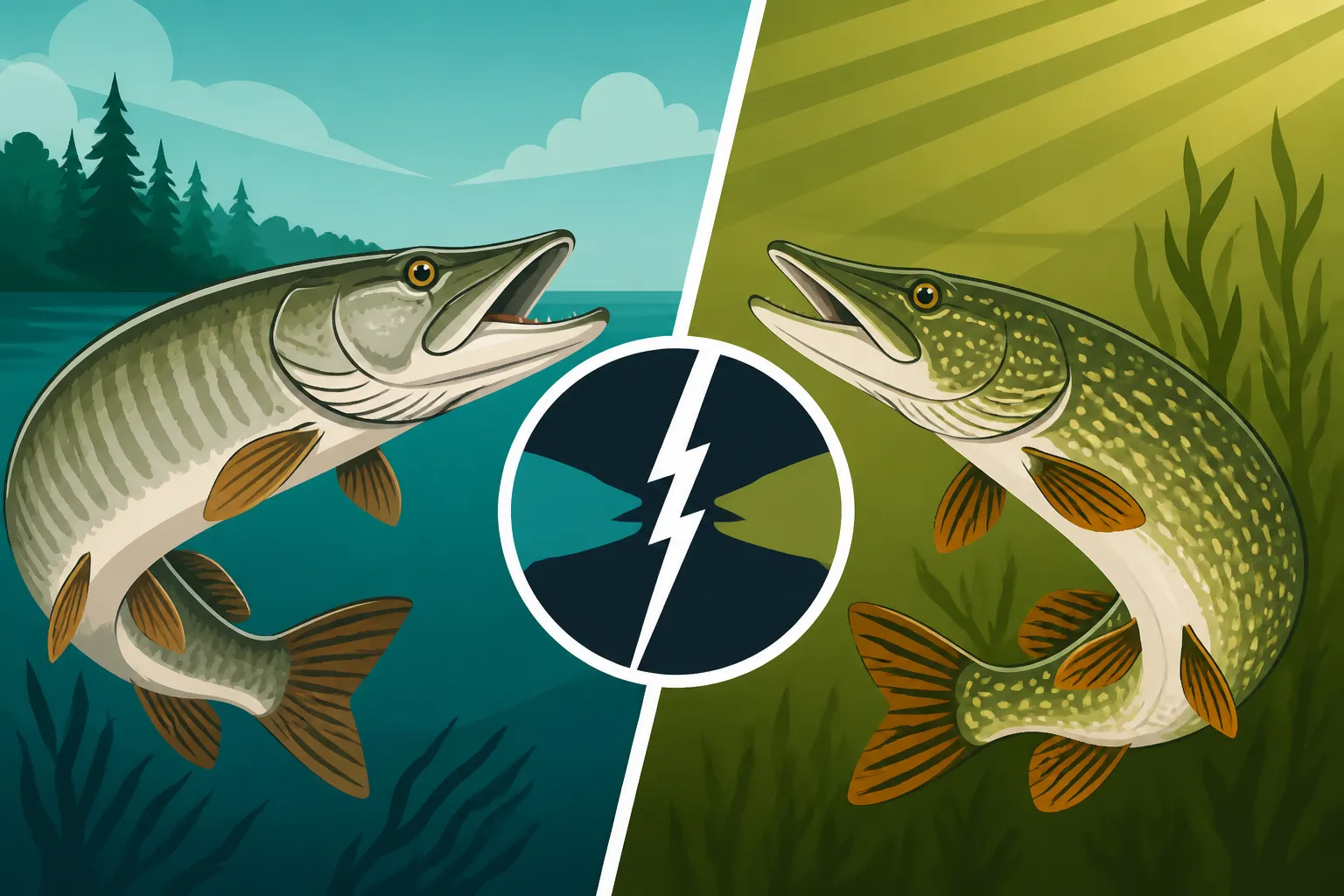
Northern pike are known for their distinct, light-colored, bean-shaped or horizontal bar markings on a darker, typically olive green to brownish body. These markings can be quite prominent, almost like stripes or elongated spots running horizontally along their flanks. The overall impression is often a darker fish with lighter patterns. They also frequently have a yellowish-white belly and sometimes a reddish tint to their lower fins, which can be quite striking. Their tail and dorsal fins are often spotted. This coloration is perfect for blending into weedy environments and among submerged timber, helping them ambush prey effectively. If you've ever cast a line on the Mississippi River Walleye and Pike Fishing in Northern Illinois, you've probably seen this vibrant camouflage in action.
Muskies, on the other hand, typically feature dark markings on a lighter, often greenish or silvery-brown background. Their markings can vary widely, from distinct vertical bars (barred muskie) to spots (spotted muskie) or even a relatively clear, unpatterned body (clear muskie). This variability is why relying solely on coloration can be tricky. However, the general rule is that if you see dark markings on a lighter background, you're more likely looking at a muskie. Their fins also tend to be darker, often with dark spots or blotches. There are even tiger muskies, a sterile hybrid of northern pike and muskie, which have very distinct, dark wavy bars on a light background. These hybrids can be particularly confusing, but their head characteristics will still lean towards muskie. Because of this variability, having a good field guide or a quick reference, perhaps a waterproof one from Amazon, can be incredibly helpful when you're out on the water.
Here's a quick comparison table to help solidify these identification points:
| Feature | Northern Pike | Muskie |
|---|---|---|
| Cheek Scales | Fully scaled | Upper half scaled, lower half bare |
| Gill Cover | Fully scaled | Upper half scaled, lower half bare |
| Jaw Pores | 5 or fewer per side on lower jaw | 6-10 per side on lower jaw |
| Body Markings | Light (yellow/white) bean-shaped spots/bars on dark background | Dark (brown/green) spots, bars, or blotches on light background |
| Body Shape | More slender, somewhat cigar-shaped | More robust, elongated, powerful torpedo shape |
| Tail Fin | Often more distinctly forked | Typically more rounded, paddle-like |
Habitat and Behavioral Distinctions
It's not just their looks that set muskies and northern pike apart; their preferred hangouts and how they act in the water also provide strong clues. Understanding these behavioral differences can help you identify what you've hooked even before you get a clear look, and it can certainly improve your chances of targeting one species over the other.
Preferred Environments: Where They Like to Lurk
While both species are apex predators in freshwater systems, they do have some distinct preferences when it comes to where they set up shop. Knowing these tendencies can narrow down your identification before you even cast a line.
Northern pike are often associated with cooler, shallower, weedy areas. They absolutely love dense submerged vegetation, lily pads, and fallen timber. These environments provide excellent camouflage for their ambush style of hunting, allowing them to hide and then explode out to capture unsuspecting prey. You'll often find them lurking in the shallower bays and coves of lakes, or along slow-moving river sections with plenty of cover. They're quite tolerant of a range of water conditions and can be found in many of Illinois' diverse waterways, from the smaller lakes to the large backwaters of the Mississippi River. Their adaptability means they can be present in a wider variety of fishing spots, making them a more common catch for many anglers.
Muskies, while also loving structure, tend to prefer larger, deeper, and often clearer waters than pike. They still seek out cover like weed edges, rock piles, drop-offs, and standing timber, but they’re less confined to the shallowest, densest vegetation. Many of Illinois' top muskie waters are large reservoirs or deep glacial lakes. They often patrol deeper weed lines or suspend over open water near structures, waiting for a large meal to swim by. While they can be found in rivers, they often prefer larger river systems with good current breaks and deep pools. Because of their preference for larger, more specific habitats, muskies are often considered a more specialized target for anglers, requiring knowledge of specific Illinois Muskie Fishing: Best Lakes to Try to have consistent success.
Diet and Feeding Habits: What's on the Menu
Both muskie and northern pike are opportunistic, carnivorous predators, but their typical diet and how they approach feeding can sometimes differ, reflecting their size and habitat.
Northern pike, with their slightly smaller average size, tend to have a diet consisting of smaller fish, frogs, and even small mammals or ducklings if the opportunity arises. They are incredibly aggressive and will strike at a wide variety of prey, often hitting a lure with a startling ferocity. Their metabolism can be quite high, especially in cooler water, leading them to feed frequently. They are quintessential ambush predators, relying on bursts of speed from cover to engulf their prey. This aggressive feeding behavior makes them a thrilling catch and often leads to them striking a broader range of lures, from spoons to spinnerbaits, even those intended for bass.
Muskies, being larger on average and often targeting bigger meals, consume larger forage fish like suckers, carp, and even good-sized panfish or bass. They are truly the "fish of a thousand casts" for a reason—they are notoriously finicky eaters and can be very selective. They don't always chase down every meal; instead, they often use their powerful tail to create a vacuum, literally sucking in their prey. While they are also ambush predators, they can be more deliberate, often following a lure for a long time before deciding to strike, or not striking at all. This "follow" behavior is a classic muskie trait that can be both exhilarating and heartbreaking for anglers. Targeting them often requires larger baits and specific presentations, as detailed in many resources on Muskie Fishing in Illinois: The Complete Guide.
Spawning Differences: Cycles of Life
The reproductive cycles of muskie and northern pike, while both occurring in spring, also have subtle differences that affect their presence in certain areas at different times of the year.
Northern pike are typically earlier spawners than muskies. They often move into flooded marshes, shallow grassy areas, and flooded timber very early in the spring, sometimes even when there's still ice on parts of the lake. They prefer water temperatures in the low to mid-40s Fahrenheit. The female will scatter her eggs, which adhere to vegetation, and the male will fertilize them. There's no parental care, and the eggs hatch relatively quickly. This early spawn means they are often among the first predatory fish to become active and feed aggressively as the ice recedes, offering some fantastic early-season fishing opportunities.
Muskies spawn a bit later in the spring, generally when water temperatures are in the mid-50s Fahrenheit, usually after the northern pike have finished. They also seek out shallow, vegetated areas for spawning, but often prefer slightly deeper sections of these flats or areas with woody debris. Like pike, muskie eggs are scattered and adhere to vegetation and bottom debris, with no parental care. The later spawn means that by the time muskie are actively moving into their spawning grounds, pike have often dispersed back to their summer territories. Understanding these timing differences is helpful not just for conservation, but also for knowing when and where to focus your efforts for each species.
Fishing Challenges and Tactics
Beyond identification, the experience of catching a muskie versus a northern pike can also differ significantly, influencing your gear choices and fishing techniques. While both offer a thrilling fight, adapting your approach can make all the difference.
Fight Characteristics: The Battle on the Line
When you hook into one of these toothy critters, you'll quickly realize that while they share some predatory traits, their fighting styles can be quite distinct. Knowing what to expect can help you land the fish.
Northern pike are renowned for their aggressive, violent strikes and their powerful, head-shaking runs. When a pike hits your lure, it's often with a jarring impact, and they immediately take off, pulling hard. They're also famous for their aerial acrobatics, often jumping and thrashing on the surface, trying to throw the hook. This explosive, unpredictable fight is incredibly exciting, especially when you're using medium-heavy tackle. They give you a battle from start to finish, and their endurance can be surprising for their size. Landing a good-sized northern pike often involves quick reflexes and a rod with enough backbone to control those head shakes.
Muskies, often larger and more powerful, typically exhibit a more deliberate but equally formidable fight. While their initial strike can be sudden and powerful, their fight is often characterized by long, deep runs and stubborn refusal to come to the boat. They might not jump as frequently as pike, but when they do, it's often a spectacular sight given their size. What muskies are particularly known for is their "death roll" at the side of the boat, where they spin and twist violently, often snapping lines or throwing lures. This makes landing them particularly challenging and requires heavy-duty gear and nerves of steel. Many anglers specifically invest in specialized Muskie Gear and Tackle for this reason. The battle with a muskie is often a test of patience and strength, with many fish won or lost right at the boat.
Lure Selection: Matching the Mouth
While there's overlap in what these fish will strike, serious anglers often tailor their lure selection to maximize their chances with either muskie or northern pike.
For northern pike, a wide array of lures can be effective. They're generally less picky, and their aggressive nature means they'll often smash into anything that looks like an easy meal. Spoons, spinnerbaits, crankbaits, and even large inline spinners are all common choices. Colors that mimic local forage or are bright and flashy often work well. Because they are often found in weedy areas, weedless spoons or spinnerbaits are incredibly popular. You don't always need the largest or most expensive lures; sometimes a simple, well-presented spoon is all it takes. For targeting them, check out guides on Best Bait for Northern Pike Fishing.
Muskies, on the other hand, often demand larger, more specialized lures. Given their potential size and finicky nature, anglers typically throw massive bucktails, large crankbabaits, glide baits, and soft plastic swimbaits designed to imitate large forage. The theory is "big bait, big fish," and while muskies will occasionally hit smaller baits, consistently targeting them often means going big. Lure presentation is also critical, with specific retrieve speeds and "figure-eights" at the boat often triggering strikes. These lures are often heavier and require much sturdier rods and reels to cast and retrieve effectively. If you're looking to gear up, many serious muskie anglers browse dedicated sections on Amazon for these specialized, heavy-duty baits.
Seasonal Considerations: When and Where to Hunt
The best times to target each species can also differ, reflecting their spawning habits, preferred water temperatures, and metabolic rates throughout the year.
Northern pike fishing is often excellent in the early spring, immediately after ice-out, when they are actively feeding after their spawn. They remain active through spring and into early summer, especially in weedy areas. As water temperatures rise in mid-summer, they might move to slightly deeper, cooler water or become less active during the hottest parts of the day. Fall can see a resurgence in activity as they feed heavily before winter, becoming quite aggressive again. During winter, they are a popular target for ice fishing, often found cruising beneath the ice in shallower bays.
Muskie fishing also picks up in the spring, but usually a bit later than pike, once water temperatures stabilize. The summer months can be productive, particularly during dawn and dusk, or cloudy days. Many serious muskie anglers consider the fall to be prime time, often called "the fall bite," when muskies feed voraciously to build up fat reserves for winter. This is when some of the largest muskies are caught, often on big baits in deeper water. Winter muskie fishing, through the ice, is less common in Illinois but can occur in some areas. Understanding Illinois Fishing Seasons Guide for each species is key to planning your trips.
Angler Considerations
Beyond the thrilling chase and the challenge of identification, there are broader responsibilities and considerations for anglers pursuing these magnificent fish. Respecting the resource, understanding regulations, and even considering their culinary value are all part of the experience.
Regulations and Conservation: Protecting Our Giants
Illinois takes the management of its fish species seriously, and both muskies and northern pike have specific regulations in place to ensure healthy populations. It’s absolutely vital for every angler to know and follow these rules.
Northern pike regulations in Illinois generally involve a minimum size limit and a daily creel limit. These limits are designed to protect younger fish and ensure enough mature fish can reproduce. Because pike are more widespread and tend to reproduce more readily, their regulations might be less stringent than those for muskies. Always check the current Illinois Fishing Regulations Overview before you head out, as these can change year to year and even vary by specific body of water. Failure to comply can result in Penalties for Fishing Without a License in Illinois or for violating catch limits.
Muskies, being a prized trophy fish with slower growth rates and more specialized habitat needs, often have much more restrictive regulations. This typically includes a significantly higher minimum size limit, sometimes 36 inches or more, and often a very low daily creel limit, sometimes even "catch and release only." Many anglers who target muskies practice catch and release exclusively, recognizing the importance of these large fish to the ecosystem and the angling community. Releasing these giants unharmed ensures they can continue to grow and reproduce, providing future generations of anglers with the same thrilling opportunities. Proper handling techniques, such as using large nets and long-nosed pliers to remove hooks, are critical for the survival of released muskies. For a deeper dive, check out Illinois Muskie Fishing: Rules and Regulations for This Game Fish.
Eating Quality: From Water to Plate
While the thrill of the catch is paramount for many, some anglers also consider the culinary qualities of their catch. Both muskie and northern pike can be excellent table fare, but there are some nuances to consider.
Northern pike are widely considered a good eating fish, especially the smaller to medium-sized ones. Their flesh is white, flaky, and has a mild flavor. However, they are famously bony, often described as having "Y-bones" that can make filleting a challenge for the uninitiated. Learning a specific filleting technique to remove these bones is key to enjoying pike at the dinner table. Many anglers find the effort well worth it, especially when the fish comes from clean, cold water. They can be baked, fried, or grilled, and often absorb flavors well.
Muskies, due to their impressive size and conservation status, are less frequently kept for food. Many anglers who target them view them purely as a sport fish and practice catch and release. However, if kept within legal limits, their flesh is also white, firm, and has a mild, sweet flavor, very similar to northern pike. Like pike, they have a bony structure that requires careful filleting. Because they can grow to such immense sizes, larger muskies can sometimes accumulate more contaminants, so it's always wise to check local consumption advisories if you decide to keep one. Given the effort and dedication required to catch a legal-sized muskie, many anglers choose to savor the memory and a photograph rather than the meal.
Respecting These Fish: Angler Etiquette
Whether you're after a trophy muskie or a feisty northern pike, ethical angling practices are crucial for the health of the fishery and the enjoyment of all.
This means practicing responsible catch and release, especially for muskie. Use appropriate tackle to minimize fight time, employ large, rubberized nets that are gentle on fins and slime coat, and use hook removers to quickly and safely extract hooks. Always support the fish horizontally when lifting for a photo, avoiding vertical hangs that can damage internal organs. If you need a quality release tool or a measuring board that can handle these giants, browsing options on Amazon can be a good start.
For both species, understand their predatory nature and handle them with care. Those teeth are no joke! A good pair of long-nosed pliers is essential for hook removal, and a sturdy pair of cut-resistant gloves isn't a bad idea, especially for larger fish. Always be mindful of your surroundings, respect other anglers, and leave no trace behind. By adhering to these principles, we ensure that the incredible fishing opportunities Illinois offers for these magnificent predators will continue for generations to come.
Disclaimer
This article is for general informational purposes only and does not constitute professional advice. Laws, prices and regulations vary by location and change over time. Consult a qualified professional for guidance on your specific situation.