Illinois Striped Bass: A Rare Catch Worth Knowing About
It can be quite the surprise, and honestly, a little confusing, when you're out on an Illinois lake or river and pull in something that looks like a bass, but just doesn't quite fit the mold of our familiar largemouth or smallmouth. That's often the moment when an angler has encountered a truly rare sight: a purebred Striped Bass. This guide is going to clear up the mystery, explaining what makes these fish unique, where you might encounter one in our state, and why they're such a prized catch elsewhere.
What Exactly is a Striped Bass and Why is it Rare in Illinois?
When we talk about a Striped Bass, or "striper" as they're affectionately known, we're discussing a truly magnificent anadromous fish. That means they typically spend most of their lives in saltwater, only returning to freshwater to spawn. Think of them like the salmon of the East Coast, known for their incredible fighting power and impressive size. They are sleek, powerful, and built for speed and endurance, making them a top-tier game fish wherever they are abundant.
However, Illinois is a landlocked state, and our waters are, naturally, freshwater. This immediately presents a challenge for a species that thrives in estuaries and oceans. Any purebred Striped Bass found in Illinois waters are almost certainly the result of stockings, and usually, those stockings are experimental or indirect. Unlike some other states that have robust, self-sustaining populations in large freshwater impoundments, Illinois simply doesn't have the natural conditions or widespread stocking programs to support them.
What many Illinois anglers do encounter, and often mistake for a purebred striper, is its cousin: the hybrid striped bass, often called a "wiper." Wipers are a cross between a Striped Bass and a White Bass, and they are stocked in several Illinois lakes to provide a hard-fighting, fast-growing sport fish. The vast majority of "stripers" reported caught in Illinois are actually these hybrids. That's why catching a true, purebred Striped Bass here is like finding a needle in a haystack—a very cool, very powerful needle!
Where Do You Even Find Striped Bass in Illinois?
Given their rarity, pinpointing exact locations for purebred Striped Bass in Illinois is challenging, to say the least. Unlike our native Largemouth Bass Fishing in Illinois: The Complete Guide or Illinois Walleye Fishing: The Complete Guide, stripers aren't on every local lake map. If you were to stumble upon one, it would most likely be in a very large reservoir or perhaps in some of our larger river systems where they may have strayed or been accidentally introduced.
Historically, there have been some experimental stockings of purebred Striped Bass in a few of Illinois's larger impoundments or cooling lakes. These were often done to see how the fish would adapt to a purely freshwater environment, or to assess their potential as a sport fish in specific, limited areas. However, these programs have been few and far between, and most have not resulted in self-sustaining populations. This means that if you catch one, it's probably an older, lone survivor of such a program, or a true wanderer.
More realistically, the places you'd expect to catch a hybrid striped bass, or wiper, are the same places a purebred striper might theoretically show up. Lakes like Clinton Lake, Lake Shelbyville, and a few others are known for their hybrid populations. The Illinois Department of Natural Resources occasionally stocks wipers in these larger bodies of water because they offer diverse forage and ample room for these strong swimmers to thrive. If a purebred striper were to make a rare appearance, it would likely be in similar, large-scale systems with substantial baitfish populations. You'd need to consult the current Illinois Fishing Information Guide Covers April 2026 Through March 2027 for specific stocking details if you're looking for hybrids.
Identifying a Purebred Striper: What to Look For
This is where things get really interesting and often a bit confusing for anglers! Distinguishing a purebred Striped Bass from a White Bass or, more commonly, a hybrid striped bass (wiper), requires a keen eye. Many people catch a wiper and immediately think they've got a true striper, and honestly, who can blame them? They look quite similar at first glance. Knowing the key differences can not only help you identify your catch but also ensure you're following the correct regulations.
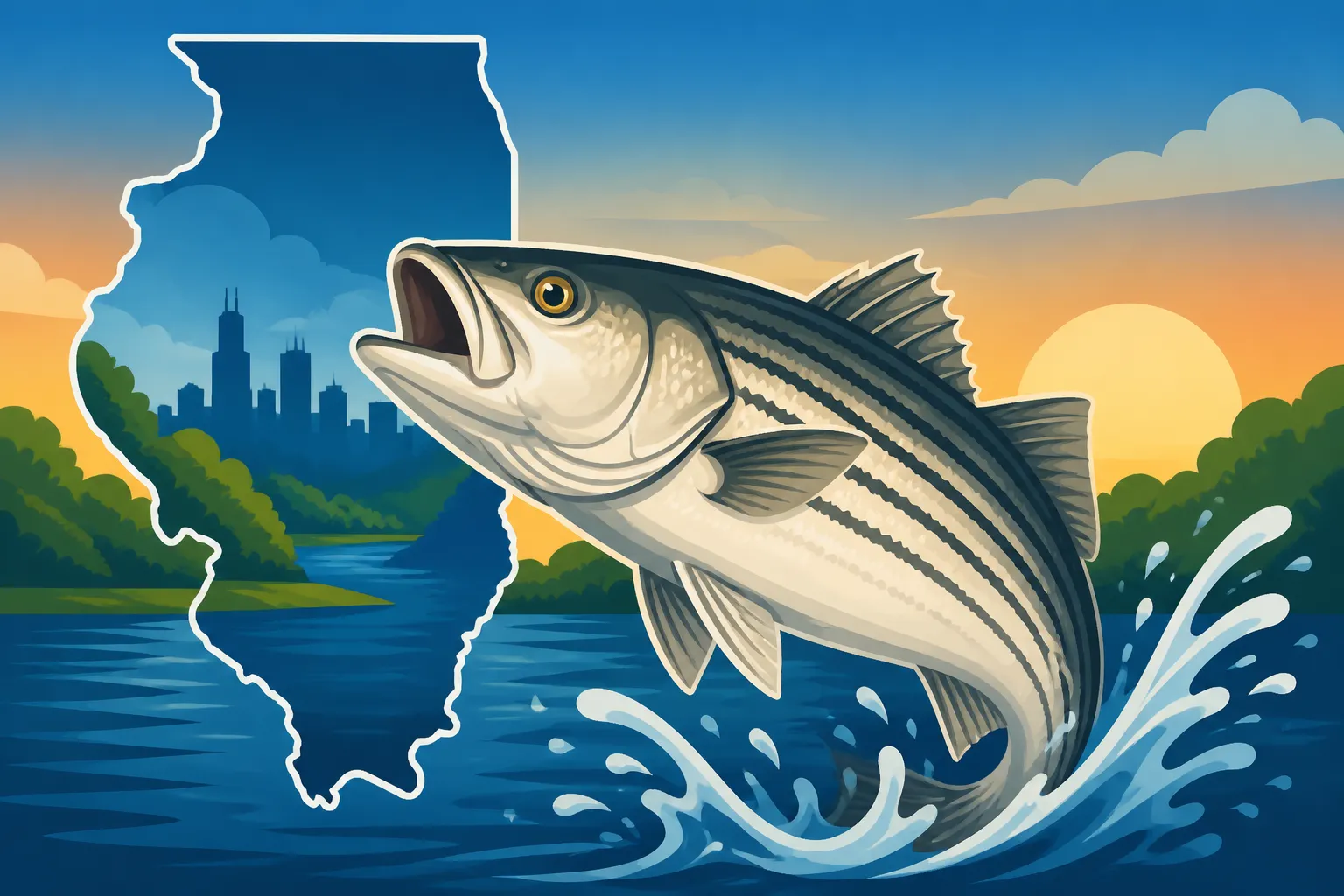
The primary feature to examine is the lateral lines on the fish's body. A purebred Striped Bass will have unbroken, distinct black lines running horizontally along its silver-white sides. These lines are generally clear and continuous from head to tail. Their body shape is also more streamlined and elongated compared to the chunkier White Bass. They also tend to have two distinct tooth patches on their tongue. If you're comparing it side-by-side with a White Bass, the size difference alone can be a major clue, as adult stripers grow much, much larger. You can learn more about similar species in White Bass vs Yellow Bass in Illinois: How to Tell Them Apart.
Now, for the tricky part: distinguishing it from a hybrid striped bass, or wiper. Wipers often have broken or irregular lines on their sides, particularly below the lateral line, where the lines might be dashed, smudged, or connect and disconnect in an inconsistent pattern. They also typically have two distinct tooth patches on their tongue, just like a purebred striper. Hybrids can also vary greatly in appearance, sometimes looking more like a White Bass and other times more like a Striped Bass. The most reliable indicator, outside of genetics, is often the continuity of those lateral lines. If those lines are consistently broken or appear disjointed, you've likely got yourself a wiper. Having a good, waterproof fish identification guide, perhaps one you ordered from Amazon, can be incredibly helpful right on the boat!
The Lateral Line Test: Stripes Don't Lie (Usually)
Let's break down that lateral line test a bit further, because it's your best friend for identification in the field. When you hold the fish, look at the darkest, most prominent horizontal lines running down its body. Count how many of those lines are truly continuous from the gill plate all the way to the tail.
For a purebred Striped Bass, you should see several, usually 7 to 8, of these dark lines, and critically, all of them (or almost all of them) will be unbroken. Imagine drawing a pencil line from one end of the fish to the other without lifting the pencil; that's what you're looking for. These lines are generally crisp and well-defined, standing out against the silver background. This unbroken pattern is a hallmark of the species and a strong indicator that you've caught something special in Illinois.
Now, for the hybrid striped bass, or wiper, it’s a different story. You’ll still see those dark lines, but many of them—especially those below the main lateral line—will be noticeably broken or interrupted. They might look like a series of dashes, or they could weave in and out, or even branch off slightly. Some might be continuous, but typically, there will be at least one or more lines that are clearly not solid from head to tail. This "broken line" characteristic is the most common and reliable way to identify a hybrid. White bass, on the other hand, typically have faint or no distinct lateral lines below their primary one, and their overall body shape is much deeper and more compressed.
| Feature | Purebred Striped Bass | Hybrid Striped Bass (Wiper) | White Bass |
|---|---|---|---|
| Lateral Lines | Mostly unbroken, distinct lines | Broken or irregular lines, especially below main lateral line | Faint or no distinct lines below primary, often only one or two prominent |
| Body Shape | Elongated, streamlined | More football-shaped, deeper than striper but less than white bass | Deep-bodied, compressed, more "panfish-like" |
| Tooth Patches | Two distinct patches on tongue | Two distinct patches on tongue | One small patch, or none |
| Size Potential | Can grow very large (30+ lbs) | Moderate to large (up to 15-20 lbs) | Small (rarely over 5 lbs) |
| Head Shape | Pointed, slightly concave profile | Variable, often slightly rounded | More rounded, blunter head |
Tongue Patches: A Subtle But Crucial Clue
While the lateral lines are often the quickest identifier, the presence and arrangement of tooth patches on the fish's tongue offer another definitive clue, especially when trying to differentiate between purebred stripers, hybrids, and true white bass. This isn't a trick you'd teach a beginner, but it's invaluable for the dedicated angler. Gently open the fish's mouth and look at the center of its tongue. You might need to use a finger to feel for them, as they can be small.
A purebred Striped Bass will have two distinct, parallel patches of teeth on its tongue. These aren't like sharp teeth you'd expect, but more like rough, sandpaper-like areas. These two patches are a consistent characteristic. The hybrid striped bass, or wiper, also shares this trait, possessing two distinct tooth patches on its tongue. This is part of why they are so hard to tell apart from purebred stripers; they inherited this feature from their Striped Bass parent.
The key difference comes when you compare them to a White Bass. A White Bass will typically have only one central tooth patch on its tongue, or sometimes none at all. This single patch, if present, is usually much smaller and less defined than the two patches found on its larger cousins. So, if you've got two patches, you're looking at either a purebred striper or a hybrid. If you've only got one or none, it's almost certainly a White Bass. This detail, combined with the lateral line examination, gives you a pretty foolproof identification system for these similar-looking species.
Fishing Techniques for Striped Bass (If You're Lucky Enough to Find Them)
If you've managed to locate a body of water in Illinois that might hold a purebred Striped Bass, or more likely, you're targeting hybrids, the techniques you'll employ are generally focused on their predatory nature and their preference for open water. These fish are powerful, aggressive feeders that love to chase baitfish, so your approach should reflect that. Don't expect them to be hiding in dense cover like a largemouth bass; instead, think about vast, open expanses of water where baitfish schools roam.
One of the most effective ways to catch these open-water predators is by trolling. Trolling allows you to cover vast areas of water, presenting your lure at various depths until you find where the fish are holding. Crankbaits, especially those designed to mimic shad or other local baitfish, are excellent choices. You might also experiment with spoons or even umbrella rigs, particularly in very large bodies of water. Varying your speed and lure depth until you get a strike is key. This method is common for Lake Michigan Salmon and Trout Fishing in Illinois and can be adapted for open-water striper/hybrid fishing.
Another popular and effective method is casting to schooling fish. If you see birds diving or baitfish scattering on the surface, chances are there are stripers or hybrids busting them from below. This is an exhilarating experience! Topwater lures, such as poppers or walking baits, can be incredibly effective in these situations, creating a commotion that mimics distressed baitfish. If the fish are deeper, fast-sinking spoons, swimbaits, or even heavy jigs can be cast into the school and retrieved quickly. Always have a rod rigged and ready for this kind of action, as these feeding frenzies can be short-lived.
Live bait is also a killer for these fish. Shad, alewives, or large shiners, if legal and available, can be fished under a bobber or on a bottom rig. When using live bait, remember that stripers and hybrids hit hard, so make sure your tackle is up to the task. Many anglers will use heavier spinning or baitcasting gear, similar to what you'd use for pike or muskie, with strong braided line. Look for fish holding around structure like humps, points, or sudden depth changes, especially where current is present, as these are natural ambush points for schooling predators.
Illinois Regulations for Striped Bass
Navigating fishing regulations can sometimes feel like trying to untangle a bird's nest of fishing line, and when it comes to rare species like the Striped Bass in Illinois, it gets even trickier. Since purebred Striped Bass are not a commonly encountered or officially managed species in Illinois waters, they often fall under general regulations or are addressed as part of hybrid striped bass rules. It's crucial to understand that general statewide rules, like those discussed in Illinois Fishing Regulations Overview, might apply, but specific site-specific rules always take precedence.
For the most part, if you catch a purebred Striped Bass in Illinois, it would likely be considered incidental to targeting other species, or perhaps it's a holdover from a past stocking. There isn't typically a specific statewide size or creel limit for purebred Striped Bass. However, this is where the hybrid striped bass distinction becomes critical. Hybrids are managed in many Illinois waters, and specific regulations regarding their size and daily catch limits will be posted at the particular lake or river where they are stocked. For example, lakes like Clinton Lake or Lake Shelbyville might have special regulations for hybrids that apply to both size and how many you can keep. Always, always check the current IDNR fishing guide for the specific body of water you are fishing.
So, what should you do if you catch a true purebred striper? The safest bet is to treat it with care. If you're not sure of its identity, or if there are no specific regulations listed for purebred stripers in the area, it's often best practice to release it carefully, especially given its rarity. You can quickly snap a photo for bragging rights (and proof!) before letting it go. If you are confident it's a hybrid, then adhere strictly to the site-specific regulations for hybrid striped bass. The penalties for fishing without a license or exceeding catch limits can be severe, so knowing your fish and knowing the rules is paramount. Remember, ignorance of the law is no excuse, and game wardens absolutely can check your catch, just like they check your Illinois Fishing License Guide for 2026.
The Hybrid Loophole: Understanding Wiper Rules
Let's dive a bit deeper into those hybrid striped bass, or "wiper" rules, because these are what you'll most likely encounter and need to follow. As we discussed, hybrids are the offspring of a Striped Bass and a White Bass, and they are intentionally stocked in several large Illinois reservoirs and lakes to provide a robust sport fishery. Because they are regularly stocked and managed, specific regulations are in place for them, unlike the purebred striper. These rules are put in place by the Illinois Department of Natural Resources to maintain healthy populations and ensure sustainable fishing opportunities for everyone.
These regulations typically involve specific daily creel limits (how many fish you can keep) and often minimum length limits (how long a fish must be to be kept). For instance, a common regulation might be a daily limit of 3 hybrid striped bass, with a minimum length of 17 inches, or some variation thereof. These numbers are not arbitrary; they are based on biological surveys and population assessments to ensure that enough fish survive to maturity and reproduce (or in the case of hybrids, are available for stocking). You will usually find these specific rules posted at boat ramps, park offices, or within the official Illinois Fishing Information Guide for the particular lake or river you're fishing.
It's your responsibility as an angler to know these rules before you cast a line. While it's tempting to think, "Oh, it's just a bass," treating a hybrid striped bass like a largemouth bass (which often has different size and creel limits, see Illinois Statewide Bass Daily Catch Limit of Six Fish) could land you in hot water. A game warden isn't going to care if you genuinely mistook it for something else; they care if you're in compliance. If you're unsure, ask at a local bait shop, check the IDNR website, or default to catch-and-release. It's better to be safe than sorry when you're talking about fines and potential loss of fishing privileges.
The Appeal of the Striped Bass: Why Anglers Love Them Elsewhere
While purebred Striped Bass might be a rare ghost in Illinois waters, they are an absolute legend in other parts of the country, particularly along the Atlantic Coast and in large freshwater impoundments in states like Tennessee, Arkansas, and the Carolinas. Anglers there specifically target these powerful fish, and their passion for stripers is completely understandable once you learn what makes them such an incredible catch. If you've ever felt the sheer power of a big fish, you can appreciate the allure.
The primary appeal of the Striped Bass is its incredible fighting ability and its impressive size potential. These are not dainty fish. They grow large, often exceeding 30 pounds in their native range, and can easily top 50 pounds, with the world record pushing close to 82 pounds! Imagine hooking into a fish that powerful; it's like battling a freight train. They make long, drag-screaming runs, pull hard, and don't give up easily, providing an exhilarating challenge that tests both angler and tackle. For many, landing a trophy striper is the pinnacle of freshwater (or saltwater) angling.
Beyond the fight, stripers are also appreciated for their table fare. Their firm, flaky white meat is considered excellent eating by many, making them a desirable catch for both sport and sustenance. This combination of being a hard-fighting game fish and a delicious meal contributes to their immense popularity. While we may not have a thriving purebred striper fishery in Illinois, understanding their appeal helps us appreciate the rare chance encounter, and certainly helps explain why their hybrid cousins are such a valued addition to our own fishing scene.
Looking Beyond the Landlocked State: The Striper's Legacy
It’s clear that while the purebred Striped Bass remains a true rarity in Illinois, its legacy and the excitement it brings to anglers cannot be overstated. We might be a landlocked state, but the allure of these powerful fish, even in hybrid form, certainly resonates with our angling community. From the Mississippi River to our deepest lakes, Illinois offers incredible fishing opportunities, but the striper offers a glimpse into a different kind of angling challenge.
The fascination with Striped Bass isn't just about the fish itself; it's about the challenge, the thrill of the chase, and the sheer power of nature. Even in Illinois, where the focus is more on species like Illinois Walleye Size and Catch Limits or Illinois Blue Catfish: Where the Biggest Fish Are Caught, the presence of hybrids keeps that powerful striper spirit alive. They remind us of the incredible diversity of fish species out there, and how a little bit of genetic magic can bring the fight of the ocean right to our freshwater doorstep.
So, the next time you're out on one of Illinois's big lakes, perhaps on the Illinois River Fishing Guide or another large waterbody, and you hook into something that pulls exceptionally hard and displays those distinctive stripes, take a closer look. You might just have a hybrid on your line, providing a fantastic fight, or, just maybe, you've landed that incredibly rare purebred Striped Bass, a true testament to the surprises our waters can hold. Remember to always fish responsibly, know your regulations, and enjoy every moment on the water.
Disclaimer
This article is for general informational purposes only and does not constitute professional advice. Laws, prices and regulations vary by location and change over time. Consult a qualified professional for guidance on your specific situation.