Fishing Regulations for Boundary Waters Explained
One of the trickiest parts of enjoying the fantastic fishing opportunities here in Illinois is navigating the often-confusing regulations, especially when you find yourself casting a line in waters that share a border with another state. It’s a common frustration: you just want to fish, but suddenly you're wondering if your Illinois license is even valid or if the length limits you know by heart still apply. This guide is here to untangle those specific issues for you, making your trips to our boundary waters less about legal anxiety and more about reeling in a great catch.
The Frustration of Fishing Boundary Waters
There's nothing quite like heading out for a day on the water, only to be plagued by nagging questions about whether you're following the rules. Fishing Illinois's boundary waters means dealing with an extra layer of complexity that can make even seasoned anglers pause. You’re not just dealing with Illinois Department of Natural Resources (IDNR) regulations; you might also need to consider what Iowa, Missouri, Indiana, Kentucky, or even Wisconsin has to say about it. It’s enough to make anyone scratch their head and wish they'd just stuck to a local pond.
Why Boundary Water Rules are Different
The reason boundary water rules exist and can be so complex is pretty straightforward: shared resources. Rivers like the Mississippi, Wabash, and Ohio don't just stop at an imaginary state line. They flow on, often forming the very border between states. Because fish don't carry passports, and the health of the fishery impacts all bordering states, agreements—or sometimes, lack thereof—are put in place to manage these shared natural assets. Each state wants to protect its resources and provide opportunities for its residents, leading to reciprocal agreements, or sometimes, very distinct rules that apply right down the middle of the river.
These differences can manifest in various ways, from license requirements to specific daily catch limits and even length restrictions. What's legal on the Illinois side might land you a ticket on the Iowa side, even if you’re just a few feet away. It's not about making things hard for anglers; it's about the delicate balance of conservation and jurisdiction. Understanding these underlying reasons can help you appreciate why you need to be extra vigilant when fishing these unique locations. It's a testament to the collaborative, albeit sometimes cumbersome, effort required to manage such valuable ecosystems shared by millions of people across multiple states.
Common Misconceptions and Costly Mistakes
One of the biggest misconceptions anglers have about boundary waters is assuming that if they have a license from one bordering state, it automatically covers them on the shared water. This is often not the case, or at least not entirely. While some waters have full reciprocity, allowing you to fish with either state's license, others might only cover certain sections or specific species, or require you to possess both licenses. It's a patchwork quilt of rules, not a simple blanket policy.
Another costly mistake is failing to check the site-specific regulations for the body of water you're fishing. Even if you understand the general reciprocity for licenses, the catch limits or size restrictions might differ depending on which bank you launch from or which part of the river you're on. For instance, the statewide bass limits in Illinois might be different from the specific rules applied to a stretch of the Mississippi River. The penalties for fishing without a license in Illinois, or violating catch limits, can range from hefty fines to confiscation of gear, so it’s crucial to know before you go.
Illinois's Key Boundary Waters and Reciprocity Agreements
Illinois is fortunate to share some incredible fishing opportunities with its neighbors, thanks to several major rivers and, of course, the grand Lake Michigan. Each of these boundary waters comes with its own set of considerations for anglers.
The Mighty Mississippi River
The Mississippi River is, without a doubt, Illinois's most significant boundary water. It forms a substantial portion of our western border, touching both Iowa and Missouri. For anglers, this means navigating agreements with two different states.
When you're fishing the Mississippi River that borders Iowa, you'll be glad to know there's generally a reciprocal agreement. If you possess a valid fishing license from either Illinois or Iowa, you can fish the entire main stem of the Mississippi River from bank to bank, including any backwaters and sloughs contiguous to the main channel. This means your Illinois Fishing License Reciprocity With Iowa is typically quite good. However, always remember that while your license might be valid, the fishing regulations (like length limits or daily catch limits) generally follow the state where you are physically fishing, or sometimes, the most restrictive of the two states. It's a nuance that can trip up even experienced anglers.
Similarly, the Mississippi River also borders Missouri. The reciprocity here is equally important for anglers traveling between states. A valid Illinois fishing license or a valid Missouri fishing license will typically allow you to fish the shared waters of the Mississippi River. Again, this covers the main channel and contiguous backwaters. This is critical knowledge for anyone planning a trip or living near the border, and you can find more details in our guide on Illinois and Missouri Shared Water Fishing License Rules. However, always double-check the specific rules for the pool or stretch you plan to fish, as localized regulations can sometimes override general reciprocity on certain species or habitats. These agreements are a huge benefit, allowing you to chase those monster catfish or abundant crappie without needing multiple licenses for the same stretch of river.
Wabash River and the Indiana Border
To our east, the Wabash River delineates a significant portion of the Illinois-Indiana border. Like the Mississippi, this shared waterway comes with its own set of rules and reciprocity agreements designed to make fishing accessible for residents of both states.
Anglers with a valid fishing license from either Illinois or Indiana can typically fish the main stem of the Wabash River from bank to bank. This means if you're standing on the Illinois side, casting into the Wabash, your Illinois license is sufficient. Conversely, an Indiana license holder can cast from their side or even boat over to the Illinois side of the main river. This agreement is a boon for those who enjoy the diverse fishing opportunities the Wabash offers, from bass to catfish. Our article on Fishing the Wabash River With an Indiana License dives deeper into these specifics. However, keep in mind that these reciprocal agreements usually apply only to the main stem of the river. Tributaries, oxbows, or embayments that are entirely within one state's boundary usually require that state's license. So, if you venture off into a creek on the Illinois side, be sure you're covered by an Illinois license.
It's also crucial to remember that while the license might be reciprocal, the daily creel limits and size restrictions will often defer to the regulations of the state from which you launched your boat or are physically fishing, or again, the more conservative of the two. Always carry a copy of both states' fishing regulations if you're planning an extensive trip, or at least have the IDNR and Indiana DNR apps handy on your phone for quick reference.
Ohio River and the Kentucky Border
Down south, the mighty Ohio River forms Illinois's southernmost border with Kentucky, offering yet another expansive body of water with unique cross-state angling opportunities.
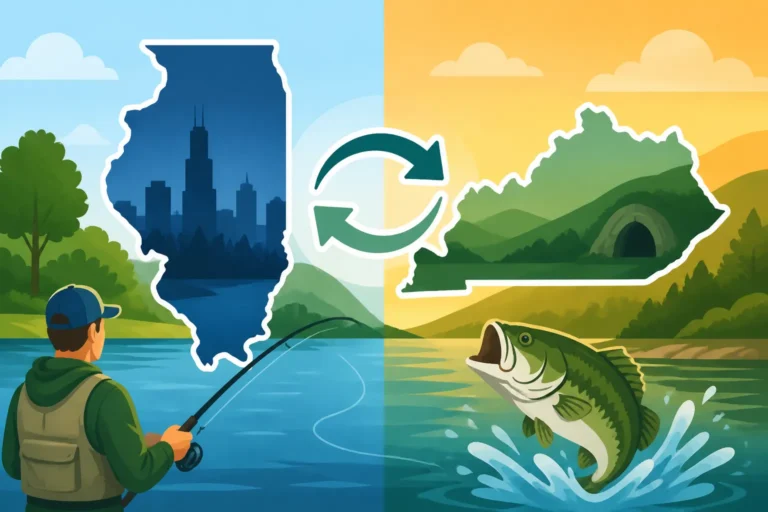
The Ohio River operates under a similar reciprocal agreement to the Mississippi and Wabash. If you possess a valid fishing license from Illinois or Kentucky, you are generally permitted to fish the entire main channel of the Ohio River. This makes it convenient for anglers on both sides to access the excellent catfish, bass, and panfish populations that the Ohio River holds. Knowing that you can cross between Illinois and Kentucky to fish the same water with a single license saves a lot of hassle and expense. This simplifies things for folks who live near Cairo or Paducah.
However, as with all boundary water agreements, the devil is in the details. While your license might be recognized across the main channel, any embayments, tributaries, or areas clearly within the physical boundaries of one state will typically require that state's license. Always consult the Illinois Fishing Information Guide Covers April 2026 Through March 2027 or Kentucky’s fishing guides for the most current and specific regulations for particular species, as these can vary by state even within shared waters. For more on this, check out our piece on Crossing Between Illinois and Kentucky to Fish the Same Water.
Lake Michigan and Wisconsin (and Indiana, Michigan)
While not a river in the traditional sense of a "boundary water" with explicit bank-to-bank reciprocity for river fishing, Lake Michigan is a massive shared resource bordering Illinois, Wisconsin, Indiana, and Michigan. Angling here requires a different understanding of interstate rules.
Illinois anglers primarily fish the Illinois portion of Lake Michigan. If you launch from a harbor like Chicago's DuSable Harbor or Waukegan and stay within Illinois waters, your standard Illinois fishing license and appropriate stamps (like the Lake Michigan Salmon Stamp Requirements for Anglers) are all you need. However, if you venture into the waters of Wisconsin, Indiana, or Michigan, you absolutely need to possess the appropriate license and stamps from that state. There isn't a broad reciprocal agreement like on the rivers that allows a single license to cover the entire lake for all states. Each state manages its portion of the Great Lakes quite distinctly.
For instance, if you're trolling for salmon and cross into Wisconsin waters, you'd need a valid Wisconsin fishing license. This is particularly relevant for charter boats or private vessels that might travel significant distances. While there are some general agreements about interstate fisheries management and stocking efforts for the lake as a whole, individual angler licensing remains state-specific once you leave your home state's jurisdictional waters. This is a common point of confusion, so always check the specific rules if you plan on fishing near a state line on Lake Michigan. You can read more about fishing border waters in our guide on Fishing Border Waters With a Wisconsin License.
Navigating Licensing and Regulations
Successfully fishing Illinois's boundary waters means being prepared, not just with your rods and reels, but with the right knowledge and documentation. It's about proactive planning to avoid any unexpected issues.
Understanding Reciprocity Agreements
Reciprocity agreements are fantastic tools for anglers, simplifying access to shared waterways. They mean that instead of needing two separate state fishing licenses to fish a river that forms a state border, often one license is sufficient. For example, on certain stretches of the Mississippi River, an Illinois resident can fish with their Illinois license, and an Iowa resident can fish with their Iowa license, and both are valid across the entire width of the river. This is the essence of Illinois Fishing License Reciprocity With Iowa.
However, it's vital to grasp what these agreements don't always mean. They often apply strictly to the main stem of the river and sometimes the immediate contiguous backwaters. They usually do not extend to tributaries that flow entirely within one state's borders, or to lakes and ponds that are fully contained within a single state, even if they're close to the border. Furthermore, while the license might be reciprocal, the fishing regulations—like catch limits, size minimums, or tackle restrictions—can still differ and often default to the regulations of the state in whose waters you are physically located, or to the most restrictive of the two. This is why it's so important to consult a comprehensive Illinois Fishing Regulations Overview and the specific regulations of the neighboring state. Always carry both states' regulation guides or have digital access to them.
Site-Specific Rules and the Illinois Fishing Information Guide
Even within Illinois, and certainly within boundary waters, fishing rules can vary dramatically from one body of water to another. This is where site-specific regulations come into play. It's not enough to know the statewide bass limit; you need to know if the lake or river stretch you're on has its own unique rules. Our article on Why Fishing Rules Vary by Lake and River explains this in more detail. Many larger reservoirs, state park lakes, and specific stretches of rivers will have special regulations designed to manage their unique fisheries.
The single most important document for any Illinois angler, especially those venturing into boundary waters, is the Illinois Fishing Information Guide. This guide, published annually by the IDNR, contains all the statewide regulations, specific site rules, and details on reciprocity agreements. You can usually pick up a physical copy at bait shops, sporting goods stores like those found on Amazon, or IDNR offices, or download a digital version from the IDNR website. Always make sure you're referencing the most current guide; for instance, the Illinois Fishing Information Guide Covers April 2026 Through March 2027 will be critical for your trips in the upcoming season. It’s an angler’s bible, packed with crucial details for every fish species and body of water.
Essential Gear and Documentation for Border Water Angling
Beyond your typical fishing gear, there are a few essentials you'll want to have when venturing into Illinois's boundary waters. First and foremost, always have your valid Illinois fishing license readily accessible. Digital copies on your phone are generally accepted, but a printed copy can save a lot of hassle if your phone battery dies or signal is spotty. It's also wise to have a form of ID, as game wardens may ask for it to verify your residency and license.
Secondly, always carry the current fishing regulations for both Illinois and the bordering state you might be interacting with. As mentioned, even with reciprocity, specific catch limits can differ. A waterproof bag for these documents is a smart investment. If you're boating, ensure all your Illinois boating safety gear checklist items are in order, including appropriate life jackets, throwable PFDs, and sound-making devices, as these rules are usually tied to your boat's registration state. Being prepared with all your paperwork and safety gear not only keeps you legal but also ensures a stress-free and enjoyable day on the water.
Here’s a quick overview of key boundary water reciprocity for Illinois:
| Boundary Water | Bordering State | Typical License Reciprocity | Key Considerations |
|---|---|---|---|
| Mississippi River | Iowa | IL or IA license covers main channel & contiguous backwaters | Fishing regulations (limits, sizes) usually follow the state you're fishing in, or most restrictive. |
| Mississippi River | Missouri | IL or MO license covers main channel & contiguous backwaters | Same as Iowa: check specific regulations for limits and sizes. |
| Wabash River | Indiana | IL or IN license covers main channel | Does not typically cover tributaries or embayments fully within one state. Check site-specific rules. |
| Ohio River | Kentucky | IL or KY license covers main channel | Similar to Wabash, focus on the main channel. Specific regulations may vary by state. |
| Lake Michigan | Wisconsin/IN/MI | No general reciprocity; need license from state you're fishing in | Each state manages its portion distinctly. Specific stamps often required (e.g., salmon stamp). |
What Happens When You Break the Rules
Nobody wants to get a ticket while they're out enjoying a peaceful day of fishing. Unfortunately, ignorance of the law is rarely an excuse, especially when it comes to boundary water regulations. Understanding the potential consequences can serve as a strong motivator to do your homework before heading out.
Penalties for Fishing Without a License
Fishing without a valid license, or fishing in a reciprocal water body with an invalid license for that particular area or condition, can lead to significant penalties. In Illinois, getting a citation for fishing without a license in Illinois often results in a fine, which can be quite substantial. It's not just a slap on the wrist. Additionally, game wardens have the authority to confiscate your fishing gear, and in some cases, your catch. Imagine losing your favorite rod and reel, and having to pay a hefty fine on top of that, all because you didn't realize your license wasn't valid on a specific stretch of the river.
The cost of a fishing license is a tiny fraction of what a fine would be. For example, an annual resident license is very affordable compared to a multi-hundred-dollar fine. It’s simply not worth the risk. Always make sure your license is current and applicable to the waters you intend to fish. Our How to Get an Illinois Fishing License guide can walk you through the simple steps to ensure you're always properly covered. Taking a few minutes to confirm your license status can save you a world of trouble and financial strain.
Violating Catch Limits and Other Regulations
Beyond licensing, violating catch limits, size restrictions, or specific bait/tackle regulations can also lead to serious trouble. For instance, if you're fishing the Mississippi River and the Illinois Walleye Size and Catch Limits allow for six fish over 14 inches, but the Missouri regulations for that specific pool only allow four fish over 15 inches, and you keep five 14.5-inch walleye while in Missouri waters, you could be cited. These are the kinds of nuanced situations that game wardens patrol for, and they are well-versed in the interstate agreements.
The consequences for violating catch limits can be similar to fishing without a license: fines, forfeiture of your catch, and potentially even your gear. Repeated offenses can lead to more severe penalties, including suspension of your fishing privileges. It's a sobering thought, but one that emphasizes the importance of knowing the rules, especially when you're on waters that are essentially shared jurisdiction. Always check the Illinois Fishing Season and Catch Limit Rules and the rules of the adjacent state for the most up-to-date information before you hit the water. It’s better to err on the side of caution and release a fish if you're unsure about its legality or your personal limit.
Disclaimer
The information provided in this guide is for general informational purposes only and does not constitute legal advice. Fishing regulations are subject to change, and it is the responsibility of each angler to consult the official Illinois Department of Natural Resources (IDNR) publications and the relevant publications of bordering states for the most current and accurate information before fishing. Always verify specific rules and reciprocity agreements for the exact body of water you plan to fish.