Fish Finders for Illinois Lake Fishing
Many Illinois anglers know the frustrating feeling of spending hours on the water, casting blindly, and wondering if there are any fish around at all. Whether you're drifting across the open expanses of Lake Shelbyville or navigating the brushy coves of Rend Lake, it's easy to feel like you're playing a perpetual game of hide-and-seek with the fish. This guide is dedicated to pulling back the curtain on fish finders, equipping you with the knowledge to understand, choose, and effectively use these incredible tools to turn your Illinois fishing trips from guesswork into strategic, successful outings.
What Exactly Is a Fish Finder and How Does It Work?
At its core, a fish finder is your underwater eyesight. It takes the mystery out of what lies beneath your boat or even right off the bank. Gone are the days of relying solely on intuition or local legend; with a fish finder, you get a real-time glimpse into the aquatic world, seeing structure, depth, and, yes, even the fish themselves. It's a game-changer for anyone serious about improving their catch rate.
The Magic of Sonar: Sending Out Sound Waves
The fundamental principle behind every fish finder is sonar, which stands for SOund NAvigation and Ranging. Think of it like a bat echolocating in the dark. Your fish finder sends out pulses of sound waves from a device called a transducer. These sound waves travel through the water until they hit an object – whether that's the bottom, a submerged tree, a school of baitfish, or your target species like a big largemouth bass. When the sound waves hit an object, they bounce back as an echo to the transducer.
The fish finder then measures the time it took for the sound wave to go down and come back up. Since it knows the speed of sound in water, it can accurately calculate the distance to that object. The faster the echo returns, the shallower the object. This constant process of sending and receiving pulses, all happening incredibly fast, creates a continuous picture of the underwater environment on your display screen. It's a truly fascinating bit of technology that, when you understand it, makes finding fish much less daunting.
The Transducer: The Heart of the Operation
If sonar is the magic, the transducer is the magician's wand. This seemingly simple device is probably the most critical component of your fish finder system. It's responsible for both sending out those sound waves and receiving the returning echoes. The placement and quality of your transducer directly impact how well your fish finder performs. A poorly mounted transducer can lead to a fuzzy, unreliable display, no matter how expensive your head unit is.
Transducers come in various forms, designed for different mounting applications. The most common is a transom mount, which attaches to the back of your boat. There are also trolling motor mounts, popular with bass anglers for their clean readings, and even in-hull transducers that shoot right through the fiberglass, offering protection but with some signal loss. For kayak anglers, specialized portable or clamp-on transducers are often the go-to. No matter your setup, ensuring your transducer has a clear, unobstructed "view" of the water beneath your boat is paramount to getting accurate and useful readings.
Interpreting the Display: From Arches to Bottom Structure
When you first look at a fish finder screen, it can seem like a jumble of colors and shapes. But once you learn to interpret what you're seeing, a whole new world opens up. The display essentially scrolls from right to left, showing you a historical view of what your boat has passed over. The bottom is usually represented by a solid band at the bottom of the screen, with its thickness and color density indicating hardness. A thick, bright line often means a hard bottom, like rock or gravel, while a thinner, softer line suggests mud or silt.
Fish typically appear as "arches" or "boomerangs." A full, strong arch indicates a fish that passed through the sonar cone from one side to the other, often a larger fish. Shorter lines or partial arches could be smaller fish, or fish that just barely clipped the edge of the cone. Schools of baitfish often show up as dense clouds or blobs. Beyond fish, you'll see "structure" – submerged trees, brush piles, rock humps, ledges, and even artificial fish attractors. Learning to differentiate between these elements is key to identifying potential holding areas for your target species, helping you find those sweet spots whether you're after Illinois Walleye Fishing: The Complete Guide or a trophy Largemouth Bass Fishing in Illinois: The Complete Guide.
Decoding the Different Types of Fish Finders for Illinois Lakes
The world of fish finders has expanded dramatically over the years, moving far beyond just simple depth readings. Today, you have a range of technologies, each offering unique advantages depending on your fishing style and the waters you explore in Illinois. Understanding these distinctions is crucial for making an informed purchase that truly elevates your angling game.
Traditional 2D Sonar: The Tried-and-True Workhorse
Traditional 2D sonar, often called "broadband" or "CHIRP" sonar on modern units, is what most people picture when they think of a fish finder. This technology uses a conical beam of sound waves to scan the water column directly beneath your boat. Modern 2D sonar, especially CHIRP (Compressed High-Intensity Radiated Pulse) variations, is incredibly powerful, offering excellent target separation and clarity. It excels at showing you fish arches, bait balls, and the overall contour of the bottom.
You'll often have options for different cone angles. A wider cone covers more area but sacrifices some detail, making it good for scanning large sections of water, like when searching for schools of crappie on Rend Lake. A narrower cone provides more detailed returns directly beneath your boat, perfect for pinpointing individual fish or specific pieces of structure. While it might not give you the photographic detail of newer technologies, 2D sonar remains an indispensable tool for identifying fish and understanding depth, and it's a feature you'll find on virtually every fish finder on the market, from entry-level to high-end units.
Down Imaging and Side Imaging: Seeing What's Beneath and Around You
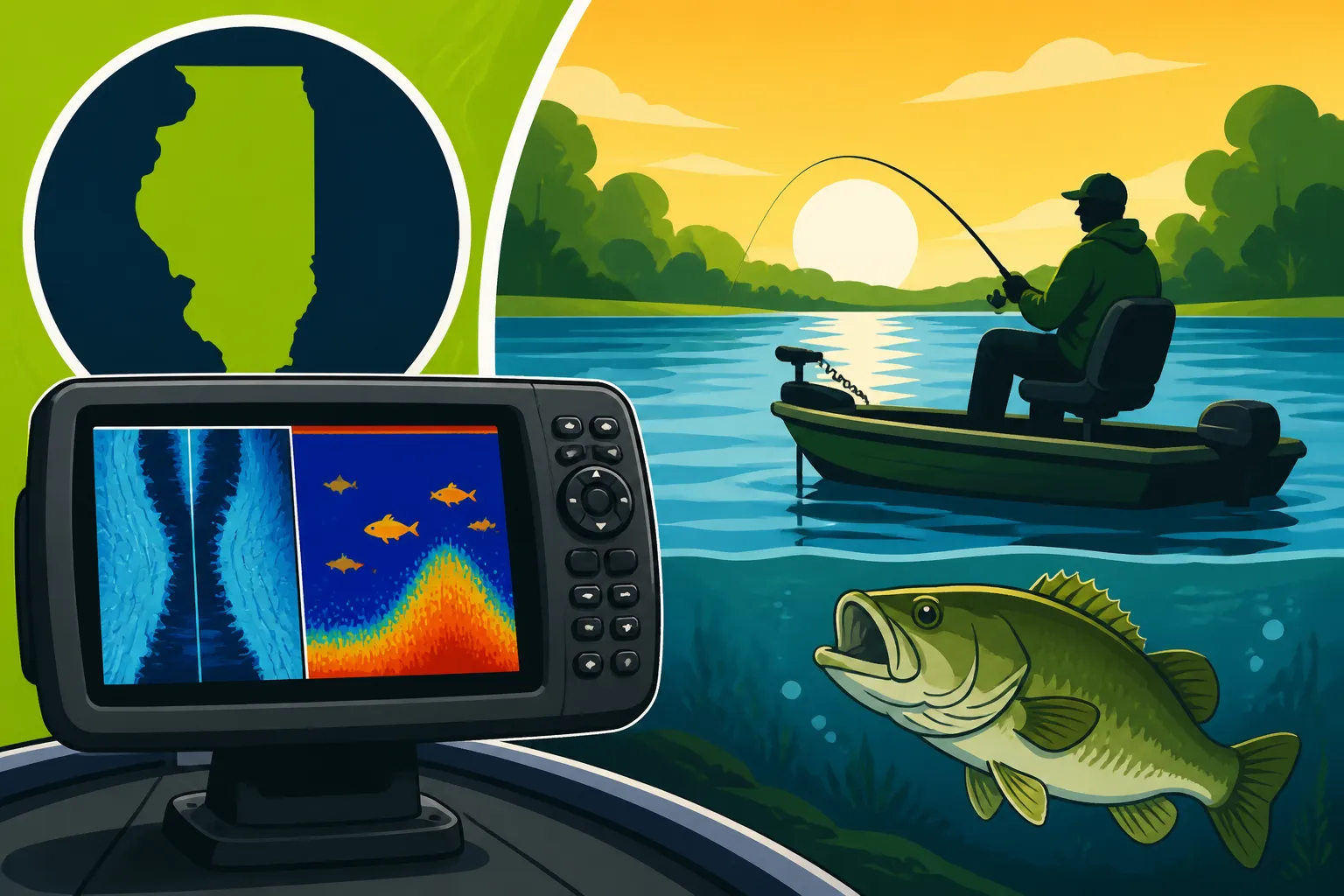
This is where fish finder technology really started to push boundaries, offering views that truly transform how you understand the underwater landscape. Down Imaging (sometimes called DownScan or ClearVü) uses a very thin, high-frequency beam that acts like an X-ray directly beneath your boat. The result is a photo-like image of the bottom structure, clearly showing individual tree limbs, rock piles, and even fish relating to them. You can literally see a bass sitting next to a submerged log rather than just an ambiguous arch.
Side Imaging (or SideScan, StructureScan) takes this concept and expands it outwards, allowing you to scan vast areas to the left and right of your boat. Instead of just seeing what you're directly over, you can see hundreds of feet in either direction, revealing brush piles, sunken boats, rock ledges, and schools of fish off to the side. This is an absolute game-changer for efficiency, letting you cover a wide area quickly, like when searching for a submerged creek channel in Lake Shelbyville or scouting the weed lines for pike on the Mississippi. Many anglers combine 2D, Down Imaging, and Side Imaging on split screens to get the most comprehensive view possible, painting a full picture of the terrain.
GPS Combo Units: Navigation and Fish Finding in One
For many anglers, a fish finder without GPS is like a car without a steering wheel. Most modern fish finders are actually "combo units" that integrate full-featured GPS mapping and chartplotting capabilities right into the display. This means you not only see the fish, but you also see your boat's position on a detailed map, complete with contours, navigational markers, and even satellite imagery on some high-end models. This is particularly valuable on large, complex Illinois lakes where precise navigation is key.
The ability to drop "waypoints" is one of the biggest advantages of a GPS combo unit. When you find a promising brush pile, a school of baitfish, or even catch a fish in a productive spot, you can instantly mark that location. This allows you to return to that exact spot later, whether it's an hour later, the next day, or even next season. You can also track your trolling paths, navigate safely through channels, and avoid hazards. For serious anglers fishing anywhere from Lake of Egypt to Lake Michigan, a robust GPS system is almost as important as the sonar itself, making these units incredibly versatile tools for Best Fishing Spots in Illinois.
Key Features Every Illinois Angler Should Prioritize
When you start looking at fish finders, the sheer number of options and technical specifications can feel overwhelming. It's easy to get caught up in the jargon. However, for fishing our diverse Illinois waters, from shallow ponds to deep reservoirs, a few key features stand out as truly impactful for your success on the water. Focusing on these will help you narrow down your choices and invest in a unit that genuinely meets your needs.
Screen Size and Resolution: Clarity is King on the Water
Imagine trying to read a blurry map in bright sunlight – not ideal, right? The same goes for your fish finder. Screen size and resolution are paramount for clear, easy-to-read images, especially when you're dealing with detailed Down or Side Imaging. A larger screen (think 7 inches or more) provides more real estate to display information, which is a huge benefit if you plan to use multiple views simultaneously, like a split screen showing 2D sonar, Down Imaging, and your GPS map.
Resolution, measured in pixels (e.g., 800×480, 1024×768), determines the sharpness and detail of the image. Higher resolution means more pixels, leading to crisper images and better target separation. This allows you to distinguish a fish from a piece of structure more easily or see individual tree limbs within a submerged brush pile. Investing in a unit with a good screen, even if it means a slightly higher upfront cost, will pay dividends in reduced eye strain and more accurate interpretation of the underwater world, especially during those long, sunny days on the water.
Power (Wattage) and Frequency: Deeper Dives and Finer Details
These technical specs might sound intimidating, but they directly relate to how well your fish finder can perform in different situations. Power, typically measured in RMS (Root Mean Square) wattage, determines how deep your sonar can effectively reach and how quickly it can transmit and receive signals. Higher wattage means more power, which translates to better performance in deeper water and at higher boat speeds. If you're planning to fish deep reservoirs like Clinton Lake or explore the depths of Lake Michigan, a unit with higher wattage is definitely something to prioritize.
Frequency refers to the pitch of the sound waves your transducer emits. Different frequencies are good for different tasks:
- Low Frequencies (e.g., 50 kHz or 83 kHz): These waves penetrate deeper and cover a wider cone, making them excellent for deep water fishing and general scouting, but they offer less detail.
- High Frequencies (e.g., 200 kHz or 455/800 kHz): These provide much greater detail and target separation but don't penetrate as deep and have a narrower cone. They are ideal for shallow water, identifying structure, and seeing individual fish.
- CHIRP Sonar: Many modern units use CHIRP technology, which sweeps across a range of frequencies instead of just one. This allows for incredibly detailed, high-resolution images with excellent target separation at various depths.
The best fish finders often offer multiple frequencies or CHIRP, giving you the versatility to adapt to different depths and conditions, ensuring you get the best possible picture of the fish and structure below, no matter what part of the state you're fishing.
Mapping and Chartplotting Capabilities: Navigating Illinois Waters with Confidence
For many Illinois anglers, especially those venturing onto larger bodies of water, detailed mapping is just as important as the fish-finding sonar itself. Mapping and chartplotting capabilities provide an overlay of your boat's position on a topographical map of the lake or river. These maps often include depth contours, navigational aids, and points of interest. Some units come with pre-loaded maps, while others require purchasing additional map cards. Brands like Humminbird and Lowrance offer excellent mapping options.
The real power of these features lies in their ability to help you locate and stay on productive structure. You can see ledges, humps, creek channels, and submerged roadbeds on the map before you even drive over them. This allows you to plan your attack, troll precise contours, and return to specific areas repeatedly. Many units allow you to customize these maps, adding your own waypoints and trails, which is incredibly useful for remembering those "honey holes" you discover. Whether you're navigating the sprawling backwaters of the Mississippi River or looking for a specific depth break in a state park lake, good mapping capabilities are a crucial tool for both safety and success, helping you understand Why Fishing Rules Vary by Lake and River.
| Feature Type | Key Benefit | Ideal For | Common Use in Illinois |
|---|---|---|---|
| Screen Size | Easy viewing, multi-screen layouts | All anglers, especially split-screen users | Monitoring sonar and GPS simultaneously |
| Resolution | Clear, detailed images, target separation | Anglers needing precise structure ID | Distinguishing fish from cover in murky water |
| Power (Wattage) | Deep water penetration, high-speed performance | Deep lakes, large reservoirs, fast trolling | Finding fish in Lake Michigan depths |
| Frequency | Versatility for various depths and detail | Adapting to different fishing conditions | Switching from shallow crappie to deep walleye |
| Mapping/GPS | Navigation, waypoint marking, structure identification | Large lakes, unfamiliar waters, precision fishing | Locating submerged creek channels on Carlyle Lake |
| Down Imaging | Photo-like view of structure directly below | Pinpointing fish on specific cover | Identifying bass holding tight to a tree trunk |
| Side Imaging | Wide area scanning, finding distant structure | Covering large areas quickly, scouting | Finding distant brush piles on Rend Lake |
Choosing the Right Fish Finder for Your Illinois Fishing Style
There's no one-size-fits-all fish finder. The best unit for you will depend heavily on how you fish, where you fish, and what species you typically target. An avid tournament bass angler in a high-performance boat will have vastly different needs than someone who enjoys leisurely bank fishing with their kids. Let's break down some common Illinois fishing scenarios and the fish finders that fit them best.
For the Kayak and Small Boat Enthusiast
Kayak fishing is exploding in popularity across Illinois, offering a quiet, intimate way to explore countless lakes and rivers. However, space and power are often at a premium. For kayak and small boat anglers, portability, compact size, and efficient battery usage are paramount. You'll want a unit that doesn't overwhelm your limited deck space and can run for hours on a small 12V battery. Many popular models are available from retailers like Bass Pro Shops or online at Amazon that fit these criteria.
Look for units with a 5-inch or 7-inch screen that offers 2D sonar and ideally Down Imaging. Side Imaging, while useful, might be overkill for many kayak applications due to the slower speeds and limited mounting options for optimal wide-beam coverage. Consider models with easy-to-install transducer mounts, such as those that attach directly to a trolling motor or scupper hole. Integrated GPS is also a huge plus for marking those productive spots, especially on larger paddling destinations like the Fox River or Kankakee River. Battery-powered castable sonar units are also a fantastic portable option for Kayak Fishing Gear for Illinois Waters if you don't want to deal with mounting hardware.
For the Dedicated Bass or Walleye Boat Angler
If you're running a fiberglass bass boat or a multi-species rig, your needs are at the other end of the spectrum. You're likely looking for maximum performance, detail, and connectivity. Dedicated bass and walleye anglers often fish large reservoirs and navigate complex structures, demanding the highest-end technology. This is where large, high-resolution screens (9 inches and up), networked systems, and advanced sonar technologies truly shine.
You'll want a unit, or ideally multiple units, that offer full 2D CHIRP sonar, Down Imaging, and Side Imaging. Many serious anglers run two units – one at the bow (often linked to a trolling motor transducer) for up-close structure scanning and one at the console for high-speed navigation and deep water scanning. High wattage is important for deep water detection, and precise GPS mapping with custom contour capabilities is essential for staying on those subtle breaks or pinpointing submerged humps where Illinois Walleye Fishing: The Complete Guide states they might be. Look for units that support networking, allowing transducers, GPS, and even engine data to be shared between multiple displays for a seamless fishing experience.
Bank Fishing and Portable Options: Don't Get Left Out!
Just because you don't have a boat doesn't mean you can't benefit from fish finder technology! Bank anglers face the challenge of not knowing what's out of casting range or what the immediate drop-off looks like. This is where portable and castable fish finders come into their own. Castable sonar devices are small, spherical units that you tie to your fishing line and cast out. They float on the surface, transmit sonar data wirelessly via Bluetooth or Wi-Fi to your smartphone or tablet, and show you depth, structure, and fish directly on your screen.
These are incredibly versatile for scouting new spots from shore, determining depth, and identifying submerged cover in ponds, small lakes, or riverbanks. They're also fantastic for ice fishing, offering a portable way to see what's directly beneath your hole. While they don't offer the detailed mapping or extensive range of boat-mounted units, they provide invaluable real-time information that can dramatically improve your success from shore. For those who frequent Best Bank Fishing Spots in Illinois, a castable unit is a low-cost, high-impact tool to add to your arsenal.
Getting Your Fish Finder Set Up and Ready to Roll
Once you've made the exciting decision to purchase a fish finder, the next crucial step is getting it properly installed and configured. A top-of-the-line unit is only as good as its setup. Many anglers overlook this phase, leading to frustrating performance issues. Taking the time to do it right from the start will save you headaches and ensure you're getting the most out of your investment on the water.
Mounting Your Transducer: Placement is Everything
The transducer is your fish finder's eye, and its placement is absolutely critical for clear, accurate readings. The primary goal is to ensure the transducer is in clean, "bubble-free" water flow, especially when your boat is moving. For transom mounts, this usually means placing it on the lowest part of the transom, just above the bottom of the hull, making sure it's not in line with any strakes, rivets, or the prop wash, which can create turbulence and interfere with the sonar signal. It should be submerged enough to maintain contact with the water at speed but not so deep that it creates excessive spray.
For trolling motor mounts, the transducer typically bolts directly to the bottom of the motor housing. This is often an ideal location because the trolling motor is usually deployed when you're moving slowly or holding position, providing a very clean water signal. In-hull or shoot-through transducers, while offering protection, require careful placement in a section of solid fiberglass without air pockets. Always follow the manufacturer's specific instructions, as incorrect mounting is the number one cause of poor fish finder performance. Remember, a clear view for the transducer means a clear picture for you.
Powering Your Unit: Battery Life and Wiring Tips
Your fish finder needs a reliable power source to operate effectively. Most units run on a 12-volt DC system, typically drawing power from a marine battery. The key here is to ensure you have a dedicated power circuit with appropriately sized wiring and an in-line fuse to protect your unit from electrical surges. Avoid wiring your fish finder directly to your boat's starting battery if possible, especially if you plan on long fishing days or running multiple electronics. A separate "house" battery or a dedicated deep-cycle battery for your electronics is always recommended to prevent draining your starting battery.
For kayak and portable setups, compact sealed lead-acid (SLA) or lithium-ion (LiFePO4) batteries are excellent choices. Lithium batteries are lighter and offer longer run times but come with a higher price tag. Always ensure your wiring connections are clean, secure, and waterproof to prevent corrosion and intermittent power issues. Nothing is more frustrating than your fish finder cutting out just as you're over a promising school of fish! Proper wiring not only ensures consistent performance but also protects your valuable electronics investment.
Initial Settings and Fine-Tuning for Optimal Performance
Once your fish finder is physically installed and powered up, it's time to dive into the settings. While many units have excellent "auto mode" features, taking a few minutes to fine-tune your settings can significantly enhance performance.
- Sensitivity: This controls how much detail the sonar picks up. Too low, and you'll miss faint echoes (like small baitfish or subtle structure). Too high, and you'll get excessive noise and clutter on the screen. Start around 70-80% and adjust in small increments.
- Noise Rejection: This filter helps eliminate unwanted interference from other electronics (like your trolling motor) or engine noise. Experiment with different levels until your screen is clear without losing detail.
- Color Palette: Modern fish finders offer various color schemes. Choose one that provides the best contrast and clarity for your eyes, especially in different lighting conditions. A good palette makes it easier to distinguish fish from structure.
- Scroll Speed: This dictates how fast the image moves across your screen. Match it to your boat speed; a faster scroll speed at higher boat speeds gives a more accurate representation.
Don't be afraid to play with these settings on the water. What works best in a shallow, calm bay might not be ideal in deep, choppy conditions. Taking the time to understand and adjust these parameters will unlock your fish finder's full potential, helping you precisely locate species whether you're targeting Illinois Bass Pre-Spawn Timing at Rend Lake or deep-water catfish.
Mastering Your Fish Finder: Beyond the Basics
Buying a fish finder is just the first step; truly mastering it takes practice and a willingness to learn. Many anglers scratch the surface of what these devices can do, but with a bit of dedication, you can transform your unit from a simple depth finder into an invaluable tool for unlocking the secrets of Illinois's waters. It's about moving beyond just seeing "blobs" and starting to read the underwater landscape.
Interpreting Fish Arches and Structure: Reading the Underwater World
We talked about fish appearing as arches, but there's more to it. The shape, thickness, and even the "strength" of an arch (often indicated by color intensity) can tell you a lot. A thick, well-defined arch usually signifies a larger fish. If the arch is suspended above the bottom, it's a fish actively feeding or holding in the water column. If it's tightly "glued" to the bottom, it might be a bottom-dwelling species or a fish hunkering down. Distinguishing between fish and debris, especially in areas with a lot of submerged vegetation or timber, comes with practice.
More importantly, learn to identify different types of structure. Is that a submerged tree, a rock pile, a brush pile, or a dense bed of weeds? Each type of structure holds different species at different times. A dark, jagged return might indicate rock, while a fuzzy, less defined return could be a brush pile or weeds. Observing how fish relate to this structure – are they on top, to the side, or suspended above it? – is key to understanding their behavior. This insight is critical, whether you're chasing Best Bass Fishing Lakes in Illinois or Best Crappie Fishing Lakes in Illinois. Don't just look for fish, look for why they might be there.
Using Waypoints and Trails: Marking Your Honey Holes
The GPS capabilities on your fish finder are far more than just navigation; they are your personal diary of productive fishing spots. Whenever you find something interesting on your sonar – a brush pile loaded with crappie, a school of baitfish, a rocky point where you caught a walleye, or even a sudden depth change – immediately drop a waypoint. Give it a descriptive name (e.g., "Crappie Brush 15ft," "Walleye Rock Hump," "Bass Tree"). These waypoints become your personal treasure map, allowing you to return to those exact coordinates with precision, even if conditions change or you're fishing a vast, featureless area.
Additionally, use the "trail" or "track" feature to record your boat's path. This is invaluable for patterning fish. You can see exactly what depth or contour you were following when you got bites, allowing you to replicate successful drifts or trolling passes. Reviewing your trails and waypoints after a trip helps you analyze patterns and plan future excursions, making you a more efficient and successful angler. This feature is particularly useful for tournament anglers who need to revisit precise spots.
Understanding Water Temperature and Depth: Key to Finding Fish
While fish finders are great for showing you fish and structure, they also provide crucial environmental data like water temperature and depth. These aren't just numbers; they are vital clues that can help you understand fish behavior and predict where they might be. Different species have preferred temperature ranges. For instance, bass become active and start to spawn when water temperatures hit certain thresholds. Crappie will move shallower as the water warms up in spring.
Depth is equally important. Fish will often relate to specific depths depending on the time of day, season, and available cover. Knowing the exact depth of a hump, a creek channel, or a weed line allows you to present your bait at the perfect level. Your fish finder's temperature gauge can also help you identify thermoclines – distinct layers of water with different temperatures – which are often key areas where baitfish and game fish congregate during warmer months. Combining sonar images with temperature and depth readings creates a holistic understanding of the underwater environment, giving you a powerful edge and informing your decisions based on the Water Temperature and Fish Activity Guide.
Disclaimer
This article is for general informational purposes only and does not constitute professional advice. Laws, prices and regulations vary by location and change over time. Consult a qualified professional for guidance on your specific situation.