Does an Iowa Fishing License Work on the Mississippi River Near Illinois?
Anglers often face a head-scratching dilemma when casting a line in boundary waters, especially along the mighty Mississippi River, where state lines blur on the water. It’s easy to get confused about whether your Iowa fishing license holds up when you’re technically on the Illinois side or if you’ve ventured into a shared zone. This guide aims to clear up that common frustration, diving deep into the specifics of Illinois and Iowa fishing license reciprocity on the Mississippi River.
The Nuance of Border Water Fishing Licenses
Fishing in waters that form a boundary between states, like the Mississippi River between Illinois and Iowa, introduces a layer of complexity to licensing. It’s not as simple as needing a license for every state whose water you might touch; instead, specific agreements often come into play.
Understanding Reciprocity Agreements
Reciprocity in the world of fishing licenses basically means that if you hold a valid fishing license from one state, it might be recognized as valid in certain shared waters of an adjacent state. These agreements are fantastic because they prevent anglers from needing to buy multiple licenses just to fish a single body of water that happens to be a state line. However, these agreements aren't universal, and their terms can be quite precise, defining exactly which portions of the water are covered and under what conditions. For instance, the Mississippi River is a prime example of where these agreements are critical. Without them, fishing the vast expanse of the river would be a bureaucratic nightmare for anyone living close to the border.
Where the Mississippi River Becomes a Shared Zone
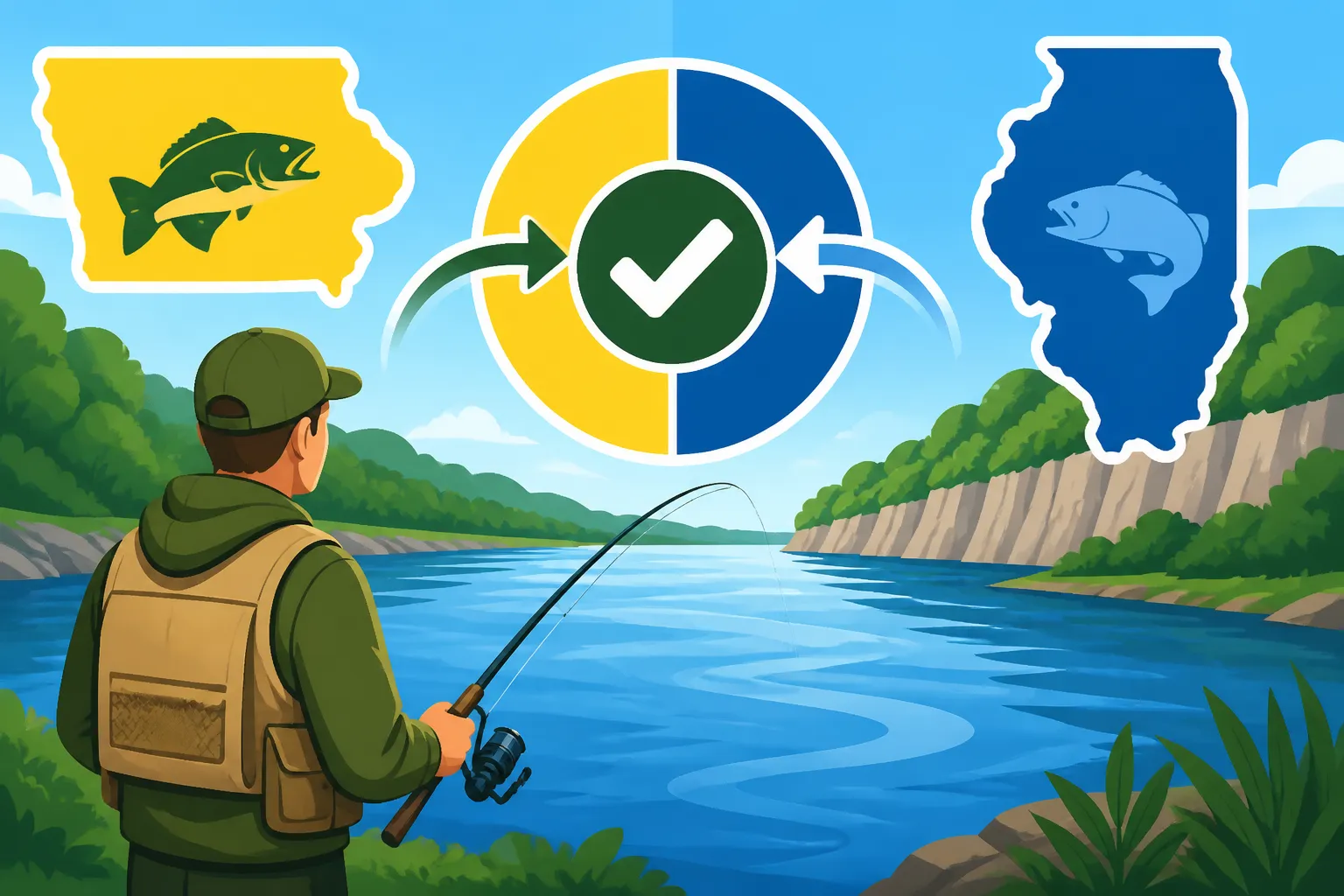
The Mississippi River forms the entire western border of Illinois, stretching for hundreds of miles from Dubuque, Iowa, down to Cairo, Illinois, where it meets the Ohio River. Along the lengthy stretch where it borders Iowa, the river is largely considered a shared waterbody for fishing license purposes. This means that for the most part, if you're out on the main channel of the Mississippi River, or in many of its backwaters and sloughs that are directly connected to the main channel, a valid fishing license from either Illinois or Iowa should be sufficient. This shared zone typically extends to what's defined as the ordinary high water mark on both sides of the river, encompassing the main flow, islands, and connected backwater lakes. It's truly a unique setup that allows for much more freedom and less hassle for local anglers.
Illinois and Iowa Reciprocity: The Specifics
While the general idea of reciprocity is comforting, the devil is in the details. Knowing exactly what your Iowa license covers and when an Illinois license becomes necessary is paramount to avoiding an unexpected encounter with a conservation officer.
What an Iowa License Covers on the Mississippi
If you possess a valid Iowa fishing license, you are generally covered to fish the main stem of the Mississippi River that borders Illinois. This includes fishing from a boat anywhere in the main channel, and often extends to the connected backwaters, sloughs, and side channels. For instance, if you launch your boat from a ramp near Davenport, Iowa, and motor out into the main river, your Iowa license is good to go, even if you drift over what might be considered the "Illinois side" of the river. This also typically applies if you're fishing from the Iowa bank, and your line extends into the main channel.
However, it's crucial to understand that "connected backwaters" usually implies waters directly accessible from the main river by boat, without passing over dry land. These agreements are designed to facilitate ease of access for those who primarily fish the river itself. So, whether you're chasing Channel Catfish with a hefty setup or trying to land a Walleye, as long as you're in the designated reciprocal waters, your Iowa license should be sufficient. You can often find official guides, sometimes available on platforms like Amazon, that further detail these specific boundary agreements.
When You Still Need an Illinois License
Here's where many anglers can get tripped up. While your Iowa license is valid in the shared waters of the Mississippi River, it absolutely does not cover you if you step onto Illinois soil to fish, or if you venture into waters that are definitively considered non-reciprocal Illinois territory.
Consider these common scenarios where an Illinois fishing license is required, even if you have an Iowa license:
- Fishing from the Illinois Bank: If you're casting from the shore, a dock, or any land-based structure on the Illinois side of the river, you must have an Illinois fishing license. Your Iowa license offers no protection once your feet are firmly planted in Illinois.
- Fishing Illinois Tributaries: Any river, stream, or lake that flows into the Mississippi River from Illinois, but is not part of the immediately connected backwater system defined by the reciprocity agreement, requires an Illinois license. For example, if you decide to fish the Rock River or the Illinois River upstream from their confluence with the Mississippi, your Iowa license won't cut it.
- Fishing Isolated Illinois Backwaters: Some backwater lakes and sloughs on the Illinois side might become isolated from the main river during periods of low water, or they might be state-managed waters that are explicitly excluded from reciprocity agreements. If there's any doubt, it's always safer to assume you need an Illinois license. Always check the current Illinois Fishing Information Guide for precise details on site-specific rules, as these can vary.
- Fishing in Illinois State Park Lakes: Lakes within Illinois State Parks, even if relatively close to the Mississippi, are typically managed solely by the Illinois Department of Natural Resources (IDNR) and require an Illinois license.
The key takeaway is that an Iowa license grants you access to the river itself and its immediately connected fringes, but not the sovereign land or truly separate water bodies of Illinois. Understanding these distinctions is crucial, especially as penalties for fishing without a license in Illinois can range from significant fines to confiscation of gear.
Navigating Different State Regulations
Even within the shared waters of the Mississippi River, anglers often grapple with conflicting regulations regarding catch limits, size restrictions, and fishing seasons. The general rule of thumb for these reciprocal waters is usually that you must adhere to the regulations of the state whose license you are holding.
For example, if you're fishing with an Illinois license, you must follow Illinois's statewide bass fishing limits, Walleye size and catch limits, and Illinois catfish daily limits explained in their regulations. If you're using an Iowa license, you'll be held to Iowa's rules. This can get particularly tricky if you're licensed in one state but land a fish that would be legal under the other state's rules, but not your own. Conservation officers will enforce the rules of the license you possess.
It's not uncommon for anglers to choose to obtain both licenses if they frequently traverse the river and intend to keep fish, simply to avoid any potential conflicts or confusion. This way, you can legally keep fish according to either state's regulations, assuming you possess the corresponding license and are within the shared water boundaries. However, remember that possession limits often combine catches from both states, so you can't simply double your limit by having two licenses. The most important thing is to always be informed and prepared, understanding that why fishing rules vary by lake and river.
Practical Advice for Anglers on the Mississippi River
Navigating the waters where two states meet can be confusing, but with a bit of preparation and understanding, you can enjoy all the fishing opportunities the Mississippi River has to offer without any undue stress.
Best Practices for Dual-State Anglers
For those who regularly fish the Mississippi River and find themselves moving between Illinois and Iowa waters, or even just fishing the shared main channel, there are some undeniable best practices to follow:
- Consider Both Licenses: If you frequently fish both the main channel and occasionally venture onto the banks or into tributaries of either state, seriously consider purchasing both an Illinois Fishing License Guide for 2026 and an Iowa license. This eliminates nearly all reciprocity concerns within the designated shared waters and gives you the flexibility to fish from either bank or any tributary. While this might seem like an added expense, it provides peace of mind and broadens your fishing horizons significantly.
- Stay Informed Annually: Fishing regulations, including reciprocity agreements and specific limits, can change from year to year. Before your first trip of the season, always check the most current official fishing handbooks from both the Illinois Department of Natural Resources (IDNR) and the Iowa Department of Natural Resources (Iowa DNR). These guides are often available digitally on their websites or in print at bait shops, sporting goods stores like those found through Amazon, or local IDNR offices.
- Carry Proof: Whether it's a physical printed copy or a digital version on your phone, always have proof of your valid fishing license(s) readily accessible. Conservation officers regularly patrol the Mississippi River, and they will ask to see your license. Having it handy makes their job easier and your interaction smoother.
- Know Your Location: Be aware of your exact location on the river. While a GPS unit or a good mapping app on your phone can help, understanding the local landmarks, bridges, and channel markers can also indicate whether you're firmly in reciprocal territory or have veered into state-specific waters.
Avoiding Common Pitfalls and Fines
The thrill of landing a big fish can quickly turn sour if you find yourself facing a fine for a licensing infraction. Here’s how to avoid those common pitfalls:
- Misinterpreting "Shared Waters": The most frequent mistake is assuming all waters connected to the Mississippi River are shared. Remember the distinction: reciprocal agreements typically cover the main channel and directly connected backwaters. If a body of water on the Illinois side is separated by even a small piece of dry land or clearly marked as an Illinois-only lake, an Iowa license is not valid. This is especially true for smaller ponds or specific lakes within Illinois State Park Fishing Spots.
- Forgetting About Bank Fishing: It cannot be stressed enough: if your feet are on Illinois soil, you need an Illinois license. Even if you just step off your boat onto an island that's technically part of Illinois, and you decide to cast a line, you're expected to have an Illinois license.
- Ignoring Local Site-Specific Regulations: Even within the general statewide or reciprocal rules, some lakes or river sections might have site-specific regulations. For instance, certain areas might have catch-and-release only periods on some waters, or specific slot limits for bass. Always consult the official IDNR Fishing Information Guide for any unique rules for the specific stretch of river you are fishing. This is one of the biggest reasons why checking site-specific rules before fishing an Illinois lake is so important.
- Consequences of Non-Compliance: If a conservation officer finds you fishing without a proper license in Illinois, the penalties can include fines, which can be substantial, and potentially even the confiscation of your fishing gear. It's a risk simply not worth taking. Knowing the Penalties for Fishing Without a License in Illinois can motivate you to double-check your license status.
By understanding these nuances and taking proactive steps, your fishing adventures on the Mississippi River will be enjoyable and stress-free, letting you focus on the fish rather than the paperwork.
Illinois and Iowa Mississippi River Fishing License Comparison
To make things a bit clearer, here's a quick comparison of when an Iowa fishing license is generally valid versus when an Illinois license is required while fishing the Mississippi River border waters.
| Scenario | Iowa License Valid? (on Mississippi River) | Illinois License Required? (on Mississippi River) | Notes |
|---|---|---|---|
| Fishing from a boat in the main channel | ✅ Usually | ✅ Also Valid | Both licenses are generally reciprocal in the main stem. However, you must follow the catch limits/size regulations of the state whose license you hold. |
| Fishing from Iowa shore/bank | ✅ Definitely | ❌ | If you are physically standing on Iowa land, your Iowa license is all you need. |
| Fishing from Illinois shore/bank | ❌ | ✅ Definitely | Any fishing from the physical bank or land on the Illinois side requires an Illinois license. Your Iowa license is not valid here. |
| Fishing directly connected backwaters (by boat) | ✅ Usually | ✅ Also Valid | Most backwaters directly accessible from the main river are included in reciprocity, but always verify specific locations, as some may be excluded. |
| Fishing isolated Illinois backwaters/tributaries | ❌ | ✅ Definitely | Waters clearly designated as Illinois-only (e.g., landlocked lakes, non-reciprocal tributaries) require an Illinois license. Examples include the Kankakee River Fishing Guide in Illinois or the Illinois River Fishing Guide. |
| Purchasing bait/tackle in Illinois | ✅ No license required | ✅ No license required | A fishing license is only required for the act of fishing, not for purchases. Many local bait shops (even those found with a quick search on Amazon for fishing gear) carry official guides. |
| Fishing during Illinois Free Fishing Days | ❌ | ✅ Not needed | During designated Illinois Free Fishing Days, residents and non-residents alike can fish Illinois waters without a license. This includes the Mississippi River when accessed from the Illinois side or in Illinois-only waters during that specific period. |
This table provides a general overview, but it’s always best to consult the official IDNR and Iowa DNR guides for the most current and site-specific information.
Final Thoughts on Mississippi River Licenses
Navigating the Illinois and Iowa fishing license rules on the Mississippi River doesn't have to be a source of stress. The reciprocal agreement is a fantastic resource that allows anglers from both states to enjoy the vast fishing opportunities the river offers. However, it's those edge cases—the moment you step onto the bank, or venture into a tributary—that require careful attention.
Always remember that while your Iowa license generally works in the shared main channel, fishing directly from the Illinois bank or in specific Illinois-only waters will always require an Illinois Nonresident Fishing License Guide or an Illinois resident license. Staying informed, carrying your license, and knowing your location will ensure your time on the water is spent reeling in fish, not worrying about regulations. After all, the aim is to have fun and make some great memories out on the water, whether you're targeting smallmouth bass or enjoying some Catfish bottom fishing techniques.
Disclaimer
The information provided in this guide is for general informational purposes only and is not intended as legal advice. Fishing regulations are subject to change, and it is the angler's responsibility to consult the most current official publications from the Illinois Department of Natural Resources (IDNR) and the Iowa Department of Natural Resources (Iowa DNR) before fishing. Non-compliance with fishing regulations can result in fines and penalties.