Coho Salmon vs Atlantic Salmon: How to Tell Them Apart
For any angler spending time on the vast, beautiful waters of Lake Michigan here in Illinois, one of the most rewarding pursuits is undoubtedly chasing salmon. But sometimes, when you've got a gleaming, silver torpedo flopping in your net, you might pause and wonder, "Is this a Coho or an Atlantic?" It's a common moment of confusion, especially for those new to the salmon game, and it’s a question that can actually make a big difference in how you handle your catch, from regulations to bragging rights. This guide is here to clear up that confusion, giving you all the tools you need to confidently tell a Coho salmon from an Atlantic salmon, even when they’re splashing in the bottom of your boat.
Understanding the Allure of Salmon in Illinois Waters
Lake Michigan, one of our magnificent Great Lakes, wasn't always home to salmon. The story of these powerful fish in our waters is one of intentional stocking and incredible adaptation, turning a once-struggling ecosystem into a world-class fishery. For Illinois anglers, the presence of salmon means exciting fights, delicious table fare, and the thrill of pursuing truly magnificent sportfish.
A Brief History of Salmon in Lake Michigan
Back in the 1960s, a visionary effort began to introduce Pacific salmon species, primarily Coho and Chinook, into Lake Michigan. The goal was twofold: to control an exploding alewife population, which was causing ecological imbalance, and to create a brand new sport fishery. This endeavor was a resounding success, transforming the lake into a premier salmon destination. While Pacific salmon like Coho became the backbone of this fishery, Atlantic salmon have also been periodically stocked, though in much smaller numbers and with varying success rates over the years. These efforts have provided anglers in Illinois, particularly those focusing on the Lake Michigan Salmon and Trout Fishing in Illinois fishery, with a diverse and exciting range of challenges and opportunities.
For many years, the salmon run was the highlight of the fishing calendar, drawing anglers from all over the Midwest to places like Chicago's lakefront or the harbors further north. The sheer power of these fish on the end of a line, coupled with their striking beauty, cemented their place in the hearts of Illinois anglers. It’s a privilege to pursue these fish, and understanding each species only deepens that appreciation.
Why Distinguishing Between Salmon Species Matters
At first glance, a silver-sided fish with a forked tail might just look like "a salmon" to the untrained eye. However, making an accurate identification is more than just academic; it has practical implications for every angler. First and foremost, fishing regulations, including size limits and daily creel limits, can sometimes vary between species. Mistaking one for another could lead to unknowingly violating a rule, which is something no responsible angler wants. You can always check the current Illinois Fishing Information Guide for the latest rules, or consult resources like the Illinois Fishing License Guide for 2026 to ensure you're squared away before you even cast a line.
Beyond regulations, knowing your species helps you refine your fishing techniques. Coho salmon, for example, often respond differently to lures and presentations than Atlantic salmon do. If you're targeting one but catching the other, it might indicate that your approach needs adjustment. Furthermore, many anglers have strong preferences when it comes to taste or fighting style, and recognizing what you've caught allows you to better manage your harvest or even release strategy. It truly elevates your entire experience on the water when you can confidently identify what you've hooked.
Coho Salmon: The Silver Bullet of Lake Michigan
The Coho salmon, often affectionately called "silvers" due to their striking chrome appearance, are arguably the most popular salmon species in Illinois's Lake Michigan fishery. They're known for their aggressive strikes, acrobatic fights, and tendency to patrol shallower waters, especially during certain times of the year. If you're fishing for salmon in Lake Michigan, there's a good chance you're targeting Coho.
Key Physical Characteristics of Coho Salmon
When a Coho salmon comes boatside, there are several tell-tale signs to look for. Their body shape is generally more streamlined and torpedo-like than some other salmon species.
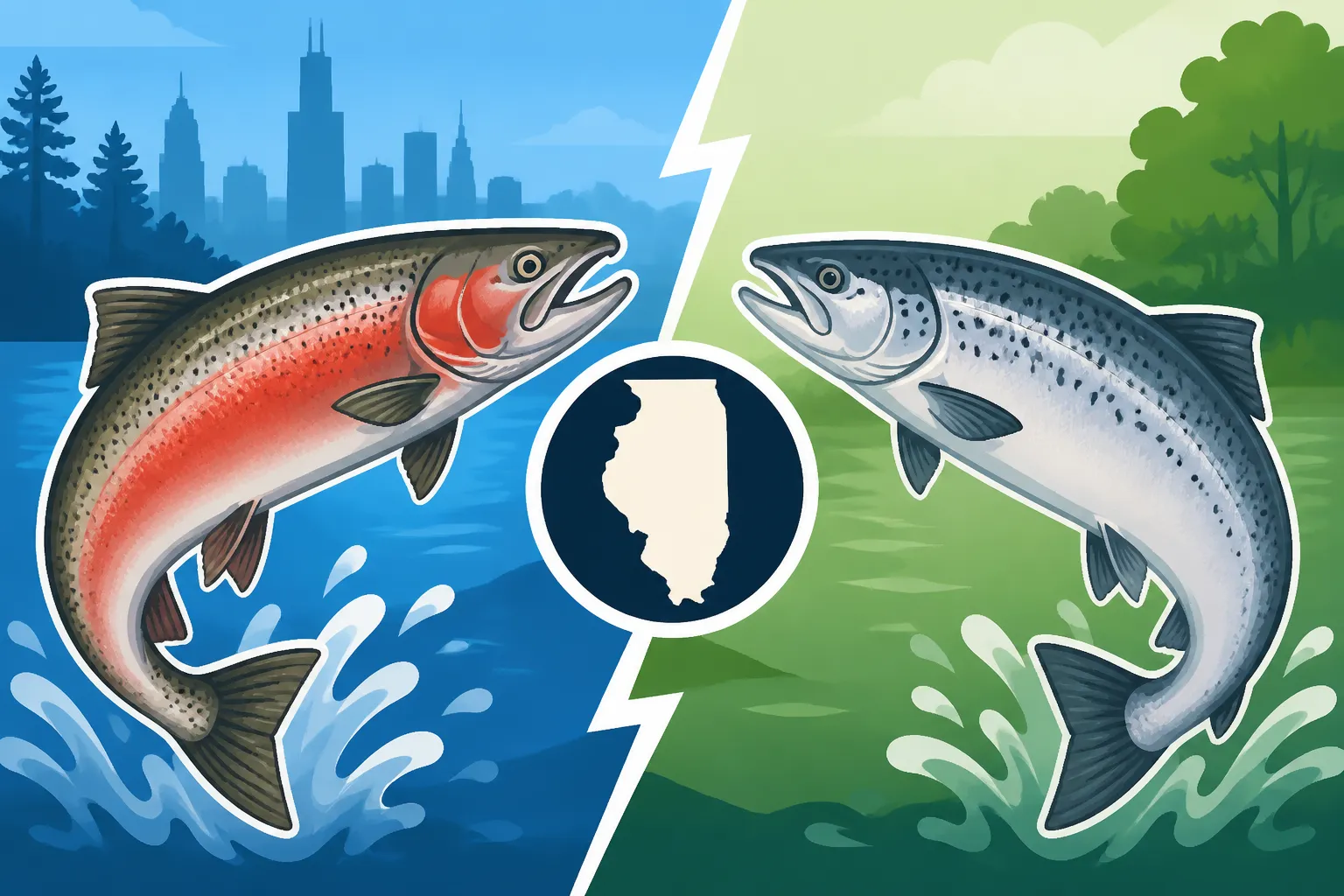
- Tail (Caudal Fin): The most defining characteristic is often the tail. Coho salmon typically have a lightly spotted tail with spots primarily on the upper lobe only, if present at all. The tail is also usually lightly forked, but not deeply V-shaped.
- Mouth and Gums: Open its mouth carefully and look at the gum line. Coho salmon will have white gums along the base of the teeth on the lower jaw, with black or grey tips to the teeth. This "white gum line" is a critical identifier.
- Spots: Their body usually has small, sparse spots on the back, often above the lateral line, and sometimes very few to no spots below it. These spots are less defined and fewer in number compared to a Chinook salmon.
- Dorsal Fin: The dorsal fin is typically plain and unspotted.
- Anal Fin: Coho generally have 12-15 rays in their anal fin, which is a detail that can be hard to count on a wiggling fish but contributes to their overall fin profile.
- Coloration: While in the lake, they are bright silver on their sides with a darker, bluish-green back. As they get closer to spawning, their coloration can darken significantly, with males developing a reddish tint on their sides.
Observing these features closely, perhaps with a quick reference from a fishing identification chart you might keep on your boat or even find on Amazon for quick access, will help solidify your identification.
Coho Behavior and Habitat in Illinois
Coho salmon in Lake Michigan are typically found throughout the water column, but they often prefer the upper layers, especially during the spring and early summer when they're actively feeding on alewives. During this time, they tend to congregate in nearshore waters, often within just a few miles of the Illinois shoreline, and are frequently targeted by anglers fishing out of Chicago, Waukegan, or Winthrop Harbor. Their feeding behavior is aggressive, and they'll readily strike trolled spoons, dodgers, and flies.
As the season progresses and water temperatures change, they might move into deeper offshore waters, only to return to nearshore areas, harbors, and rivers for their spawning run in the late summer and fall. This seasonal migration means that understanding Best Months for Lake Michigan Salmon Fishing in Illinois can greatly improve your chances of encountering them. Their energetic fights, characterized by aerial jumps and strong runs, make them a favorite among sport anglers.
Common Gear and Techniques for Coho
Coho salmon are often caught by trolling, which involves pulling multiple lines with lures behind a moving boat. Downriggers, dipsy divers, and planer boards are all common tools used to present baits at various depths and distances from the boat. Popular lures include bright-colored spoons, dodgers and fly combinations, or even small crankbaits. The key is often speed and finding the right depth where the fish are actively feeding. For shore anglers, casting spoons or small crankbaits from piers and breakwalls, especially during spring and fall runs, can be highly effective. If you’re looking to get started, checking out comprehensive guides like Lake Michigan Salmon Trolling Setup can be a huge help.
Atlantic Salmon: A Rarity and a Challenge for Illinois Anglers
Unlike the plentiful Coho, Atlantic salmon are a much rarer catch for anglers in Illinois, making them a highly prized and often surprising discovery. While they are native to the Atlantic Ocean and its tributary rivers, stocking efforts have introduced them to some of the Great Lakes, including Lake Michigan, though their populations here are generally much smaller and more localized than those of their Pacific cousins.
Key Physical Characteristics of Atlantic Salmon
Atlantic salmon have a distinct appearance that sets them apart from Coho, though both are undeniably beautiful fish.
- Tail (Caudal Fin): One of the most telling features of an Atlantic salmon is its unspotted tail, or at most, very faint, indistinct spots. The tail is also typically less forked than a Coho's, often appearing squarer or only slightly emarginate.
- Mouth and Gums: Unlike Coho, Atlantic salmon will have a uniformly dark or black gum line at the base of their teeth on the lower jaw. This is a crucial distinction. Their mouth is also typically smaller in proportion to their body than a Coho's or Chinook's.
- Spots: Atlantic salmon typically have fewer, larger, and more distinct spots on their body, often resembling "X" or "Y" shapes. These spots are usually concentrated above the lateral line and are less uniformly scattered than a Coho's.
- Pectoral Fin: Their pectoral fin is generally quite long, often extending past the front of the dorsal fin, which can be another subtle clue.
- Slender Body: Atlantics often appear more slender and graceful than the robust Coho.
- Coloration: Similar to Coho, they are bright silver in the lake with a dark back, but their spotting pattern is different. As they mature and prepare to spawn, males can develop a pronounced "kype" (a hooked jaw) and darker, often mottled coloration.
Recognizing an Atlantic salmon truly requires attention to these details, and it's why guides like Illinois Lake Michigan Atlantic Salmon Fishing Guide are so important for anglers hoping to encounter these special fish.
Where to Find Atlantic Salmon in Illinois (and Why They're Rare)
Atlantic salmon populations in Lake Michigan are sustained primarily through stocking programs, rather than natural reproduction on a large scale within Illinois's waters. Because of this, their presence is often more localized and unpredictable compared to Coho. While they can be found cruising the open waters of Lake Michigan, particularly in areas where they have been stocked, they are not as widely distributed or numerous as Coho.
They tend to be a more elusive fish, sometimes preferring cooler, deeper waters for longer periods or exhibiting less aggressive feeding patterns than Coho. Anglers might encounter them in similar areas to Coho, but often as an incidental catch rather than a targeted species. Their rarity makes each capture a significant event, a true "trophy" in the eyes of many.
Fishing for Atlantic Salmon: A Specialized Pursuit
Because of their lower numbers and sometimes more cautious nature, actively targeting Atlantic salmon can be a more specialized endeavor. Fly fishing for them in the spring and fall in tributaries (where they might occasionally be stocked or congregate for spawning) can be highly effective, requiring delicate presentations with streamers and nymphs. When found in Lake Michigan, they might strike many of the same lures as Coho, but their preference can sometimes lean towards smaller, more natural baitfish imitations.
Anglers specifically hoping for an Atlantic salmon might consider lighter tackle, which allows for a more subtle presentation. Patience is definitely a virtue when it comes to Atlantics; they are not always as eager to strike as their Coho counterparts, making each successful hook-up that much more satisfying.
Side-by-Side Comparison: Coho vs. Atlantic Salmon
To help you quickly distinguish between these two magnificent fish species, let’s put their key identifying features side-by-side. Think of this as your quick-reference cheat sheet for those moments of excitement on the water.
Visual Cues for Quick Identification
Here's a table summarizing the main differences you should look for:
| Feature | Coho Salmon (Oncorhynchus kisutch) | Atlantic Salmon (Salmo salar) |
|---|---|---|
| Tail (Caudal Fin) | Lightly spotted, usually on upper lobe only; moderately forked. | Unspotted or very faint spots; squarer/less forked. |
| Lower Gum Line | White at the base of teeth, black/grey tips on teeth. | Uniformly dark or black gums. |
| Body Spots | Small, sparse spots on back, often above lateral line. | Fewer, larger, more distinct "X" or "Y" shaped spots, mainly above lateral line. |
| Pectoral Fin | Shorter, usually not extending past eye. | Longer, often extending past front of dorsal fin. |
| Body Shape | More robust, stockier. | More slender, graceful. |
| Mouth Size | Generally larger. | Proportionally smaller. |
When you've got a fish in hand, just run through this checklist in your head. The gum line and the tail spots are usually the quickest and most reliable indicators. Remember, sometimes fish can vary slightly, but these characteristics hold true for the vast majority. It's a skill that comes with practice, so don't be discouraged if you're not an expert identifier overnight!
Behavioral Differences on the Water
Beyond physical appearance, Coho and Atlantic salmon also exhibit some differences in behavior that keen anglers might pick up on.
- Fight Style: Coho are renowned for their aggressive, often acrobatic fights. They'll jump, roll, and make fast, hard runs. An Atlantic salmon, while still a powerful fighter, might exhibit a slightly different demeanor, perhaps with longer, stronger runs and less aerial acrobatics, often staying deeper in the water column. However, this is more of a generalization, and a strong, fresh Atlantic can certainly put on a show!
- Strike: Coho tend to hit lures with a hard, aggressive strike. Atlantic salmon can sometimes be more subtle in their takes, requiring a bit more sensitivity to detect.
- Preferred Depths/Locations: As mentioned earlier, Coho are often found in the upper water column and in more nearshore areas, especially in spring. Atlantic salmon, while present, might be more scattered or prefer slightly deeper, cooler water for longer periods, making them less predictable in terms of location.
Understanding these subtle behavioral cues can give you an edge, helping you anticipate what species you might have on the line, even before you see it. This knowledge can also inform your bait choice and presentation. For instance, if you're specifically targeting Atlantics, you might choose smaller, more refined lures.
Why Accurate Identification Enhances Your Fishing Experience
Mastering the art of fish identification is more than just impressing your fishing buddies; it genuinely enriches every aspect of your angling adventures. From following the rules to catching more fish, knowing your species truly matters.
Adhering to Regulations and Catch Limits
This is perhaps the most critical reason for accurate identification. Illinois fishing regulations are put in place to manage fish populations sustainably, ensuring that future generations can enjoy the same incredible fishing opportunities we have today. Sometimes, different salmon species will have different minimum size requirements, daily catch limits, or even special possession limits. For example, if you're not sure about the specific rules for Illinois Lake Michigan Atlantic Salmon Fishing Guide, mistaking an Atlantic for a Coho could inadvertently lead to a violation if their limits differ.
Always keep a copy of the current Illinois Fishing Information Guide handy, or download an official app if available. When in doubt, it’s always better to err on the side of caution. An honest mistake due to misidentification can still carry penalties, so taking the time to learn these differences is a commitment to responsible angling.
Improving Your Fishing Strategy
Imagine you're out on Lake Michigan, and you've been having some luck, but you're not quite sure what you're catching. If you can confidently identify that you're primarily hooking Coho, for instance, you can then focus your efforts. You might adjust your trolling speed, switch to specific spoons known for Coho, or target certain depths and areas where Coho are most active. This targeted approach, informed by accurate species identification, will almost certainly lead to more successful outings.
Conversely, if you realize you've unexpectedly caught an Atlantic, you might take a moment to reflect on what worked. Was it a particular lure? A specific depth? This information can then be filed away for future trips when you might want to try to specifically target those rare and rewarding Atlantics. Tools and resources, whether physical guides or digital ones you can quickly access on your phone, can be found on platforms like Amazon and can make a big difference in quickly referencing identification tips while on the water. The more you know about the fish you're chasing, the better you become at finding and catching them.
Angling is a lifelong learning process, and distinguishing between species like Coho and Atlantic salmon is a fundamental skill that enhances both your success and your enjoyment on the water.
Disclaimer
This article is for general informational purposes only and does not constitute professional advice. Laws, prices and regulations vary by location and change over time. Consult a qualified professional for guidance on your specific situation.