Best Tackle Setup for Muskie Trolling
For many Illinois anglers, the dream of hooking into a monstrous muskie is what keeps them on the water, but the sheer size and power of these apex predators means you can't just show up with any old bass gear. If you've ever felt the heartbreaking snap of a line or the disheartening drag scream of an undersized reel when a true 'ski hits, you know the frustration. This guide is all about helping you put together the perfect tackle setup for muskie trolling in Illinois waters, ensuring you're ready for that fight of a lifetime.
The Foundation: Rods and Reels for Trolling Power
When you're chasing muskie, especially when trolling, your rod and reel aren't just tools; they're your primary connection to a fish that can easily weigh 20, 30, or even 40 pounds. Skimping here is like bringing a butter knife to a sword fight – you might make contact, but the outcome won't be in your favor. We need gear that can handle the violent strike, the relentless runs, and the sheer torque a big muskie can generate.
Rod Specifications for Muskie Trolling
A proper muskie trolling rod needs to be a beast. We're talking about heavy power and a moderate-fast to moderate action. Why heavy? Because you'll often be pulling massive lures, sometimes weighing many ounces, which create tremendous drag in the water. A rod with insufficient backbone will constantly be loaded, making it hard to read strikes or even know if your lure is running correctly. The length is also crucial, typically ranging from 8 feet to over 10 feet. Longer rods help spread out lines when multiple rods are in use, reducing tangles, and they also offer better leverage for controlling large fish and absorbing their head shakes. For Illinois muskie fishing, especially in lakes known for big fish like Kinkaid Lake or Lake Shelbyville, a solid, heavy trolling rod is non-negotiable.
The action, whether moderate-fast or moderate, is vital for absorbing the shock of a muskie strike without tearing the hooks out of their notoriously tough mouths. A moderate action allows the rod to bend further into the blank, cushioning the initial impact and maintaining pressure throughout the fight. This prevents snap-offs when a big muskie makes a sudden dive or a powerful run right after hitting your lure. Furthermore, the rod should have a comfortable, long handle to provide leverage against powerful fish and to fit securely into boat rod holders. You can find excellent options from brands like St. Croix or Daiwa at places like Bass Pro Shops, which often have dedicated muskie sections.
Choosing the Right Trolling Reel
Your reel for muskie trolling must be robust, reliable, and capable of handling heavy lines and big fish. This isn't the place for finesse spinning reels. We're looking at conventional (baitcasting) reels, often purpose-built for big game or saltwater applications, that offer a high line capacity, a strong drag system, and durable components. A common mistake is using a reel that's too small, leading to burned-out drag washers or insufficient line. Imagine fighting a 40-inch muskie only to have your reel lock up mid-fight – a nightmare scenario that's all too real if your gear isn't up to snuff.
Key features to look for include a star drag or lever drag system that can smoothly deliver at least 15-20 pounds of drag pressure. The retrieve ratio should be medium to slow (around 4.0:1 to 5.5:1), providing plenty of cranking power to retrieve large lures and bring a thrashing muskie to the boat. Line capacity is also paramount; you'll want a reel that can comfortably hold at least 200-300 yards of 80-100 pound braided line. Reels like those from Abu Garcia, Penn, or Shimano are popular choices among muskie anglers for their proven reliability. When you're ready to upgrade or pick up your first muskie trolling reel, checking out reviews and specs on Amazon can give you a good idea of what's available before heading to a specialist store. This setup is crucial for success, especially in lakes known for trophy fish. Illinois Muskie Fishing: Best Lakes to Try will give you an idea of where this gear truly shines.
Line, Leaders, and Connections: The Unbreakable Link
The line and leader system is the critical link between your tackle and the muskie. Any weakness here, and all your heavy-duty rods and reels become moot. Muskie have rows of razor-sharp teeth that can easily shred standard fishing lines, and their immense power demands a line that can withstand incredible pressure. Getting this part of your setup right is non-negotiable.
Main Line Choices for Muskie Trolling
For muskie trolling, braided line is almost universally preferred. Its zero-stretch properties offer several advantages: it transmits every vibration from your lure directly to the rod, making it easier to detect subtle bites or know if your lure is fouled. More importantly, it provides maximum pulling power and incredible abrasion resistance, which is vital when a muskie dives into cover or makes long runs. A common choice is 80 to 100-pound test braided line. While this may seem excessive, it's not about the fish breaking the line in open water; it's about shock absorption, standing up to muskie teeth (to a degree), and the ability to retrieve expensive lures that might get snagged.
Monofilament line, while having some stretch that can be beneficial for shock absorption in other applications, is generally avoided for muskie trolling. The stretch can make it harder to detect strikes, and its lower abrasion resistance makes it more vulnerable to muskie teeth and submerged structure. Some anglers might use a short section of heavy monofilament or fluorocarbon as a "shock leader" between their braid and a wire leader, mainly for its abrasion resistance against the muskie's body rubbing the line during a fight, but never as the primary leader material against the teeth. Remember that rules about line strength and species-specific tackle can apply, so it's always wise to consult Illinois Muskie Fishing: Rules and Regulations for This Game Fish.
Robust Leaders for Toothproof Defense
This is where many anglers, especially newcomers, make a critical error. Muskie have teeth capable of cutting through standard fishing line as if it were sewing thread. You absolutely need a heavy-duty leader that can withstand those choppers. The most common and effective choice for muskie is a wire leader. These aren't your ultralight bass leaders; we're talking about heavy-gauge multi-strand wire, often covered in nylon or fluorocarbon for added stealth and abrasion resistance, or thick fluorocarbon leaders.
For trolling, fluorocarbon leaders in the 100-200 pound test range, 12-36 inches long, are popular for their near-invisibility and rigidity, which helps prevent lures from fouling. However, many seasoned muskie anglers still prefer heavy-duty wire leaders made from stainless steel or titanium, typically 80-150 pound test, for ultimate tooth protection. Titanium leaders are often favored for their kink resistance and memory-free performance. Whatever you choose, ensure your leader is equipped with strong, heavy-duty snaps and swivels that can handle the massive forces of a striking and fighting muskie. Barrel swivels help prevent line twist from rotating lures, and high-quality snaps ensure your expensive muskie baits stay connected. This is not the place to economize; a cheap snap can cost you the fish of a lifetime and a valuable lure.
Lures That Lure: Trolling Baits for Illinois Muskie
Muskie trolling is all about covering water and presenting a large, enticing meal to these notoriously finicky predators. The right lure, presented at the right depth and speed, can be the difference between a long day of casting and the thrill of a screaming reel. Muskie lures are a world unto themselves, often large, expensive, and designed to provoke aggressive strikes.
Top Trolling Lure Styles
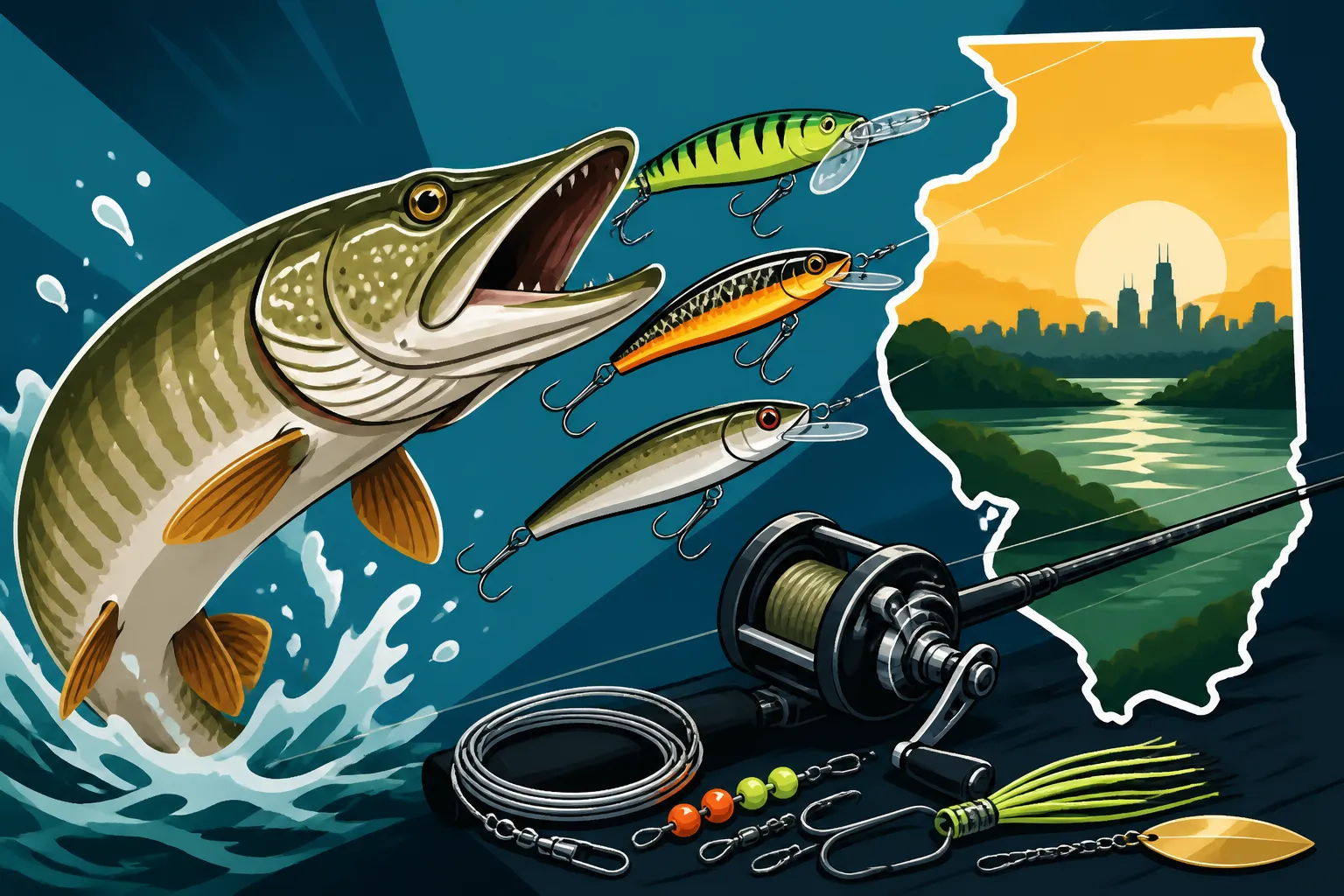
When it comes to muskie trolling, you'll find a variety of lure styles, each with its own advantages. The most common include large crankbaits, bucktails, and soft plastics. Big crankbaits are probably the most popular choice for trolling. These come in various shapes and sizes, from jointed models that mimic swimming baitfish to large lipped baits designed to dive to specific depths. Brands like Bagley, Rapala, or Bondy Bait Company make crankbaits that are well-regarded for muskie. You'll want a selection that covers different depth ranges, from shallow-running models for weed edges to deep divers for open water humps and drop-offs. The flash, wobble, and vibration of a crankbait can trigger a muskie's predatory instincts from a distance.
Bucktails, while often associated with casting, can also be trolled effectively, especially larger models designed to run deeper or with added weight. Soft plastics, particularly large paddle tail swimbaits rigged on heavy jig heads, are another excellent option, offering a realistic profile and action. The key is to have a variety, considering that muskie preferences can change based on water temperature, clarity, and forage. For more detail on what these fish might be feeding on, check out Best Lures for Muskie Fishing Based on What They Eat.
Depth Control and Presentation
Trolling isn't just about dragging a lure behind the boat; it's about precise depth control and presentation. Understanding how deep your lures are running is paramount to targeting muskie effectively. Different lures have different diving capabilities at various trolling speeds and line lengths. You'll need to experiment and sometimes use tools like line counter reels or dive curves for specific baits to know where your lure is in the water column.
For reaching greater depths or precisely positioning lures, many muskie anglers incorporate planer boards or downriggers into their setup. Planer boards allow you to spread out multiple lines horizontally, covering a wider swath of water and keeping lures away from the boat's prop wash. This can be especially effective when fishing clear waters or trying to cover expansive flats. Downriggers, more commonly associated with salmon and trout on Lake Michigan, can also be used for muskie to precisely deliver lures to specific depths, particularly in deeper lakes. While some of the biggest muskie lakes in Illinois are not as deep as Lake Michigan, understanding the concepts of Downriggers and Planer Boards for Lake Michigan can certainly apply to deeper presentations for muskie elsewhere. The goal is to put your bait exactly where the muskie are holding, whether that's suspended over deep water, hugging a break line, or cruising a weed edge.
Essential Accessories for a Successful Trolling Trip
Beyond the rod, reel, line, and lures, there are several crucial accessories that will make your muskie trolling experience safer, more efficient, and ultimately, more successful. Muskie fishing, by its very nature, demands specialized tools due to the size and power of the fish, as well as the lures used.
Rod Holders and Boat Setup
When you're trolling, you're not holding your rod; it's securely placed in a heavy-duty rod holder. These aren't flimsy plastic holders; we're talking about robust, metal rod holders that can withstand the violent strike of a muskie without bending or breaking. They should be mounted securely to your boat, capable of holding your heavy muskie rods firmly in place. Many anglers utilize multiple rod holders to run a spread of several lines, which is typical for trolling. Investing in good quality, adjustable rod holders that allow you to vary the angle of your rods is key to a versatile trolling setup.
Your boat itself also plays a significant role. A stable fishing platform, whether it's a dedicated bass boat or a multi-species craft, is important. You'll need ample storage for your oversized lures and tackle, and a reliable trolling motor for precise speed control is invaluable. Many muskie boats also feature large livewells, though with muskie, catch and release is highly encouraged, so having a good measuring board and release tools is more critical than a livewell. For more general advice on suitable vessels, consider looking at Best Fishing Boats for Illinois Lakes.
Specialized Muskie Tools and Safety Gear
Handling a muskie, whether for a quick photo or release, requires a specific set of tools for both your safety and the fish's well-being. A long-handled, heavy-duty net with a rubberized mesh is absolutely essential. The rubberized mesh protects the fish's slime coat and prevents hooks from getting tangled. You'll also need long-nosed pliers or jaw spreaders to safely remove hooks from a muskie's toothy maw. A pair of heavy-duty bolt cutters or side cutters is also a wise addition to your tackle box; in some cases, cutting the hook might be the safest option for the fish if it's deeply embedded.
Don't forget a large measuring board to quickly document your catch and release it efficiently. Gloves, while not always necessary, can offer an extra layer of protection from fins and teeth during handling. When you're dealing with such powerful fish and large, multi-treble hooks, safety is paramount. Keep your tackle box well-stocked with these specialized items. Remember, these fish are a precious resource, and proper handling ensures they can be caught again. You can find many of these items, from nets to specialized pliers, at your local sporting goods store or through online retailers like Amazon. Having the right Illinois Muskie Gear and Tackle makes all the difference.
Table: Essential Muskie Trolling Tackle Components
| Component | Key Characteristics | Why it Matters | Common Options / Considerations |
|---|---|---|---|
| Rod | Heavy Power, Moderate-Fast Action, 8-10+ ft length | Handles large lures, absorbs strikes, leverage for big fish | St. Croix, Daiwa, Okuma Muskie Rods |
| Reel | Conventional (Baitcasting), High Line Capacity, Strong Drag | Holds heavy braid, smooth drag for powerful runs | Abu Garcia Revo Toro Beast, Shimano Tranx, Penn Fathom |
| Main Line | 80-100 lb Braided Line, No Stretch | Sensitivity, strength, abrasion resistance | PowerPro, Daiwa J-Braid, Berkley X9 |
| Leader | 100-200 lb Fluorocarbon or Titanium/Steel Wire, 12-36" | Tooth-proof, prevents cut-offs, lure action | Stealth Tackle, Tyger Leader, AFW Titanium |
| Lures | Large Crankbaits, Bucktails, Soft Plastics (8-14+ inches) | Covers water, triggers aggressive strikes, mimics forage | Rapala Super Shad Rap, Grandma, Bondy Bait, Musky Mania |
| Net | Large, Long-Handled, Rubberized Mesh | Safe landing & release, protects fish, prevents tangles | Frabill, Beckmann, StowMaster |
| Pliers | Long-Nosed, Heavy-Duty, Jaw Spreaders | Safe hook removal from toothy mouths | Knipex, Muskie Tools, Dr. Slick |
| Rod Holders | Heavy-Duty, Metal, Adjustable | Securely holds rods against violent strikes | Cannon, Scotty, Cabela's Quick Draw |
Disclaimer
This article is for general informational purposes only and does not constitute professional advice. Laws, prices and regulations vary by location and change over time. Consult a qualified professional for guidance on your specific situation.