Downriggers and Planer Boards for Lake Michigan
One of the biggest frustrations for anglers new to Lake Michigan is understanding how to effectively present lures to salmon and trout that often suspend in the vast, deep waters. It's not like casting to a visible bass bed or dropping a jig into a river eddy. This guide is all about demystifying the essential tools – downriggers and planer boards – that will revolutionize your Lake Michigan trolling game, helping you reach those elusive fish at precise depths and spread out your offerings like a pro.
Understanding Lake Michigan's Trolling Challenge
Lake Michigan isn't your average fishing hole; it's an inland sea, presenting a unique set of challenges to even the most seasoned angler. You're not just dealing with big water, you're dealing with immense depths and a wide-open expanse where fish can literally be anywhere. This vastness is precisely why traditional casting or even simple flat-line trolling often falls short. The fish aren't always near the surface, and they're rarely concentrated in a small area. This is where specialized gear becomes not just helpful, but absolutely essential for consistent success. Trying to fish Lake Michigan without the right tools is like trying to paint a mural with a toothbrush – you might get some paint on the wall, but you won't cover much ground effectively.
The Depths and the Dispersion
When you look at a contour map of Lake Michigan, you quickly realize how deep it gets, often plunging hundreds of feet. Salmon and trout, especially species like Chinook salmon and lake trout, don't just hang out near the surface. They often suspend in the water column, meaning they could be 50 feet down, 100 feet down, or even deeper, cruising over water that's several hundred feet deep. The sheer volume of water means these fish can be incredibly dispersed, making it a monumental task to find them if you're not actively covering a wide range of depths and horizontal space. Imagine trying to find a few specific needles in an Olympic-sized swimming pool – that's the scale we're talking about without the right approach.
Moreover, these fish are constantly on the move, chasing baitfish like alewives. Their depth can change hour by hour, influenced by light penetration, baitfish movement, and even boat traffic. Simply dragging a lure behind your boat at a fixed shallow depth will only catch fish that happen to be at that exact depth and directly in your wake, which is a very small percentage of the available fish. To truly be successful, you need a way to present multiple lures at various depths simultaneously, essentially creating a vertical fishing net that sweeps through the water column.
Targeting Specific Temperature Zones
One of the most critical factors influencing salmon and trout on Lake Michigan is water temperature. These cold-water species thrive within a very specific temperature range, often referred to as the "thermocline" – a distinct layer in the water column where the temperature changes rapidly. Finding and staying in this temperature band is paramount. Fish will often stack up just above, within, or just below this layer, where they find both comfort and an abundance of baitfish.
Without a way to precisely control your lure's depth, you're essentially guessing where the thermocline might be and hoping your lure stumbles into it. Downriggers allow you to place your baits exactly where you want them, whether that's 47 feet down, 62 feet down, or whatever depth your fish finder (and temperature probe) tells you the magic zone is. This precision is a game-changer. It turns a hopeful guess into a calculated presentation, significantly increasing your chances of getting bites. Anglers who consistently catch fish on Lake Michigan are often those who are masters at finding and staying in the optimal temperature zones.
The Need for Spreading Out Lines
Beyond depth control, there's the challenge of presenting multiple lures without them tangling or competing with each other in the boat's wake. Trolling involves covering water, and the more lures you can present effectively, the greater your chances of encountering fish. However, simply deploying many lines directly behind the boat creates a chaotic mess, especially when turning or battling a fish. You end up with tangles, fouled lines, and a lot of frustration.
This is where the concept of "spreading out" your offerings becomes vital. You want to create a wide horizontal footprint with your lures, mimicking a school of baitfish or covering a broader swath of water. Imagine your boat as the center of a fan; you want to present lures not just straight back, but also far out to the sides. This not only prevents tangles but also allows you to cover more water and observe which presentations, depths, or colors are performing best on a given day. Achieving this wide spread efficiently and without a mess is precisely what planer boards are designed to do.
Demystifying Downriggers: Getting to Depth
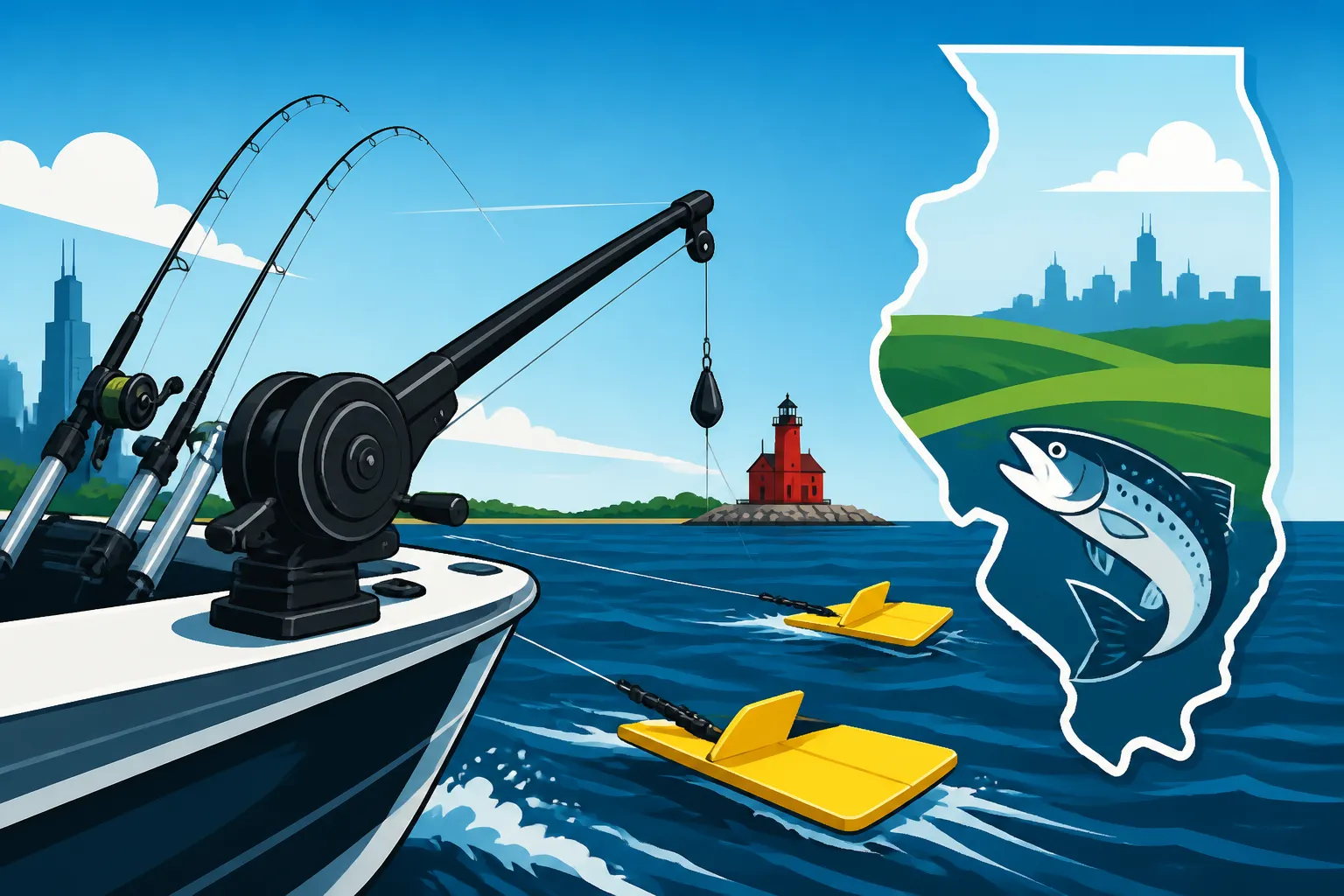
If you've ever seen a boat on Lake Michigan with heavy cannonballs descending into the water, you've witnessed downriggers in action. These ingenious devices are truly the workhorses of deep-water trolling, allowing anglers to put lures right into the fish's strike zone, no matter how deep that might be. They eliminate the guesswork and make precision depth control a reality, which is absolutely critical for species like Chinook salmon and lake trout that often hug specific depth contours or thermoclines. Without them, you'd be relying on heavy lead-core line or massive inline weights, which can be cumbersome and less precise.
How Downriggers Work
At its core, a downrigger is a winch system designed to deploy a heavy weight, often a lead "cannonball" weighing anywhere from 6 to 15 pounds, to a precise depth. Your fishing line, with its lure, is attached to this weight via a "release clip." Here's the magic: once the downrigger weight is lowered to your desired depth (indicated by a counter on the unit), the fishing line is lightly clipped to the cable. The lure then runs free, trailing behind the cannonball at that exact depth.
When a fish strikes, the tension of the strike pulls the line free from the release clip, and you're fighting the fish directly on your rod and reel, without the drag of a heavy weight. This provides a much more natural fight and a better feel for the fish. After the fight, you simply reset the clip, attach your line, and send the weight back down. It's a remarkably efficient system for maintaining depth, and it means you can use lighter tackle to fight the fish itself, as the heavy weight is only there to get the lure down. Many anglers find reliable downrigger setups available at Bass Pro Shops or online retailers.
Types of Downriggers
Downriggers come in a few main flavors, each with its own advantages, largely depending on your budget and how often you plan to hit the big water:
- Manual Downriggers: These are the most basic and typically the most affordable option. You crank a handle to raise and lower the weight. They are perfectly functional for many anglers, especially if you're only running one or two downriggers or don't mind the physical effort of retrieving the weight after each fish or depth change. They are robust and reliable, often seen on smaller boats or as secondary units.
- Electric Downriggers: These are the Cadillac of downriggers, utilizing an electric motor to raise and lower the weight at the push of a button. While a greater investment upfront, they offer unparalleled convenience, especially when frequently changing depths or when dealing with multiple hook-ups. Many electric models feature advanced functions like auto-stop at the surface, depth cycling, and even integrated line counters. For serious Lake Michigan anglers, electric downriggers are often considered a worthwhile investment, making the day on the water much more enjoyable and efficient.
- Small, Clamp-On Downriggers: For kayaks or very small boats, there are compact, clamp-on downriggers. These are designed for lighter weights and shallower applications, but can still be effective for getting a single lure deeper than traditional trolling methods. They are usually manual and very portable.
Choosing the right type depends on your specific needs, the size of your boat, and how serious you are about targeting deep-water species.
Setting Up and Using a Downrigger Effectively
Getting your downrigger set up correctly is crucial for performance. First, securely mount the downrigger to your boat. This is typically done with a heavy-duty pedestal mount or a clamp-on rail mount, depending on your boat's configuration. Ensure it's sturdy enough to handle the forces of lowering heavy weights and the occasional snag.
Next, spool the downrigger with specialized cable, usually stainless steel or heavy-duty braided line designed for this purpose. Attach your release clip to the cable, making sure it's easily adjustable for tension. Some clips are designed for monofilament, others for braid, and some are universal.
When deploying, lower your lure into the water first, ensuring it's swimming correctly a short distance behind the boat. Then, attach your fishing line to the release clip, being careful not to put too much tension on the line, which can cause premature releases. Slowly lower the cannonball to your desired depth using the counter as your guide. Keep an eye on your fish finder for bait balls, temperature breaks, and fish arches. Many anglers will also run a temperature probe on their downrigger weight to pinpoint the thermocline. Pay attention to your rod tip after the line is released; it should have a gentle bend, indicating the lure is running freely. If it's too slack, your line might not be properly tensioned or the lure could be fouled. Proper deployment of your Downrigger Setup for Lake Michigan Salmon Trolling will significantly increase your strike rate.
Planer Boards: Expanding Your Spread
If downriggers are about vertical control, planer boards are all about horizontal expansion. They are essential tools for any serious Lake Michigan angler looking to present multiple lures away from the boat's prop wash and cover a much wider swath of water. Imagine them as wings for your boat, extending your fishing presence far to the sides, presenting lures to fish that might be spooked by the boat itself or simply cruising outside your direct path. Without planer boards, you're severely limited in the number of lines you can run simultaneously without tangles, and you're leaving a lot of fish-holding water untouched.
The Purpose of Planer Boards
The primary goal of planer boards is to take your fishing lines and pull them out to the sides of your boat. This achieves several critical objectives:
- Increased Coverage: By spreading lines out, you can cover a much wider area, increasing the probability of encountering fish. Instead of just fishing a 10-foot wide path directly behind your boat, you can easily fish a 50 to 100-foot wide path, sometimes even more. This broad sweep helps locate scattered fish more efficiently.
- Avoid Prop Wash: The churning water created by your boat's propeller, known as prop wash, can spook some fish. Planer boards allow you to present lures in undisturbed water, often making them more appealing to wary salmon and trout.
- Reduced Tangling: With lines running out to the sides, you can deploy more rods without the risk of them crossing and tangling, especially when turning the boat or when a fish strikes. This organized spread is key to efficient multiple-rod trolling.
- Mimicry: A wide spread of lures can sometimes mimic a larger school of baitfish, which can attract predatory salmon and trout from a greater distance.
Planer boards are a cornerstone of effective trolling strategies on Lake Michigan, allowing for versatility and a significant boost in fish-finding capabilities.
Types of Planer Boards and Their Use
There are generally two main types of planer boards, each suited for different applications:
- Inline Planer Boards: These are smaller, individual boards that attach directly to each fishing line. They run out to the side of the boat, pulling just that one line. They are popular for smaller boats or when you want a more flexible spread, easily adjusting the distance each board runs out. Examples include popular models often found at Amazon or specialized tackle shops. They are great for precision, allowing you to fine-tune where each individual lure is running relative to your boat.
- Mast/Big Board Systems: These systems use larger, heavier boards that are tethered to a main tow line. This tow line is deployed from a mast mounted on the front or side of the boat. Multiple fishing lines are then attached to the main tow line via release clips, and these clips slide down the tow line, carrying the individual fishing lines out to the big board. Big board systems are fantastic for running many lines (sometimes 6-10 lines per side!) and offer a very wide, stable spread. They require a bit more setup but are incredibly efficient for serious tournament anglers or charter captains. They are particularly effective when targeting schooling fish that are widely dispersed.
Each type has its place. Inline boards are simpler to start with and often more portable, while mast systems offer maximum line capacity and coverage for dedicated trolling boats. You can learn more about specific setups in Planer Boards for Lake Michigan Trout Fishing.
Rigging and Deploying Planer Boards
Proper rigging and deployment are key to getting your planer boards to perform effectively.
For inline planer boards:
- Attach the board: Most inline boards clip directly onto your main fishing line. Ensure the clip is oriented correctly for the board to track outwards.
- Deploy your lure: Let out your lure a desired distance behind the boat (e.g., 50-100 feet).
- Attach the board: Clip the planer board onto your line, usually with the line running through a front clip and a rear clip that allows it to slide.
- Let it out: Slowly release more line, allowing the board to pull itself away from the boat. As it moves out, monitor your line counter to know how much line is out behind the board, which determines the lure's effective distance from the boat.
For mast/big board systems:
- Deploy the main tow line: From your mast, deploy the main tow line, allowing the big board to run out to your desired distance, typically far out to the side.
- Attach release clips: Your fishing lines, each with its lure, are attached to specialized planer board release clips. These clips then attach to the main tow line.
- Send them out: As you release line from your fishing reel, the clip slides down the main tow line, carrying your lure out to the big board. You can space these clips out along the tow line to create different depths and horizontal distances.
Always ensure your clips are set correctly for the line type you're using (mono vs. braid) and that they release reliably when a fish strikes. A good set of clips can be a worthy investment, preventing lost fish due to premature release or clips that don't let go at all. Keep your main tow line tight and your clips regularly cleaned to ensure smooth operation.
Combining Downriggers and Planer Boards for Maximum Effect
The true artistry of Lake Michigan trolling often lies in the seamless integration of downriggers and planer boards. While each tool is powerful on its own, their combined use creates a sophisticated, multi-dimensional presentation that maximizes your chances of success. It's about building a "spread" – a carefully orchestrated array of lures covering various depths and horizontal distances – that efficiently searches the vast waters for hungry salmon and trout. Think of it as creating a fishing grid, not just a single line.
The Synergistic Approach
When you combine downriggers and planer boards, you're no longer limited to just a straight line behind the boat or a single depth. Instead, you're creating a fishing system that targets multiple zones simultaneously.
Imagine this:
- Deep Water Hunters: You might run two downriggers directly behind the boat, setting one at 60 feet and another at 80 feet, each presenting a different spoon or dodger/fly combo to target deep-holding lake trout or salmon cruising the thermocline. These are your foundational deep lines, designed to hit precise depths.
- Mid-Depth and Wide: Then, you deploy planer boards to the sides. On the inside boards (closer to the boat), you might run lines with short lead cores or diving lures, targeting fish at 20-40 feet. These lures are far enough from the boat's wake to appear natural but still relatively close.
- Surface and Far Out: On the outermost planer board lines, you might run long fluorocarbon leaders with lighter spoons or stickbaits, perhaps with a small inline weight, targeting higher-riding salmon or active trout that are chasing baitfish closer to the surface, far from the boat.
This multi-faceted approach allows you to experiment with different depths, lure types, and colors across a broad area, quickly identifying what the fish are keying in on that day. It's an information-gathering machine as much as a fish-catching one.
Strategic Lure Placement
Strategic lure placement is crucial when running a full spread. It's not just about putting lures out; it's about minimizing tangles and maximizing appeal.
- Stagger Depths and Distances: Avoid running all your lures at the exact same depth or horizontal distance. This helps prevent tangles when making turns or dealing with currents. For example, if you have a downrigger at 60 feet, the next deepest lure on a planer board might be at 40 feet, and so on. Similarly, vary the lead-lengths behind your planer boards to create even more separation.
- Speed and Direction: Your trolling speed and direction significantly impact how your lures run. Experiment with small turns – sometimes a slight turn will cause an outside lure to speed up and drop, while an inside lure slows down and rises, triggering strikes. Similarly, varying your speed can make lures appear more erratic and enticing.
- Lure Action: Consider the action of your lures. Some lures are designed to run deeper with less line out, while others need more line to achieve their desired depth and action. Match your lure choice to its intended depth and placement in your spread. For a detailed guide on what to use, check out Lake Michigan Salmon Trolling Setup.
Adjusting to Conditions
Lake Michigan is a dynamic environment, and successful anglers are constantly adjusting their spread based on conditions.
- Wind and Waves: Rougher water can cause lures to "blow out" (come to the surface) or run erratically. You might need to use heavier weights on your downriggers or adjust your planer board setup to maintain depth and stability. On calm days, fish might be more easily spooked, requiring longer lead-lengths behind your boards and downriggers.
- Sunlight: Bright sun often pushes fish deeper, calling for more reliance on your downriggers. Overcast days or low light conditions might bring fish higher in the water column, making planer boards with shallower presentations more effective.
- Baitfish Presence: Pay close attention to your fish finder. If you mark schools of baitfish at a certain depth, deploy your downriggers and planer board lines to target that specific zone. If bait is scattered, a wider, more varied spread might be necessary.
- Species Targeted: If you're specifically targeting deep-dwelling lake trout, your downriggers will be paramount. If coho salmon are active higher in the water column, your planer boards running shallower will be your bread and butter. Understanding Lake Michigan Salmon Season Timing in Illinois and Lake Michigan Trout Season Timing in Illinois helps with these decisions.
Learning to read the water, your electronics, and the behavior of your gear is an ongoing process, but the combination of downriggers and planer boards gives you the tools to react to whatever Lake Michigan throws at you.
Essential Gear and Maintenance for Trolling Success
Having the right downriggers and planer boards is just one part of the equation for successful Lake Michigan trolling. The rest of your gear plays a crucial role, from the rods and reels that fight the fish to the lines and lures that entice them. Investing in quality equipment and maintaining it properly will ensure your time on the water is productive and enjoyable, rather than filled with frustrating equipment failures. This is especially true when you're far out on Lake Michigan, where a gear malfunction can quickly ruin a trip.
Trolling Rods and Reels
When selecting rods and reels for Lake Michigan trolling, you need gear that can handle the specific demands of this type of fishing:
- Rods: Trolling rods for downriggers and planer boards are typically longer (8-10 feet is common) and have a moderate, parabolic action. This forgiving action helps absorb the shock of a strike when the line pops from the release clip, preventing immediate break-offs. It also provides a consistent bend to help keep fish hooked during the fight, especially with the surge of a powerful salmon. Look for rods with durable guides and comfortable grips, designed to withstand the constant stress of trolling. Rods like those designed for salmon and trout trolling, available at Bass Pro Shops or specialized tackle stores, are often ideal. For more specifics, consider checking out Best Trolling Rods for Lake Michigan Salmon.
- Reels: Line counter reels are almost universally used for Lake Michigan trolling. These reels, usually baitcasting models, have a digital or mechanical counter that tells you exactly how much line you have let out. This is critical for repeating successful presentations and knowing how far back your lure is running behind the boat or planer board. Choose reels with a smooth, powerful drag system, capable of handling the long, strong runs of a large salmon or trout. Capacity is also important; you'll want reels that can hold several hundred yards of line (e.g., 20-30 lb mono or 30-50 lb braid).
Matching your rod and reel for balance and performance is important, and you'll often have dedicated setups for your downriggers and another set for your planer board lines.
Lures, Baits, and Line Choices
The world of Lake Michigan lures and baits is vast and exciting, with new innovations constantly appearing.
- Lures: Spoons, dodger/fly combinations, and stickbaits are the holy trinity of Lake Michigan trolling lures.
- Spoons: These are perhaps the most versatile, coming in countless sizes, colors, and patterns. They mimic baitfish like alewives and have an irresistible wobbling or fluttering action. Popular spoon colors vary by season and water clarity, but metallics, greens, blues, and oranges are often staples.
- Dodger/Fly Combos: Dodgers are attractors that wobble and flash, imparting an erratic action to a trailing fly or small spoon. Flies, typically tied with Mylar and synthetic fibers, imitate small baitfish or invertebrates. This combination is incredibly effective for attracting salmon.
- Stickbaits: These long, slender lures imitate minnows and are particularly effective for targeting salmon and trout closer to the surface or when fish are feeding aggressively.
- Baits: While artificial lures dominate, sometimes natural baits like cut bait or whole alewives, often trolled behind a flasher, can be deadly, especially for lake trout.
- Line: Your main fishing line choice depends on personal preference, but generally, anglers use:
- Monofilament (Mono): Offers stretch, which can be forgiving when fighting strong fish, and is generally more abrasion-resistant. Popular in 15-25 lb test.
- Braided Line: Has virtually no stretch, offering excellent sensitivity for detecting subtle bites and deeper penetration with less diameter. It's often used with a fluorocarbon leader. Popular in 20-50 lb test.
- Fluorocarbon Leaders: Nearly invisible underwater, fluorocarbon is often used as a leader material (10-30 lb test) attached to mono or braid, especially in clear Lake Michigan waters.
Experimentation with lures, colors, and line types is part of the fun and challenge of Lake Michigan fishing. Always check local tackle shops for what's hot right now.
Maintenance and Storage Tips
Proper maintenance of your downriggers, planer boards, and all associated tackle is essential for longevity and reliable performance. Lake Michigan's freshwater environment, while not as corrosive as saltwater, still requires attention.
- Rinse Everything: After every trip, rinse all your gear – downriggers, planer boards, rods, reels, and lures – with fresh water. This removes any grime, fish slime, and potential microscopic organisms.
- Lubrication: Periodically lubricate your downrigger moving parts, pulleys, and the internal mechanisms of your reels with marine-grade lubricants.
- Inspect Lines and Clips: Regularly inspect your downrigger cables for fraying and your fishing lines for nicks or abrasion. Check your release clips for proper tension and replace them if they become worn or unreliable. Your planer board tow lines and clips should also be inspected for wear.
- Rod and Reel Storage: Store rods in racks or tubes to prevent damage to guides and blanks. Store reels in a dry place, preferably covered, to protect them from dust and moisture. Loosen reel drags during storage to prevent compression of the drag washers.
- Lure Storage: Organize your lures in tackle boxes, keeping similar types and colors together. Make sure hooks are sharp and replace any rusty or dull ones. Consider Tackle Box Setup for Illinois Species to keep your gear organized and ready.
- Winterizing: If you store your boat for the winter, ensure your downriggers are properly serviced and stored indoors if possible. Disconnect batteries from electric downriggers.
Dedicating a little time to post-trip maintenance will save you headaches and money in the long run, ensuring your gear is always ready for your next big Lake Michigan adventure. Remember to also review your Illinois Boating Safety Equipment Checklist before heading out.
| Feature | Downriggers | Planer Boards |
|---|---|---|
| Primary Function | Achieve precise vertical depth control | Achieve wide horizontal spread of lures |
| Lure Depth | Very precise, can go very deep (10-200+ ft) | Typically shallower to mid-depth (0-60 ft) |
| Lure Position | Directly behind the boat, at controlled depth | Out to the sides of the boat, away from wake |
| Number of Lines | 1-2 per unit usually (can stack) | Multiple lines per board/system |
| Target Species | Deep-holding Salmon, Lake Trout | High/Mid-level Salmon, Trout, Steelhead |
| Boat Size | Typically larger boats (18ft+) | All sizes, inline for smaller, mast for larger |
| Cost | Higher, especially electric models | Varies, inline less, mast systems more |
| Complexity | Moderate to high | Low to moderate |
| Line Release | Specialized release clip frees line on strike | Clip frees line from tow line on strike |
| Maintenance | Mechanical parts, cable, clips | Clips, tow lines, board integrity |
Downriggers and planer boards are not just tools; they are extensions of a serious angler's strategy on Lake Michigan. They empower you to overcome the challenges of depth and dispersion, placing your offerings precisely where the fish are holding and covering an expansive area. By understanding how they work, choosing the right types for your needs, and diligently maintaining your gear, you'll unlock a new level of success and enjoyment on these incredible Illinois waters. So, get out there, experiment, and prepare to bring in some impressive catches!
Disclaimer
This article is for general informational purposes only and does not constitute professional advice. Laws, prices and regulations vary by location and change over time. Consult a qualified professional for guidance on your specific situation.