Best Time to Catch Coho Salmon on Lake Michigan in Illinois
Chasing Coho salmon on Illinois's majestic Lake Michigan can feel like a game of hide-and-seek, especially when you're trying to figure out the absolute best time to hit the water. It’s a common frustration for many anglers: you invest time, money, and effort, only to come up short because you weren't there when the fish were. This comprehensive guide will pull back the curtain on the seasonal patterns and prime conditions that make for successful Coho salmon fishing, helping you maximize your chances of a memorable catch right here in Illinois.
The Seasonal Dance: Understanding Coho Salmon Migration on Lake Michigan
Coho salmon in Lake Michigan don't just hang out in one spot all year; they're constantly on the move, driven by water temperature, food availability, and their biological clocks. Understanding this migration pattern is crucial to consistently finding them. It's not enough to know that Coho are in the lake; you need to know where they are and why they're there during different seasons. For many of us, cracking this code feels like unlocking a secret level in a video game, making the pursuit all the more thrilling.
Early Spring: A Coho Angler's Dream
Ah, early spring on Lake Michigan – for many of us, this is arguably the golden window for Coho salmon. As the ice recedes, typically from March through April, the Coho are often found in relatively shallow waters, particularly near shorelines, river mouths, and warm-water discharges. These warmer plumes of water from power plants or municipal outflows create thermal havens, attracting baitfish, and in turn, hungry Coho. The fish are eager to feed after the long winter, making them aggressive and more susceptible to a well-presented lure.
During this period, you don't necessarily need fancy deep-water trolling gear to find success. Shore anglers can do well from piers and breakwalls, especially around harbors like those in Chicago and Waukegan. Boat anglers will often target depths from 10 to 40 feet, sometimes even shallower if the water is particularly warm near an outfall. Small spoons, like those you can find a wide variety of on Amazon, and stickbaits that mimic alewives are incredibly effective. It's a time when you can often get into multiple fish quickly, experiencing some of the most consistent action of the entire year. Don't overlook the importance of finding temperature breaks – even a few degrees can concentrate fish significantly. This is often when you'll hear the most excited chatter at the boat ramp! For more on specific timing, check out our guide on Best Months for Lake Michigan Salmon Fishing in Illinois.
Late Spring into Early Summer: Spreading Out and Deepening
As late spring transitions into early summer, roughly from May through June, Lake Michigan's waters begin to warm up significantly. This warming trend signals a shift for Coho salmon. They'll start to move further offshore and deeper, following the cooler water and their primary food source, the alewives. The distinct thermocline – a layer of rapidly changing water temperature – begins to set up, and Coho will often suspend just above or within this zone, seeking their ideal temperature range.
This is when boat anglers really shine, as covering more water and targeting specific depths becomes paramount. Downriggers, dipsy divers, and lead core lines become essential tools for getting your lures down to where the fish are holding. Depths can range from 40 to 80 feet, sometimes even deeper, depending on the thermocline and baitfish schools. The fish might be more scattered than in early spring, but they're still actively feeding and growing. If you can locate schools of alewives on your fishfinder, chances are the Coho won't be far behind. It's a fantastic time for trolling, experimenting with different lure colors and depths until you dial in what the fish are hitting. Consider exploring our detailed article on Lake Michigan Salmon Season Timing in Illinois for a more in-depth look at this period.
Summer's Heat: A Tougher Bite
July and August mark the peak of summer, and for Coho salmon fishing on Lake Michigan in Illinois, it can often be the most challenging period. The entire lake warms considerably, pushing Coho even deeper and further offshore. They become much more spread out and can be finicky. The consistent schools found in spring are often gone, replaced by individual fish or smaller, transient groups. This is where patience and persistence truly pay off.
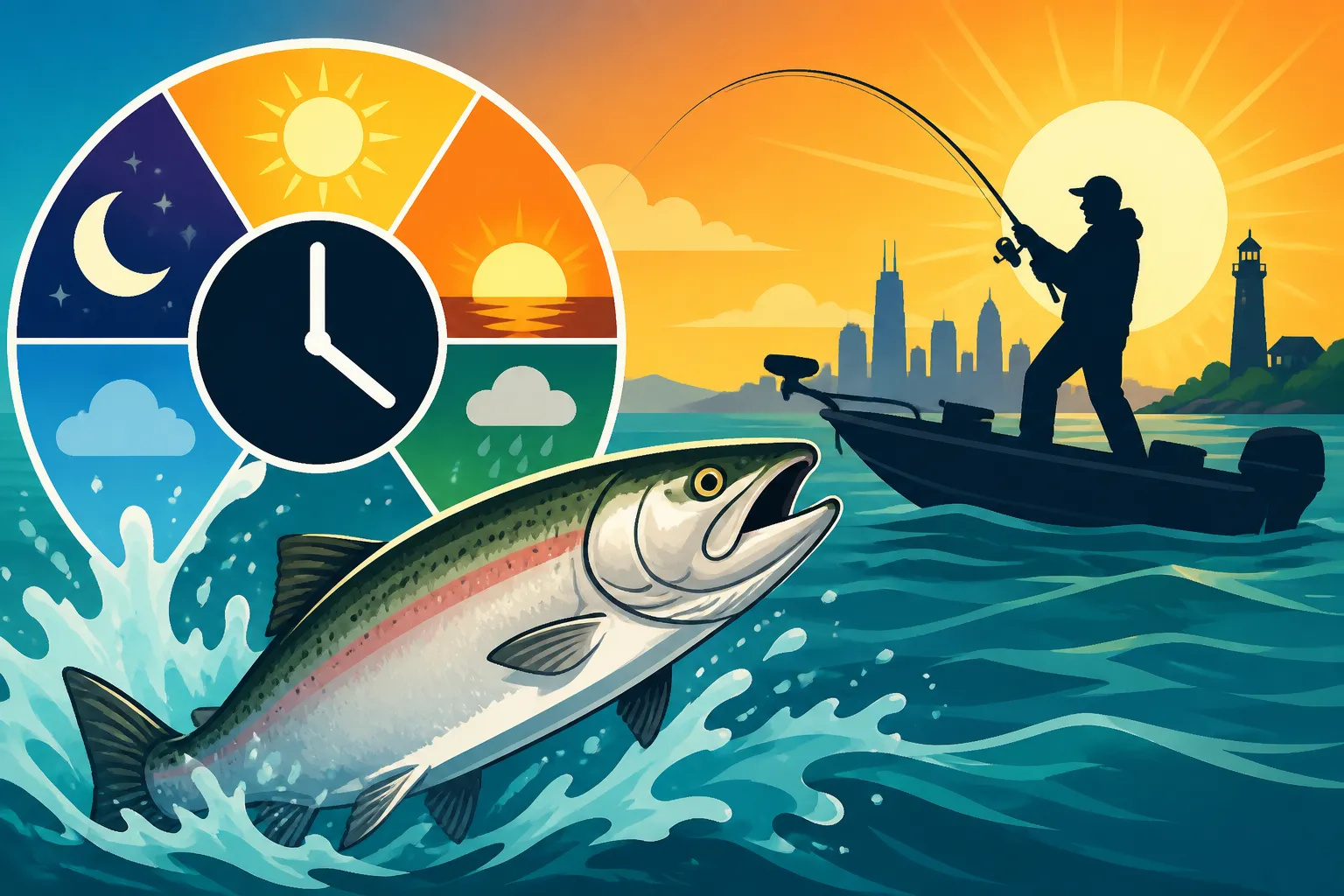
During the dog days of summer, anglers often have to work harder, sometimes venturing many miles offshore to find cooler, oxygenated water. Downriggers are almost always a necessity, and lures need to be presented with precision at depths that could be 80 to 150 feet or more. Early mornings and late evenings often provide the best bite windows, as the fish might move up slightly in the water column during lower light conditions. While not as consistent as spring, summer can still yield impressive catches, especially for those dedicated enough to put in the time and master deep-water trolling techniques. Sometimes, those big, hard-fighting Coho are a testament to the effort you put in.
Fall's Promise: The Pre-Spawn Rush
As autumn approaches, typically from September through October, another excellent opportunity for Coho salmon arises: the pre-spawn run. Similar to spring, cooling water temperatures bring the fish closer to shore and river mouths as they prepare for their spawning migration. These fish are mature, full of fight, and often quite aggressive as they stage before moving into tributary rivers to complete their life cycle.
During this time, both boat and shore anglers can experience great success. Coho will congregate near river mouths, harbors, and along traditional staging areas near the Illinois shoreline. Trolling becomes effective again in shallower to mid-range depths, and casting spoons or stickbaits from piers and breakwalls can be very productive, especially after a good rain that might encourage fish to push closer to river entrances. The fall Coho are often larger than their spring counterparts, having had a full summer of feeding. It’s a thrilling time to be on the water, offering some of the last chances to catch these magnificent salmon before winter truly sets in. This season is particularly exciting, and you can learn more about targeting them by exploring When to Chase Salmon vs Trout on Illinois's Lake Michigan Shore.
Prime Time Factors: What Triggers the Best Coho Action?
Beyond the general seasons, several specific environmental factors play a huge role in whether the Coho are biting on any given day. Ignoring these can mean the difference between a full cooler and a frustrating skunking. Learning to "read the water" and understand these influences is a skill that separates the consistently successful anglers from those who merely hope for luck.
Water Temperature: The Golden Number for Coho
If there's one factor that dictates Coho salmon activity more than any other, it's water temperature. Coho are cold-water fish and prefer a relatively narrow temperature band. Generally, their sweet spot is often cited as being between 40 and 55 degrees Fahrenheit, though they can be found outside this range. In early spring, they'll seek out the warmest available water near shore. In summer, they'll dive deep to find those cooler, comfortable zones.
Understanding how to find these temperatures is key. On a boat, a good fishfinder with a temperature gauge is invaluable. Look for temperature breaks or "thermal bars" where warmer and cooler water meet – these are often congregation points for baitfish and Coho alike. Shore anglers can monitor online reports or use simple surface thermometers near piers and harbors. A sudden drop or rise in temperature can push fish away or draw them in, so staying aware of the thermal conditions is a constant part of the Lake Michigan Coho game. Many modern fish finders, even those you can find on Amazon, offer excellent temperature readings that are critical for locating fish.
Weather Patterns and Their Impact
Weather isn't just about whether you need a raincoat; it profoundly impacts fish behavior. Stable weather patterns, especially a few days of consistent conditions, often lead to more predictable fishing. Cold fronts, on the other hand, can be a Coho angler's nemesis. A sudden drop in air temperature or a sharp change in barometric pressure can send fish into a funk, making them less willing to bite. They might suspend deeper, become sluggish, or simply ignore your offerings.
Wind direction and strength also play a significant role. Consistent winds from one direction can create current seams and concentrate baitfish. However, strong winds can churn up the water, creating turbidity (murky water) near shore that might push Coho further out. Conversely, offshore winds can push warm surface water away, drawing cooler, more appealing water closer to shore. Pay attention to the forecast, not just for your comfort, but for how it might be influencing the salmon beneath the surface.
Forage and Food Sources
Coho salmon are opportunistic predators, and their movements are heavily dictated by the presence and abundance of their food sources. In Lake Michigan, the primary forage for Coho is often alewives, a small, silvery baitfish. If the alewives are schooled up in a particular area, you can bet the Coho won't be far behind. Finding bait on your electronics is often the first step to finding salmon.
Sometimes, Coho will feed on other baitfish like smelt or even smaller juvenile fish. Understanding the baitfish patterns – whether they're shallow, deep, near shore, or offshore – gives you a massive advantage. Anglers often try to "match the hatch" by using lures that mimic the size, color, and action of the predominant baitfish. If you're consistently seeing small alewives on your fishfinder, using a smaller profile spoon or crankbait might be more effective than a large one. Keeping an eye on what's washing up on shore, or what's in the bellies of the fish you catch, can also provide valuable clues.
Gear Up for Coho: Essential Tackle and Techniques
To effectively target Coho salmon on Lake Michigan, especially when they move deeper or further offshore, you need the right tools and a solid understanding of how to use them. While you don't need to break the bank, having reliable gear makes a significant difference in your success and enjoyment.
Rods, Reels, and Line for Lake Michigan Coho
For boat trolling, a medium-heavy action trolling rod, typically 7 to 9 feet long, paired with a reliable line counter reel is often the go-to setup. The line counter is absolutely essential for replicating successful depths once you find them. Reels should be spooled with monofilament, fluorocarbon, or braided line, with varying line types chosen based on the specific presentation (e.g., braid for minimal stretch and sensitivity, mono for some give). A common line strength for Coho is 15-20 pound test.
For shore or pier fishing, a longer, medium-heavy spinning rod (8 to 10 feet or even longer) allows for longer casts to reach schooling fish. Pair this with a durable spinning reel capable of holding a good amount of 10-15 pound test line. Remember, these fish fight hard, so quality drag systems are a must. Looking for a good all-around setup? You can often find excellent combos on Amazon that are perfectly suited for Lake Michigan Coho. Don't skimp on your fishing line, as a broken line can mean losing that trophy Coho.
Lure Selection: Spoons, Plugs, and Flies
Coho salmon are notoriously aggressive, and they hit a wide variety of lures. Spoons are probably the most popular choice, coming in various sizes, colors, and actions. Popular colors often include bright patterns like orange, chartreuse, silver, and various shades of blue and green, especially those with reflective tape. Experimentation is key; what worked yesterday might not work today. Plugs and crankbaits that mimic baitfish are also very effective, especially in shallower water or when trolled.
Flasher/fly combinations, where a larger attractor (the flasher) is followed by a short leader and a fly (often mimicking a small baitfish or insect), are also deadly, particularly when fish are deeper. The flashers create vibration and attraction, drawing Coho in to see the trailing fly. Having a good selection of these different lure types in various sizes and colors in your tackle box is crucial for adapting to changing conditions on the lake. Many anglers spend hours meticulously organizing their lure collections, often ordering new patterns and colors from places like Amazon to try out the latest trends or restock old favorites.
Trolling and Downriggers: Reaching the Depths
For boat anglers, effective trolling is almost an art form. It's not just about dragging lures; it's about controlling speed, depth, and presentation with precision. Downriggers are indispensable for consistently placing lures at specific depths where Coho are holding, especially when they are suspended. These devices allow you to clip your fishing line to a heavy ball that's lowered to a precise depth, releasing the line when a fish strikes.
Beyond downriggers, tools like planer boards are used to spread multiple lines out to the sides of the boat, covering a wider swath of water and avoiding spooking fish that might be boat-shy. Dipsy divers or other directional diving aids help get lures down without the need for heavy lead, and they can be set to run out to the side as well. Mastering these techniques involves understanding how your boat speed, lure type, and line choices interact to achieve the desired depth and action. Precision in depth and speed can often be the deciding factor between a slow day and a banner day on the water. To dive deeper into these techniques, check out our article on Lake Michigan Trolling Gear for Salmon and Trout.
Where to Find Coho in Illinois: Shore, Pier, and Boat Access
Knowing when to fish is great, but you also need to know where to go. Illinois offers several fantastic access points to Lake Michigan, catering to both land-based and boat anglers who are eager to chase Coho salmon.
Shore and Pier Fishing Hotspots
For those without a boat, or simply preferring the tranquility of land, Illinois offers excellent opportunities to catch Coho from shore or piers. The Chicago lakefront, with its numerous public piers and harbors, is a prime example. Places like Montrose Harbor, Navy Pier, and the various park districts along the shore can be fantastic, especially during the early spring and fall runs when Coho move closer in. Anglers casting spoons, crankbaits, or even using live bait under a bobber can find success.
Further north, Waukegan Harbor is another highly popular spot. The piers and breakwalls here offer direct access to Lake Michigan's waters, and it's well-known for producing Coho, especially when the fish are staging or feeding near the harbor mouth. Other smaller access points and public beaches along the Illinois shoreline can also be productive, particularly after strong onshore winds push baitfish (and Coho) closer to shore. Always be mindful of local regulations and other anglers when fishing these popular spots. We've got a great resource dedicated to Best Salmon Fishing Spots on Lake Michigan that breaks down specific locations.
| Location Type | Best Season | Typical Depths (Feet) | Recommended Techniques | Key Considerations |
|---|---|---|---|---|
| Piers/Shore | Early Spring, Fall | 0-20 | Casting Spoons/Plugs, Bobber Fishing | Crowds, Weather Exposure |
| Nearshore (Boat) | Early Spring, Fall | 10-40 | Trolling Spoons/Stickbaits, Leadcore | Water Temperature, Baitfish Presence |
| Offshore (Boat) | Late Spring, Summer | 40-150+ | Downriggers, Dipsy Divers, Flashers/Flies | Electronics, Fuel, Weather Stability |
Boat Fishing: The Most Effective Way to Target Coho
Without a doubt, boat fishing offers the most versatility and often the highest success rates for Coho salmon on Lake Michigan. Boats allow anglers to cover vast expanses of water, chase temperature breaks, and target fish at precise depths using specialized gear like downriggers and planer boards. Public boat ramps are available in various locations along the Illinois coastline, including Chicago and Waukegan, providing access for trailerable boats.
When fishing from a boat, your electronics are your best friend. A quality fishfinder will help you locate baitfish schools, identify the thermocline, and mark individual salmon or groups of fish. GPS is essential for navigating the big water, marking waypoints where you find active fish, and setting precise trolling paths. Keep an eye on the marine weather forecast – Lake Michigan can get rough very quickly, and safety should always be your top priority. For boaters keen on improving their deep-water game, our article on Downriggers and Planer Boards for Lake Michigan offers a deep dive into advanced techniques. Remember, the flexibility of a boat allows you to adapt to where the Coho are on any given day, making it the premier method for consistent success.
Disclaimer
This article is for general informational purposes only and does not constitute professional advice. Laws, prices and regulations vary by location and change over time. Consult a qualified professional for guidance on your specific situation.