Tackle Box Setup for Illinois Bass Anglers
It can feel totally overwhelming to open up a new tackle box and figure out how to fill it, especially when you're targeting a specific fish like bass in Illinois. You want to be prepared for anything the water throws at you, but you don't want to carry around a whole sporting goods store! This guide is here to help you cut through the clutter and set up a practical, effective tackle box specifically for chasing largemouth and smallmouth bass across our beautiful state.
The Foundation: What Every Bass Angler's Tackle Box Needs
Before you even start thinking about specific lures, you need to make sure you have the core tools that will make your time on the water productive and enjoyable. These are your non-negotiables, the items that lay the groundwork for a successful bass fishing trip in Illinois.
Rods and Reels: Your Primary Tools
Let's be real, you can't fish without a rod and reel, right? But for bass, it’s not just any rod and reel. Bass fishing in Illinois often demands a bit more versatility than, say, panfishing. You'll want a setup that can handle powerful strikes, strong runs into cover, and the ability to cast a variety of lures.
For many Illinois anglers, a good starting point is a medium-heavy power rod with a fast action. This means the rod has enough backbone to really set the hook and fight a feisty bass, but the tip is sensitive enough to detect subtle bites. This combo is excellent for throwing everything from jigs and Texas-rigged worms to spinnerbaits and medium-diving crankbaits. If you can swing it, having a second rod with a medium power and moderate-fast action can be a game-changer for lighter lures, topwater baits, or even crankbaits that need a bit more give. Remember, a broken rod tip or tangled reel can end your day early, so investing in reliable gear from places like Bass Pro Shops can really pay off in the long run. When considering your choices, it helps to understand the nuances, so make sure to check out Best Rods for Illinois Largemouth Bass for more in-depth advice.
When it comes to reels, you’ll typically be choosing between spinning and baitcasting. Spinning reels are fantastic for beginners and for lighter lures, offering easier casting with less backlash. They're also great for finesse techniques with lighter lines. However, for heavier cover or larger, heavier lures, a baitcasting reel offers more power, precision, and control. It takes a little practice to master a baitcaster, but many experienced bass anglers swear by them for their versatility and strength. Consider a reel with a moderate gear ratio (around 6.4:1 or 7.1:1) for all-around versatility. For more detailed comparisons, you might find Spinning vs Baitcasting Reels for Bass Fishing helpful in making your decision.
Line Choices for Illinois Waters
Ah, fishing line! It seems simple, but the right line can make all the difference between landing that trophy bass and telling a sad "one that got away" story. Illinois waters can vary wildly from crystal clear to murky and stained, and each condition calls for a different approach.
- Monofilament (Mono): This is your all-around workhorse. It's affordable, has good stretch, and is easy to cast, making it very forgiving. The stretch acts like a shock absorber, which is great for topwater baits where fish often strike aggressively. However, it’s more visible in clear water and can be prone to memory (curling up) on spinning reels. A 10-14 lb test mono is usually a good starting point for general bass fishing.
- Fluorocarbon (Fluoro): This is the stealth fighter of fishing lines. It's nearly invisible underwater, has less stretch than mono for better sensitivity, and sinks, which is great for bottom contact baits like jigs and worms. The lower stretch also translates to better hook sets. The downside? It's typically more expensive and can be a bit stiffer to work with. For Texas rigs or jigs, a 12-17 lb test fluorocarbon is fantastic.
- Braided Line (Braid): Power, sensitivity, and no stretch whatsoever. Braid is fantastic for fishing heavy cover, punching through weeds, or using topwater frogs. Its incredible strength-to-diameter ratio means you can use a lighter line for more casting distance without sacrificing pulling power. However, it's highly visible, which is why many anglers tie a fluorocarbon or monofilament leader (often 3-6 feet long) to the end of their braid for better stealth. A 30-50 lb test braid with a 10-20 lb fluoro leader is a common and highly effective setup.
When choosing, think about the conditions. If you're fishing a clear gravel pit in Southern Illinois, fluorocarbon will give you an edge. If you're punching mats of hydrilla on a Northern Illinois lake, braid is your best friend.
Essential Terminal Tackle (Hooks, Weights, Swivels)
This is the nuts and bolts of your tackle box, the unsung heroes that connect your line to your lure and ultimately, to the fish. Skimping here is a rookie mistake!
- Hooks: You'll need a variety for bass.
- EWG (Extra Wide Gap) Worm Hooks: Sizes 3/0 to 5/0 are perfect for Texas-rigging plastic worms, creature baits, and craws, especially in cover. The wide gap allows for good hook penetration even with bulky plastics.
- Offset Worm Hooks: Similar to EWG but with a slightly narrower gap, good for thinner worms or when you need a more streamlined presentation.
- Straight Shank Hooks: Excellent for flipping and pitching jigs and soft plastics into heavy cover due to their strength and direct hook point.
- Treble Hooks: You'll find these already on most crankbaits, jerkbaits, and topwater lures. Having some spare #4, #6, and #8 trebles on hand to replace dull or bent hooks is smart.
- Drop Shot Hooks: Small, specialized hooks (often #1 or #2) designed for vertical presentations with small soft plastics.
- Weights: These get your lures where the fish are.
- Bullet Weights: Your go-to for Texas rigging. Get them in various sizes from 1/8 oz to 1 oz, in lead-free options if possible. Tungsten weights are more expensive but offer better sensitivity due to their density.
- Carolina Rig Weights: Typically heavier (1/2 oz to 1 oz) and often egg-shaped, used with a bead and swivel for the Carolina rig.
- Drop Shot Weights: Slender, cylindrical, or tear-drop shaped weights in 1/8 oz to 1/2 oz for drop shotting.
- Jig Heads: For swimming small soft plastics or grubs, from 1/16 oz to 1/4 oz.
- Nail Weights: Small, insertable weights for wacky rigging or adding subtle weight to soft plastics.
- Swivels: While not always necessary for bass, barrel swivels (size 7-10) are useful for preventing line twist, especially when fishing with inline spinners or when using a Carolina rig. Snap swivels can make changing lures quicker, but many anglers prefer a direct knot for strength. Always have a small assortment of these on hand.
Lure Arsenal for Illinois Largemouth and Smallmouth
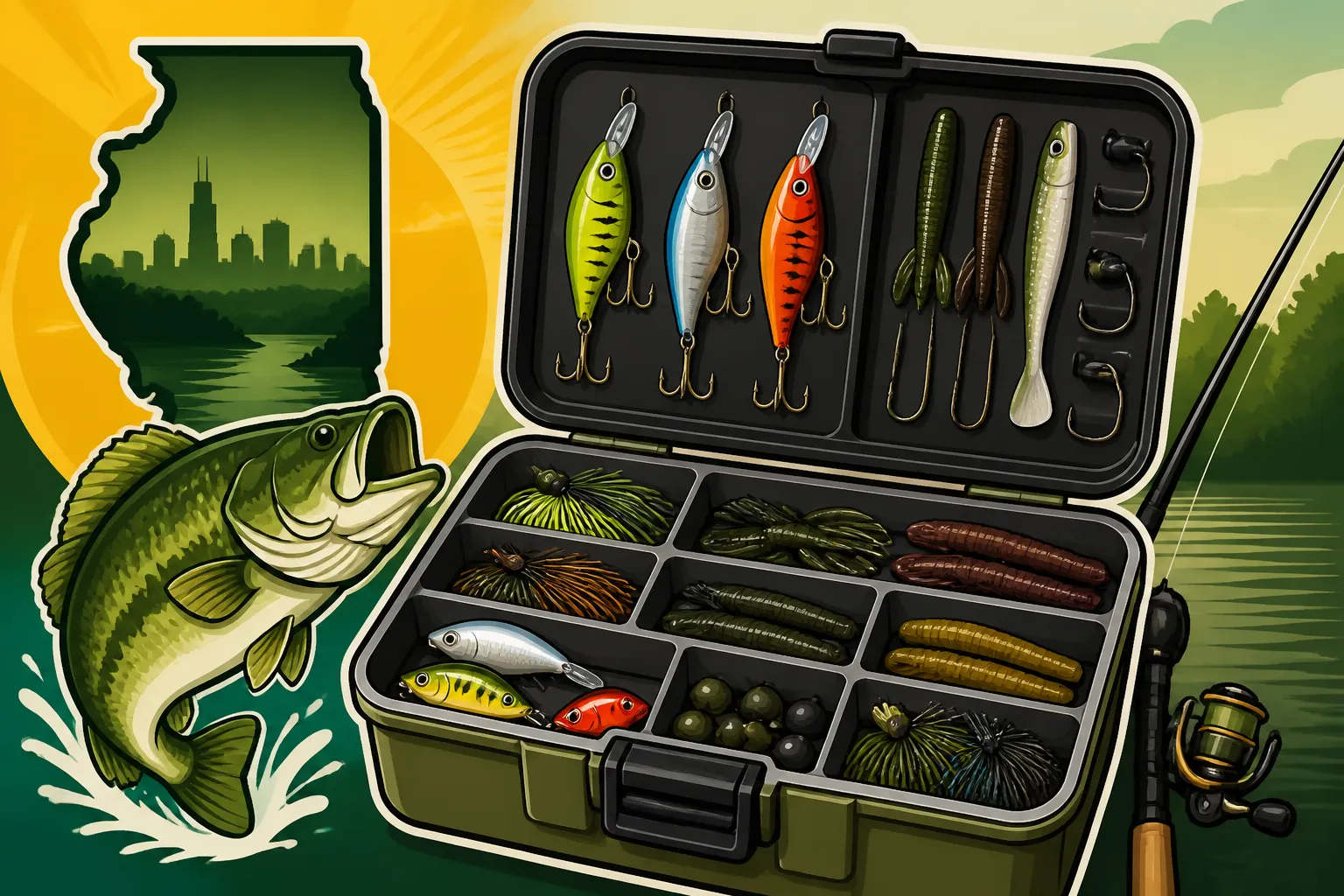
Now for the fun part: the lures! Bass in Illinois are opportunistic feeders, but they can also be incredibly finicky. Having a diverse selection of baits will allow you to adapt to changing conditions and fish moods. Remember, you don't need every single lure ever made, but a good range of types and colors will serve you well. For a deeper dive into target species, check out Largemouth Bass Fishing in Illinois: The Complete Guide and Smallmouth Bass Fishing in Illinois: The Complete Guide.
Soft Plastics: Versatility is Key
Soft plastics are, arguably, the most versatile and effective category of bass lures. They can imitate worms, crawfish, minnows, and just about anything else a bass might eat.
- Worms: The classic. Stick worms (like a Senko or its many imitators) are incredibly effective wacky-rigged or Texas-rigged. Ribbon-tail worms and curly-tail worms add action, especially on a Texas rig or Carolina rig. Keep a few different sizes (4-10 inches) and colors. Green pumpkin, black and blue, and natural shad colors are always winners. Learn how to present these effectively by reading How to Fish a Texas Rig for Bass and How to Fish a Carolina Rig for Bass.
- Creature Baits & Craws: These mimic crawfish or other aquatic critters and are excellent for flipping, pitching, or dragging on the bottom. Their appendages create a lot of subtle movement. Again, green pumpkin and black and blue are staples, especially around cover.
- Flukes & Swimbaits: Soft plastic jerkbaits (flukes) are fantastic for mimicking dying baitfish, especially in clear water. Rig them weightless or with a small belly weight. Swimbaits, with their paddle tails, are great for imitating shad or bluegill and can be fished on a weighted swimbait hook or a jig head.
Don't go overboard with colors. Start with natural greens/browns for clearer water, and darker colors (black/blue, junebug) for stained or muddy water. You can always pick up more niche colors from your local bait shop or through online retailers like Amazon as you gain experience.
Hard Baits: Crankbaits, Jerkbaits, and Topwater
Hard baits offer different actions, vibrations, and looks that can trigger strikes when soft plastics won't. They're often about covering water and finding active fish.
- Crankbaits: These baits dive when retrieved, with different models reaching different depths.
- Shallow Divers: (1-5 feet) Great for fishing over shallow cover, grass flats, or around docks. Squarebill crankbaits are particularly good for deflecting off wood and rock.
- Medium Divers: (6-12 feet) Versatile for targeting mid-depth structure or cover.
- Deep Divers: (12+ feet) Essential for reaching bass holding on deep points, ledges, or humps, especially in larger Illinois reservoirs like Carlyle or Shelbyville.
For colors, stick to shad patterns, crawfish patterns, and bright chartreuse or fire tiger for dirty water. Check out Best Crankbaits for Largemouth Bass for more specific recommendations.
- Jerkbaits: These baits are designed to be retrieved with a "jerking" or "twitching" motion, causing them to dart and suspend in the water like a wounded baitfish. They are absolute killers for suspended bass, especially in cooler water or during the Spring Bass Fishing Patterns. Shad and clear patterns are generally most effective.
- Topwater Lures: Nothing beats the excitement of a bass exploding on a topwater lure!
- Poppers: Create a "bloop" sound and splash, good for calm conditions.
- Walking Baits: (like a Zara Spook) Glide side-to-side across the surface, an irresistible action for aggressive bass.
- Frogs: Designed for fishing over heavy vegetation, pads, or matted grass. Their weedless design makes them perfect for places other lures can't go.
Topwater lures are often most effective during low light conditions or when the water is warmer.
Spinnerbaits and Jigs: All-Season Bass Catchers
These two categories are mainstays in any serious bass angler's tackle box because they consistently catch fish under a wide range of conditions.
- Spinnerbaits: With their flashing blades and vibrating skirt, spinnerbaits are fantastic search baits. They cast well, come through cover easily, and create a lot of commotion.
- Blade Types: Colorado blades (round) create more thump and vibration, ideal for stained water or slower retrieves. Willowleaf blades (long, slender) offer more flash and less resistance, great for clear water or faster retrieves. Tandem (one Colorado, one Willowleaf) is a popular versatile option.
- Colors: White/chartreuse for stained water, natural shad patterns for clear water, and black/blue for low light. Weight ranges from 1/4 oz to 3/4 oz.
- Jigs: Jigs are perhaps the most versatile bass bait, capable of imitating crawfish, bluegill, or other forage. They can be flipped, pitched, skipped, swam, or dragged.
- Football Jigs: Designed for fishing rocky bottoms, they mimic a crawfish scurrying along.
- Flipping Jigs: More compact, designed to be pitched into dense cover.
- Swim Jigs: Rigged with a paddle tail swimbait, they imitate baitfish swimming through vegetation.
- Finesse Jigs/Shaky Head Jigs: Lighter, smaller jigs for more subtle presentations when bass are finicky.
Always pair your jigs with a suitable soft plastic trailer to add bulk and action. Green pumpkin, black and blue, and brown/orange are classic jig colors.
Organization and Accessories: Keeping Your Gear in Check
Having all the right tackle won't do you much good if you can't find it or if it's damaged. Proper organization and having the right accessories are crucial for efficiency and extending the life of your gear.
Tackle Box Styles and Organization Tips
The traditional hinged tackle box with a dozen trays might be what comes to mind, but modern bass fishing often calls for more flexible and organized solutions.
- Utility Boxes (3600/3700 Series): These clear plastic boxes with adjustable dividers are the backbone of many bass anglers' setups. They allow you to see your lures at a glance and keep different categories neatly separated. You can dedicate one box to crankbaits, another to soft plastics (separated by color or type), another to jigs, and so on. Many soft-sided tackle bags are designed to hold multiple utility boxes, offering a customizable and portable system. Brands like Plano offer excellent options that are widely available at retailers like Bass Pro Shops and on Amazon.
- Soft-Sided Tackle Bags: These are incredibly popular because they're easier to carry, often have external pockets for tools and accessories, and protect your gear from bumps and drops. Look for models with waterproof bottoms to keep moisture out.
- Bulk Storage: Keep excess soft plastics in their original bags in a larger storage bin at home, only bringing what you expect to use on a given trip. This prevents them from drying out or losing their scent, and it keeps your on-the-water tackle box lighter.
- Separation is Key: Separate hooks from weights, different lure types, and even different colors of soft plastics. This prevents tangles, rust (especially if wet hooks are mixed with soft plastics), and frustrating searches when the bite is on. Using smaller, specialized containers within your larger utility boxes for terminal tackle is a smart move.
Essential Tools and Safety Items
Your tackle box isn't just for lures; it's also where you keep the tools that make fishing easier and safer.
- Pliers/Forceps: Crucial for removing hooks from fish (and sometimes yourself!), cutting wire, or crimping sleeves. Get a good pair with a comfortable grip.
- Line Cutters: Small, sharp scissors or clippers are much better than trying to bite through braided line!
- Scale and Measuring Tape: If you're serious about your catches (or want to ensure you're within the Illinois Statewide Bass Fishing Limits), a small digital scale and a flexible measuring tape are invaluable.
- Hook Sharpener: A dull hook misses fish. A small file or stone can quickly put a point back on a hook.
- First Aid Kit: Accidents happen. A small, waterproof kit with bandages, antiseptic wipes, pain relievers, and any personal medications is non-negotiable.
- Sunscreen and Insect Repellent: Protect yourself from the elements. You don't want a sunburn or mosquito bites cutting your day short.
- Camera: For those memorable catches! (Just make sure it's waterproof or in a dry bag).
Seasonal Adjustments and Advanced Tips
Bass behavior, and therefore your tackle preferences, will shift dramatically with the seasons in Illinois. What works in spring won't necessarily be your best bet in the dog days of summer. Being able to adapt your tackle box to the time of year is a hallmark of an experienced angler.
Spring Bass Fishing Additions
Spring in Illinois is all about the spawn, and bass are often in transition, moving from deeper wintering grounds to shallow spawning areas. This is a prime time for power fishing and slow, deliberate presentations.
- Focus on Pre-Spawn and Spawn Baits: Jigs (football, flipping, swim jigs) and creature baits are absolutely phenomenal in spring as bass are looking for crawfish or defending their nests. Spinnerbaits and shallow-diving crankbaits are excellent for covering water and triggering reaction strikes from aggressive fish. Lipless crankbaits can also shine when bass are staging in pre-spawn areas.
- Color Choices: Crawfish patterns (greens, browns, oranges) are paramount, as are shad and bluegill imitators. Black and blue jigs are hard to beat in stained water.
- Finesse Options: Don't forget shaky head jigs and wacky-rigged Senkos for when bass are finicky or during cooler fronts. They can be incredibly effective on bedding fish (where permitted and if you choose to target them). For more insights into this exciting time, check out Spring Bass Fishing Patterns and Best Bait for Largemouth Bass Fishing in Spring.
Summer Bass Fishing Must-Haves
When summer temperatures really heat up in Illinois, bass often move deeper or seek refuge in thick cover to escape the sun and find cooler water. Your tackle needs to reflect this.
- Deep Diving Crankbaits: These become essential for targeting bass on offshore ledges, humps, and points in larger lakes.
- Heavy Jigs and Punching Rigs: If you're fishing lakes with heavy vegetation, a heavy flipping or punching jig (up to 1-1.5 oz) with a compact creature bait is a must-have for getting through thick mats.
- Topwater Explosion: Early mornings and late evenings can offer explosive topwater action, especially with frogs over lily pads or walking baits over open water.
- Worms, Worms, Worms: Texas-rigged, Carolina-rigged, or drop-shotted worms remain effective as bass seek cooler water. Larger worms can entice bigger bites. You'll find bass in predictable patterns, especially if you know How to Find Bass in Summer Heat.
Fall and Winter Considerations
As fall arrives, bass often go on a feeding frenzy, fattening up for winter. This can be some of the best fishing of the year. Winter, though challenging, can still produce big fish for persistent anglers.
- Fall: Jerkbaits are particularly deadly in fall as bass chase schooling baitfish in open water. Bladed jigs (Chatterbaits) and spinnerbaits are also excellent for covering water and imitating fleeing bait. Crankbaits, both shallow and deep, can also produce. Don't forget topwater walking baits and poppers on those warmer fall days. Consult the Fall Fishing Calendar for Illinois Anglers to optimize your trips.
- Winter: Fishing slows down considerably, but bass can still be caught. Finesse techniques dominate. Small jigs, shaky heads, blade baits, and suspending jerkbaits are key. Fish very slowly, and consider vertical presentations. Remember, bass are lethargic in cold water, so presentation is everything. Understanding How to Catch Bass in Cold Water will be invaluable during this time.
| Lure Type | Primary Use Case (Illinois Bass) | Ideal Water Depth | Best Season(s) | Key Advantage |
|---|---|---|---|---|
| Soft Plastics | Versatile: Texas/Carolina/Wacky Rigs, Drop Shot, Flipping/Pitching | All depths | All year | Subtle, natural, weedless |
| Crankbaits | Cover water, target specific depths, reaction strikes | Shallow to deep | Spring, Summer, Fall | Vibration, sound, diving |
| Jerkbaits | Suspended bass, cooler water, dying baitfish imitation | Mid-depth | Spring, Fall, Winter | Suspends, erratic action |
| Topwater Lures | Surface strikes, low light, heavy cover (frogs) | Surface | Summer, Spring, Fall | Exciting strikes, bypasses weeds |
| Spinnerbaits | Search bait, cover water, reaction strikes, moderate cover | Shallow to mid-depth | Spring, Summer, Fall | Flash, vibration, weedless |
| Jigs | Bottom contact, heavy cover, crawfish/baitfish imitation | All depths | All year | Versatile, weedless, compact |
By carefully selecting and organizing your tackle based on these principles, you'll be well-prepared for whatever challenges and opportunities Illinois bass fishing presents. Good luck out there, and tight lines!
Disclaimer
This article is for general informational purposes only and does not constitute professional advice. Laws, prices and regulations vary by location and change over time. Consult a qualified professional for guidance on your specific situation.