How to Catch Bass in Cold Water
Catching bass when the water temperatures plummet can feel like trying to find a needle in a haystack. The vibrant, aggressive strikes of summer and fall seem to vanish, replaced by finicky bites and frustratingly empty livewells. But don't despair! This comprehensive guide will walk you through the subtle art of cold water bass fishing in Illinois, helping you understand bass behavior, choose the right gear, and master the techniques needed to find success even when the air bites.
Understanding Cold Water Bass Behavior
When the cold really sets in across Illinois's lakes and rivers, everything changes for bass. Their world slows down dramatically, and if you want to catch them, you have to understand why and how they adapt. It's not about them being completely inactive; it's about a fundamental shift in their priorities.
Why Bass Slow Down in Winter
Imagine trying to run a marathon in freezing temperatures – you're certainly not going to be as fast or energetic as you would on a mild spring day. Bass are much the same. As the water temperature drops, their metabolism, which is directly tied to water temperature, slows way down. This isn't just a minor adjustment; it's a profound physiological change. They don't need to eat as often or expend as much energy chasing down prey. This means those lightning-fast reactions and aggressive strikes you’re used to seeing become far less common.
For us anglers, this translates to bass that are less willing to chase a fast-moving lure. They're conserving energy, and they'll only strike if a meal is easy to catch and requires minimal effort. This is why you often hear experienced cold water anglers talk about "dead sticking" or excruciatingly slow retrieves – you're essentially offering a meal that looks too good (and too easy) to pass up. Lakes like Rend Lake and Lake Shelbyville, which can get quite chilly, exemplify this change in bass behavior, demanding a complete shift in your approach from the lively summer months.
Where Bass Go When Water Gets Cold
Once the chill truly settles in, bass vacate their shallow-water haunts. Those lily pads and shallow docks that produced so well in warmer months are now barren. Instead, bass seek out stability and cover in deeper water. They're looking for areas where the water temperature remains more consistent and where they can find structure to relate to, providing both ambush points and protection.
Think about deep main lake points that drop off quickly into a creek channel, steep bluff walls, or isolated humps in deeper sections of the lake. Submerged brush piles, old timber, and rock piles found in these deeper zones become magnets for bass. These features provide vertical cover, allowing bass to move up or down a few feet to find that perfect temperature zone without expending much energy. For example, on the Illinois River, bass will often congregate in deeper holes or around bridge pilings that extend to the bottom, offering both current breaks and significant depth. Locating these deeper structures, often with the help of a good fish finder, is paramount to success when fishing during the colder months.
Essential Gear for Cold Water Bass Fishing
You can't just pick up your summer gear and expect to catch cold water bass. The subtle bites and slow presentations demand a different setup. Your equipment needs to be tuned for maximum sensitivity, allowing you to detect the faintest tap even when your fingers are numb.
Rods, Reels, and Line for Sensitivity
When bass are lethargic, their bites can be incredibly light, feeling more like a slight pressure or the soft weight of a leaf rather than an aggressive thump. To feel these subtle takes, sensitivity is king. I highly recommend using medium-light to medium power, fast-action graphite rods. Graphite is known for its excellent sensitivity, transmitting even the slightest vibration directly to your hand. A fast action tip will allow for quick hook sets on those light bites, while still having enough backbone to handle a solid fish. You might find a great selection of these specialized rods on sites like Amazon.
For reels, a high-quality spinning reel with a smooth drag is often preferred for finesse techniques, especially when using lighter lines and smaller lures. Baitcasting setups can still be effective, but many anglers find spinning gear offers better control for casting lightweight baits. As for line, fluorocarbon is your best friend in cold water. It's nearly invisible underwater, which is a huge advantage in the typically clearer winter waters, and more importantly, it has very low stretch. This low stretch directly translates to increased sensitivity, letting you feel everything that's happening at the end of your line. A 6-10 lb test fluorocarbon is a good starting point for most cold water bass applications. If you're looking for the right balance, check out options for Best Rods for Illinois Largemouth Bass that prioritize sensitivity.
Cold Water Lures That Get Bites
Forget those noisy, fast-moving topwaters and crankbaits from summer. Cold water bass want something subtle, slow, and easy to catch. The goal is to tempt them into striking, not to provoke a chase. Jerkbaits are absolute legends in cold water. Their erratic, darting action followed by long pauses perfectly mimics a dying baitfish, a meal too easy for a sluggish bass to resist. Look for models like the Megabass Vision 110 or the Lucky Craft Pointer, which suspend perfectly in the water column during pauses.
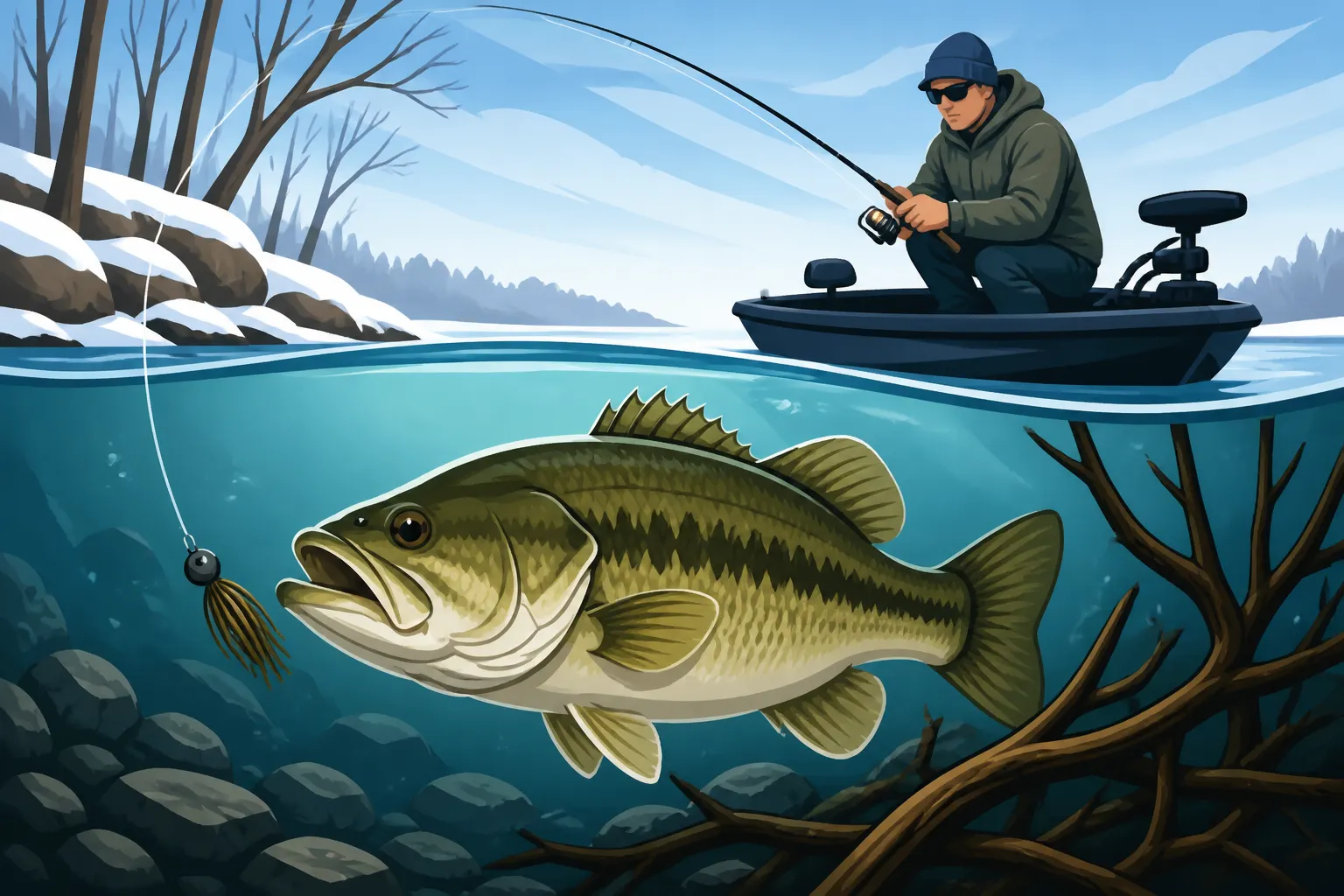
Jigs, particularly football jigs or finesse jigs with chunk-style trailers, are another cold water staple. These can be slowly dragged, hopped, or "dead sticked" on the bottom, mimicking crawfish or other slow-moving forage. Blade baits, like a Johnson ThinFisher or a Damiki Vault, are also incredibly effective. A short, sharp rip followed by a controlled fall allows the bait to flutter enticingly, triggering reaction strikes. Spybaits, which are a very subtle prop bait designed for a slow, steady retrieve, can also be deadly in clear, cold water. When browsing for these specialized baits, "Amazon" offers a wide variety that can be delivered right to your door, making it easy to stock your tackle box for the changing seasons. Don't forget to explore options that are specifically good for Winter Bass Fishing Tips.
| Lure Type | Ideal Presentation | Common Forage Mimicked | Key Characteristics |
|---|---|---|---|
| Jerkbait | Twitch, Twitch, Pause (long) | Dying Baitfish | Erratic darting action, suspends on pause |
| Finesse Jig | Drag, Hop, Dead Stick | Crawfish, Baitfish | Slow, bottom-oriented, subtle profile |
| Blade Bait | Rip, Fall, Repeat | Baitfish (dying/struggling) | Vibrating action on retrieve, flutters on fall |
| Spybait | Slow, Steady Retrieve | Small Baitfish | Subtle rolling and flashing, minimal vibration |
| Deep-Diving Crankbait | Slow Roll, Bottom Contact | Crawfish, Baitfish | Bumps bottom, deflecting off cover |
Proven Techniques for Cold Water Bass
Having the right gear is only half the battle. You need to know how to present your lures in a way that appeals to sluggish, cold water bass. This means slowing down your whole approach and focusing on precision.
Slow Presentations and Finesse Tactics
This is where your patience will truly be tested. When the water is cold, a fast retrieve is almost guaranteed to get you nowhere. You need to slow everything down, sometimes to an almost excruciating crawl. "Dead sticking" a finesse jig or a soft plastic can be incredibly effective. Cast it out, let it sink to the bottom, and then simply let it sit there for an extended period – sometimes 10, 20, or even 30 seconds – before making a very subtle twitch or barely moving it a few inches. Often, the bite will come when the lure is completely still.
For jerkbaits, the cadence is typically "twitch, twitch, pause," but in cold water, those pauses can be dramatically longer, sometimes up to 15 seconds or more between sets of twitches. Watch your line for any movement during these pauses, as a bass might just pick it up and swim off. When using blade baits or deep-diving crankbaits, a "slow roll" or methodically bumping the bottom with long pauses can trigger strikes. The key across all these techniques is to give the bass ample time to see the lure, approach it, and decide to take it. This deliberate approach is also often effective during the Illinois Bass Pre-Spawn Fishing Patterns when bass are still sluggish but starting to feed up.
Targeting Specific Structures in Winter
Bass aren't just in deep water; they're in specific parts of deep water. They seek out areas that offer both depth and some form of cover or transition. Main lake points that extend into deep water are prime targets, especially if they have some form of rock, wood, or gravel where the bass can hide and ambush. Steep bluffs or channel swings where the main river or creek channel makes a sharp turn and comes close to shore are also excellent spots. These areas often concentrate baitfish, and in turn, bass.
Focus on working your lures meticulously along these structures. Don't just cast blindly. Use your electronics to identify submerged timber, rock piles, or old roadbeds. Make multiple casts from different angles to thoroughly dissect the area. For instance, if you're working a deep brush pile, cast past it and slowly retrieve your jig right through the branches. The goal is to put your lure right in front of a bass's nose and keep it there for as long as possible. Understanding why Fishing Rules Vary by Lake and River often comes down to these kinds of structural differences, which influence where fish will hold.
Overcoming Common Cold Water Challenges
Cold water fishing presents unique obstacles beyond just the fish being lethargic. You’re battling the elements, finicky fish, and sometimes, your own dwindling patience.
Dealing with Finicky Bites
It’s one thing to say bass are finicky in cold water; it’s another to experience it. You might feel a subtle tick, or just a heavy sensation, only to reel in and find nothing. Or worse, you might go hours without a single bump. Patience is truly a virtue here. When bites are scarce, don't be afraid to downsize your lures even further. A smaller jig or a tiny grub on a shaky head might be the trick. Dropping down to lighter fluorocarbon line, say 6lb instead of 8lb, can also increase your sensitivity and fool wary fish.
Experiment with your retrieve speeds and pause durations. Sometimes, an even longer pause is needed. Other times, a slightly more aggressive twitch can trigger a reaction. Don't underestimate the power of scent. Applying a fish attractant to your lures can make a significant difference, encouraging a hesitant bass to hold onto the bait longer. It’s a lot like how anglers pursuing walleye in these same cold conditions use a lot of finesse; you might even find shared tactics with the advice in an Illinois Walleye Fishing: The Complete Guide. The key is to keep experimenting until you find the subtle trigger that works on that particular day.
Staying Warm and Safe on the Water
Fishing in cold weather isn't just uncomfortable; it can be dangerous if you're not prepared. Layering your clothing is absolutely crucial. Start with a moisture-wicking base layer, add insulating layers like fleece or down, and top it off with a waterproof and windproof outer shell. Don't forget your extremities: a warm hat, insulated gloves (or fingerless gloves with hand warmers tucked in), and waterproof, insulated boots are essential. Hand warmers and toe warmers can be game-changers on those frigid days.
Beyond comfort, safety is paramount. Cold water immersion is a serious risk. Always wear a U.S. Coast Guard-approved life jacket (PFD), even if you're typically a strong swimmer. Modern PFDs are far less bulky than they used to be and can be worn comfortably over layers. Let someone know where you're going and when you expect to return. Ensure your boat is in top condition, especially the battery and motor, as breakdowns are far more serious in cold weather. Carry emergency supplies like a first-aid kit, a fully charged cell phone in a waterproof bag, and extra warm clothes. Before every trip, double-check your Illinois Boat Safety Equipment Checklist to ensure you're prepared for any eventuality.
Disclaimer
The information provided in this guide is for general informational purposes only. Fishing regulations and conditions in Illinois can change, so always check the latest rules and safety guidelines from the Illinois Department of Natural Resources (IDNR) before heading out. Exercise caution and good judgment when on or near the water.