Best Line Weight for Lake Michigan Trout
Choosing the right fishing line for Lake Michigan trout and salmon can feel like an overwhelming task. With so many species, varying depths, and different fishing techniques, many anglers struggle with knowing what line weight will give them the best chance of success without breaking off a trophy fish. This guide is here to untangle that confusion, helping you select the perfect line to conquer the depths of Lake Michigan for its prized trout and salmon.
Understanding Lake Michigan Trout Species and Their Fight
Before we dive into the nitty-gritty of line weights, it’s crucial to understand the fish you're targeting in Lake Michigan. Each species has its own unique fighting style, average size, and habitat preferences, all of which play a role in determining your ideal line setup. It’s not a one-size-fits-all situation when you’re dealing with the diverse fishery of this incredible Great Lake.
Coho Salmon and Their Aggressive Runs
Coho salmon, often called "silvers" due to their brilliant scales, are known for their incredibly aggressive and acrobatic fights. They'll hit hard, often jump clear out of the water, and make blistering runs. While they might not be the heaviest fish in the lake, typically ranging from 3 to 10 pounds, their sheer energy and willingness to fight mean you need a line that can withstand sudden shock. A Coho hitting a dodger or a fly behind a diver can feel like a freight train, and a weaker line or poor knot can lead to heartbreak. They’re often found in the upper water column, especially in spring, which means less abrasion from structure but still demands a line with good shock absorption.
Chinook Salmon (King Salmon) – The True Powerhouses
Ah, the King Salmon! These are the heavyweights of Lake Michigan, and they earn their name. Chinook salmon can grow to impressive sizes, with fish over 20 pounds being common and some pushing 30 pounds or more. When a King hits, it’s not just a bite; it's an explosion. They make incredibly powerful, sustained runs, often stripping hundreds of feet of line from your reel in a matter of seconds. Their immense strength puts serious strain on your entire setup, from rod to reel to the line itself. If you're specifically targeting these giants, your line choice needs to prioritize brute strength and abrasion resistance to prevent them from breaking off around boat components or during their deep, powerful dives. You can learn more about these magnificent fish in our Coho Salmon Fishing in Illinois: What to Expect guide.
Lake Trout and Their Deep-Water Battles
Lake trout are the native titans of Lake Michigan, often found in the deepest, coldest parts of the lake. Unlike the flashy jumps of salmon, lake trout are known for their deep, stubborn fights. They'll hold bottom, making powerful, head-shaking surges that can feel like pulling a tractor tire from the mud. Their habitat often involves rocky structures and deep ledges, which means abrasion resistance is a huge factor. A line that can withstand rubbing against rough bottom or a downrigger cable is paramount when battling a large lake trout, which can easily exceed 15-20 pounds and sometimes push past 30. Their sheer mass and refusal to come up easily test the endurance of your gear.
Brown Trout and Rainbow Trout (Steelhead)
While not reaching the same monster sizes as Chinook or Lake Trout, brown trout and rainbow trout (often called steelhead when anadromous) offer fantastic sport fishing in Lake Michigan. Brown trout can be elusive but grow to respectable sizes, often 5-15 pounds, and are known for their strong, steady pulls. Steelhead, on the other hand, are renowned for their incredible aerial displays and blazing runs. A typical steelhead caught in the lake might be 6-12 pounds, but they fight with the intensity of much larger fish. For these species, particularly steelhead, a line with good shock strength and minimal memory is beneficial to handle their quick, unpredictable movements. Both of these trout species are often targeted closer to shore or in shallower depths, especially in early spring and fall. For more on these incredible fish, check out Illinois Lake Michigan Brown Trout Fishing Tips.
Factors Influencing Line Weight Selection for Lake Michigan
Choosing the "best" line weight isn't just about the fish; it's a complex equation involving several environmental and tactical variables. Each element affects how your line performs and how successful you'll be on the water.
Water Clarity and Depth
Lake Michigan is known for its incredible water clarity, especially offshore. In clear water, fish can be more line-shy, meaning they can see thicker or more visible lines. This often pushes anglers towards thinner diameter lines, or at least a clear fluorocarbon leader, to present baits more naturally. The clarity means that heavy, visible monofilament might deter wary fish.
Depth also plays a crucial role. When you're fishing hundreds of feet down with downriggers or heavy divers, line stretch becomes a significant factor. Monofilament, with its inherent stretch, can make it harder to feel subtle bites at extreme depths and can reduce hook-setting power. Braided lines, with their near-zero stretch, offer superior sensitivity and direct hook-sets, making them a favorite for deep-water presentations. However, the lack of stretch in braid means your rod and reel's drag system must absorb all the shock.
Trolling vs. Casting/Jigging
The technique you're employing directly dictates your line requirements.
- Trolling: This is the most common method for Lake Michigan salmon and trout. When trolling, your line is constantly under tension, often running through downrigger clips, planer board releases, or in direct contact with diver weights. This calls for lines with excellent abrasion resistance and good knot strength to handle the constant stress. For main lines on downriggers or large divers, a heavier braid or specialty monofilament is common.
- Casting/Jigging: While less common for offshore Lake Michigan, casting spoons or jigs near harbors, piers, or river mouths (especially for steelhead) requires a different approach. Here, sensitivity is key to feeling light bites, and castability is essential. Lighter monofilament, fluorocarbon, or a sensitive braided line with a fluorocarbon leader would be preferred. The ability to make long, accurate casts and detect subtle strikes makes line diameter and stretch critical factors. Our guide on Lake Michigan Pier Fishing Near Waukegan, Illinois offers some great casting insights.
Target Fish Size and Typical Conditions
Are you hoping to land a state-record Chinook, or are you happy with a mixed bag of respectable Cohos and Brown Trout? Your target fish size is paramount. If you're consistently catching 5-10 pound fish, a 15-20 pound test line might be perfectly adequate. But if you're seriously hunting for 20+ pound Kings, bumping up to 25-30 pound test, especially for leaders, provides a much-needed safety net.
Typical Lake Michigan conditions can be unforgiving. Strong currents, heavy waves, and floating debris (especially after storms or heavy rains) can put extra stress on your line. Waves can create slack in your line, making it easier for fish to shake hooks, while debris can cause nicks and abrasions that compromise line strength. During rougher conditions, a slightly heavier or more abrasion-resistant line might be a wise choice.
Rod and Reel Compatibility
Your line weight must always be compatible with your rod's rating and your reel's capacity. Every fishing rod has a recommended line weight range printed on it (e.g., 10-25 lb test). Using a line significantly outside this range can hinder the rod's performance, potentially leading to breakage or poor casting. Similarly, your reel needs to hold enough line of your chosen diameter to handle those long runs from a powerful Chinook. A reel designed for 150 yards of 10 lb mono might not be sufficient if you spool it with 10 lb braid and a monster hits. Always check your gear's specifications to ensure a balanced setup. For more about specific tackle, you might like Best Trolling Rods for Lake Michigan Salmon.
Recommended Line Types and Weights for Lake Michigan Trout
Now that we've covered the basics, let's look at the specific line types and their optimal weights for chasing Lake Michigan trout and salmon. Each has its strengths and weaknesses, making them suitable for different applications.
Monofilament Line: The Classic Choice
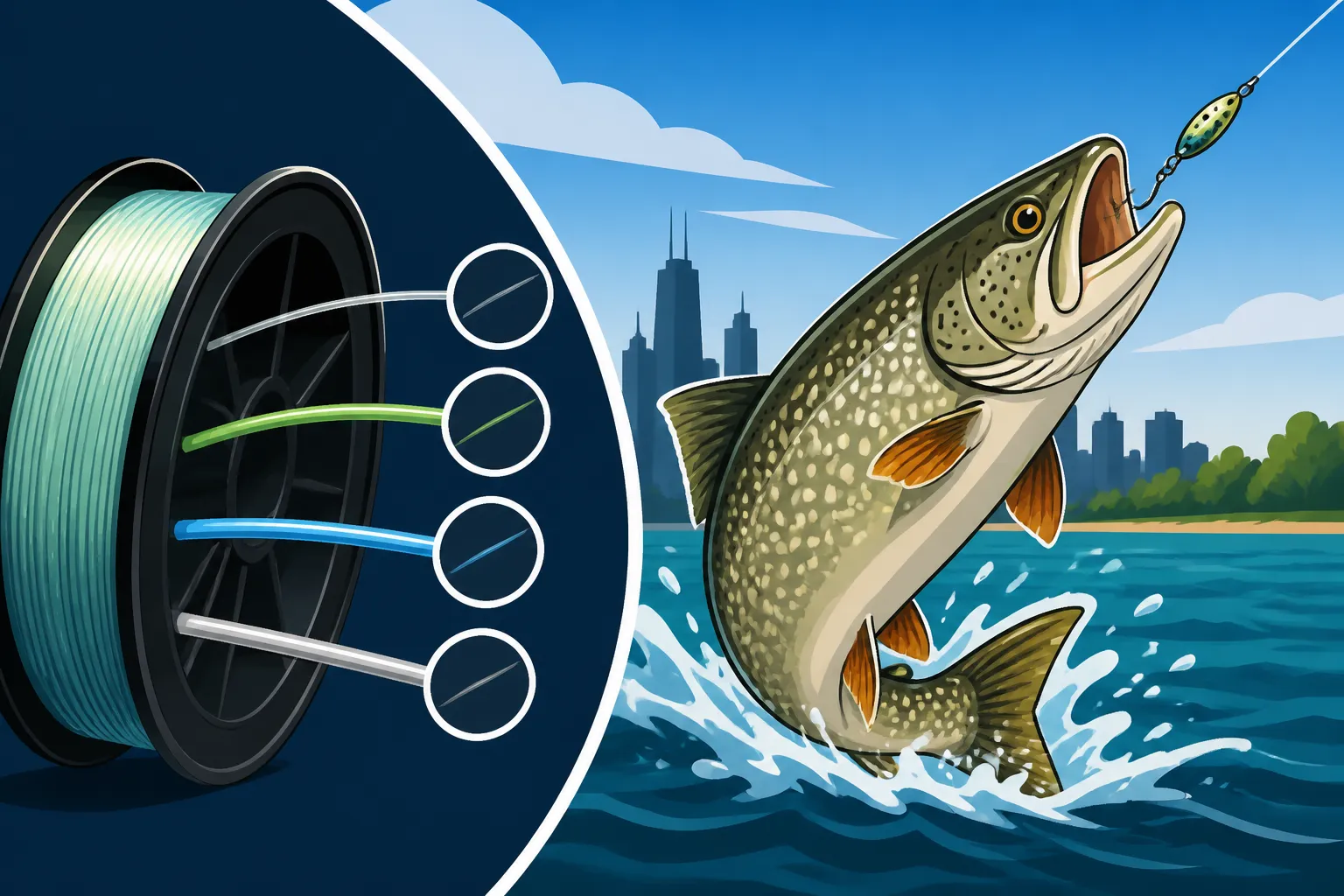
Monofilament (mono) line has been the standard for decades, and for good reason. It's affordable, easy to tie knots with, and offers a good amount of stretch, which acts as a shock absorber during violent strikes and runs. This stretch can prevent hooks from tearing out of a fish's mouth.
- Pros: Good stretch for shock absorption, excellent knot strength, affordable, relatively easy to handle.
- Cons: Higher visibility in clear water, prone to memory (coiling off the reel), susceptible to UV degradation over time, more stretch means less sensitivity at depth.
- Recommended Weights:
- Main Line for Trolling (Diver/Planer Boards): 17-25 lb test. This range provides a good balance of strength for controlling fish and enough stretch to absorb shocks. Many anglers start with 20 lb mono for general salmon and trout trolling.
- Leaders (if using braid main line): 10-20 lb test. Match the leader to the clarity and target species.
- Casting/Jigging (near shore): 10-15 lb test. Lighter mono offers better castability and sensitivity for active presentations.
Many anglers still swear by monofilament, especially for its forgiving nature. You can find quality monofilament lines at any Bass Pro Shops or online through retailers like Amazon.
Fluorocarbon Line: The Invisible Advantage
Fluorocarbon (fluoro) line is often considered a premium choice, and it's a fantastic option for leaders due to its near-invisibility in water. It has a refractive index very similar to water, making it incredibly hard for fish to detect. It also boasts excellent abrasion resistance and minimal stretch compared to mono, offering better sensitivity.
- Pros: Virtually invisible underwater, excellent abrasion resistance, good sensitivity, sinks faster than mono.
- Cons: More expensive than mono, can be stiffer and harder to tie knots with (requires proper technique), less shock absorption than mono.
- Recommended Weights:
- Leaders for Braid Main Line: 15-25 lb test. This is where fluorocarbon shines. Attach a 6-10 foot section of fluoro leader to your braided main line for invisibility. You might go lighter (15-20 lb) for wary trout and Coho, or heavier (20-25 lb) for big Chinook and Lake Trout.
- Main Line (less common for trolling): 10-20 lb test. Some anglers use fluorocarbon as a main line for direct presentations where invisibility is paramount, but its cost and stiffness can be prohibitive for filling large trolling reels.
Braided Line: Power and Sensitivity
Braided line (superline) is made from synthetic fibers woven together, resulting in incredible strength-to-diameter ratio, virtually no stretch, and fantastic sensitivity. It's a game-changer for deep-water fishing.
- Pros: Extremely strong for its diameter, near-zero stretch for maximum sensitivity and hook-setting power, incredible abrasion resistance (though can fray), long-lasting.
- Cons: Highly visible underwater (requires a leader), can be expensive, can cut fingers if not handled carefully, knots can slip if not tied properly, harder to cut without sharp scissors.
- Recommended Weights:
- Main Line for Trolling (Downriggers/Diver Rods): 30-60 lb test. Many Lake Michigan anglers use braided line as their primary running line, especially for downrigger setups and larger divers. A 30 lb braid has the diameter of 8-10 lb mono, allowing for more line capacity and less water resistance. The heavier test is for sheer breaking strength and less chance of fraying. Always use a monofilament or fluorocarbon leader with braid.
- Jigging/Casting: 10-20 lb test. The sensitivity of braid is fantastic for feeling light bites, but you'll almost always want a fluorocarbon leader for stealth.
Braid is especially useful with Downriggers and Planer Boards for Lake Michigan, allowing for precise depth control and instant feedback on bites. When rigging up with braid, remember to tie strong, tested knots, as the slick surface can lead to slippage with traditional knots.
Here's a quick comparison table to help you visualize:
| Line Type | Typical Weight Range (Main Line) | Key Advantages | Key Disadvantages | Best Lake Michigan Application |
|---|---|---|---|---|
| Monofilament | 17-25 lb | Affordable, good stretch (shock absorption), good knot strength | Visible, memory, UV degradation, less sensitive | General trolling (planer boards, smaller divers), budget-friendly |
| Fluorocarbon | (Leader: 15-25 lb) | Invisible, abrasion resistant, sensitive | Expensive, stiff, difficult knots | Leaders for all applications, wary fish, deep-water trolling |
| Braided Line | 30-60 lb | Strong, sensitive, thin diameter, no stretch | Visible, expensive, requires leader, can cut | Deep-water trolling (downriggers, large divers), main line for leaders |
Practical Tips for Choosing and Managing Your Line
Selecting the right line is only half the battle; proper maintenance and thoughtful rigging are just as crucial for consistent success on Lake Michigan.
The Importance of a Good Leader
Unless you're using monofilament as your main line in specific conditions, a leader is almost always a good idea on Lake Michigan. When using braided main lines, a fluorocarbon leader is essentially mandatory. The leader serves several vital purposes:
- Invisibility: Fluorocarbon leaders significantly reduce line visibility, making your bait presentation more natural to wary trout and salmon in clear Lake Michigan waters.
- Abrasion Resistance: Fluorocarbon is generally more abrasion-resistant than monofilament, which is crucial when fishing around structure or when a fish might rub against your boat. It also protects your more expensive braided main line from nicks and cuts.
- Shock Absorption (if mono leader): A monofilament leader can add a bit of stretch to a braided mainline setup, helping to absorb the shock of a strike.
- Sacrificial Line: If your line snags or breaks, you'll likely only lose your leader and lure, saving your expensive braided main line.
Most anglers opt for 6 to 10 feet of fluorocarbon leader, tied to the braid with a strong knot like an FG knot, Alberto knot, or uni-to-uni knot. The specific length can vary depending on conditions and personal preference. You'll want to balance the leader strength with the fish you're targeting. For mixed bags of trout and salmon, a 20 lb fluorocarbon leader is a great all-around choice.
Regular Line Inspection and Replacement
Your fishing line is your direct connection to the fish, and it's the weakest link in your entire setup if neglected. Regular inspection is non-negotiable for serious Lake Michigan anglers. After every outing, run your fingers along the last 10-20 feet of your line, feeling for nicks, abrasions, or rough spots. These weak points are accidents waiting to happen. Trim off any damaged sections immediately.
Furthermore, line doesn't last forever. Monofilament, especially, degrades with exposure to UV light and loses strength over time. Even braid, while durable, can fray or get weakened by repeated use. A good rule of thumb is to replace your monofilament main lines annually, or even more frequently if you fish often. Braided lines can last longer, but the first 50-100 feet that see the most action should be monitored closely and potentially replaced more often than the rest of the spool. Don't let a trophy fish be the victim of old, compromised line.
Balancing Strength with Presentation
There's a constant tug-of-war between using a line strong enough to land a monster and a line thin enough to present your bait naturally. While it's tempting to spool up with the heaviest line possible to prevent break-offs, excessively heavy line can spook fish in clear Lake Michigan waters, especially when the bite is tough. Thick line can also create more drag in the water, affecting lure action and diving depth.
The key is to strike a balance. Use the lightest line test that you are confident can handle the fish you expect to encounter, given your rod, reel, and drag settings. This is why lighter leaders with a heavier main line are so popular; you get the power and sensitivity of braid, but the stealth of a thin fluorocarbon leader at the business end. For more insight into the local regulations that affect your catch, check out Illinois Fishing Regulations Overview.
Experimentation and Local Knowledge
Ultimately, what works "best" can be subjective and vary by location, season, and even day. Don't be afraid to experiment with different line weights and types. Keep a log of your successes and failures. What worked perfectly for Coho in April might not be ideal for deep-water Lake Trout in August.
Perhaps the most valuable resource you have is other anglers. Spend time at the docks or local bait shops like those often stocked by Bass Pro Shops. Talk to charter captains, ask what the locals are using, and pay attention to what's working on the water. Many anglers are happy to share their knowledge, and those nuggets of local wisdom can often be the secret ingredient to a successful Lake Michigan fishing trip. The Best Time of Year to Fish Lake Michigan in Illinois can also offer great insights into seasonal preferences.
Disclaimer
This article is for general informational purposes only and does not constitute professional advice. Laws, prices and regulations vary by location and change over time. Consult a qualified professional for guidance on your specific situation.