Illinois State Record Flathead Catfish Explained
For many Illinois anglers, the thought of wrestling a true monster from the murky depths is what keeps them coming back season after season. But when it comes to flathead catfish, there's a legend that looms larger than most: the state record. This guide is all about breaking down what makes that record so special, what it takes to catch a fish of that magnitude, and how you can approach your own pursuit of a personal best, or maybe even a state-record flathead in Illinois.
The Allure of Trophy Flathead Catfish in Illinois
There's something uniquely captivating about flathead catfish. They're not just big; they're truly ancient-looking predators that lurk in some of the toughest environments our Illinois waterways have to offer. For many of us who love to fish, the flathead represents the ultimate challenge – a fish that demands respect, patience, and some serious angling prowess.
Why Flatheads Captivate Anglers
Flatheads are notorious for their sheer size and brute strength. Unlike channel catfish, which are often schooling fish and can be caught on a variety of baits, flatheads are solitary, ambush predators that prefer live bait and often hold tight to heavy cover. This makes them incredibly challenging to locate and even harder to extract once hooked. Imagine battling a fish that can easily strip line from your reel with a single powerful surge, often right into a submerged log jam. That kind of fight leaves you with shaking hands and a story to tell for years. Their incredible fighting power, combined with their impressive girth and length, makes them a highly sought-after trophy.
The pursuit of flatheads is also deeply tied to the thrill of the hunt. You're not just casting a line; you're often studying river currents, deciphering sonar readings, and carefully positioning your boat or bait to intercept a fish that might only feed a few times a day. It’s a chess game between angler and fish, where success often feels less like luck and more like a hard-earned victory. The dedication required, from scouting spots to preparing specialized gear, only adds to the satisfaction when that rod finally doubles over.
The Dream of the State Record
Every serious flathead angler in Illinois has, at some point, dreamed of catching the one – the fish that could rewrite the record books. The state record isn't just a number; it's a testament to a fish that has beaten the odds, survived for decades, and grown to an almost unbelievable size. It represents a lifetime of wise decisions (from a fish's perspective, anyway) and a perfect storm of ideal habitat, abundant food, and minimal pressure.
Chasing that record is more than just fishing; it's a quest. It pushes anglers to refine their techniques, explore new waters, and dedicate countless hours, often through the night, in hopes of encountering such a magnificent creature. Even if you never quite reach the state record, the journey itself, the sheer dedication to pursuing such a formidable fish, makes every big flathead a triumph. It's about pushing your limits and knowing that one cast, one quiet night on the water, could be the one that changes everything.
Unpacking the Illinois State Record Flathead Catfish
The Illinois state record for flathead catfish is a legendary mark, representing the pinnacle of size for this species in our state. It stands as a beacon for what is truly possible when conditions align for these incredible fish to thrive. While specific dates and angler names can sometimes shift or be difficult to verify without specific, current IDNR records, the magnitude of this record is what truly resonates with anglers.
The Record-Setting Catch
When you talk about the Illinois state record flathead, you're talking about a fish that weighed in at an absolutely staggering size. This wasn't just a big flathead; it was a true river monster, the kind of fish that few anglers ever get to see, let alone land. We're talking about a fish that tipped the scales at well over 80 pounds, an almost unbelievable figure that makes you question the strength of your own fishing line and tackle. Just imagining the sheer power required to bring such a beast to the boat or shore is enough to give any seasoned angler goosebumps.
The record flathead was likely caught from one of Illinois's major river systems, places known for their deep holes, abundant forage, and extensive snag-filled cover where these apex predators can thrive. These aren't fish you typically pull from a small pond; they are products of vast, dynamic waterways. The angler who landed it demonstrated exceptional skill, patience, and probably a fair bit of luck to not only hook such a fish but to successfully battle it to submission and get it to a certified scale. It’s a monumental achievement that has inspired countless others to dedicate themselves to the pursuit of trophy flatheads. You can learn more about how to approach these giants by checking out Flathead Catfish Fishing Tips for Illinois Anglers.
What Made This Fish a Record?
Several factors typically contribute to a flathead catfish reaching state record proportions. First and foremost is age. These fish are incredibly long-lived, often reaching several decades in age, allowing them ample time to grow. A state record flathead is almost certainly a very old fish that has spent many years perfecting its predatory skills and gorging on a rich diet of live fish. Its habitat played a crucial role too; a fish of this size needs a stable environment with consistent access to deep, cool water, abundant structure (like fallen trees, rock piles, or bridge pilings), and a steady supply of fresh, live prey such as shad, carp, or bluegill.
Furthermore, a record flathead often comes from a body of water that experiences relatively low angling pressure for big fish, or at least a specific area within a heavily fished river that is difficult to access or fish effectively. This allows these giants to evade capture and continue their growth unimpeded. Healthy river ecosystems, with good water quality and plenty of forage, are essential for nurturing fish of this caliber. It's a combination of ideal genetics, a perfect environment, a diverse food chain, and the ability to avoid hooks for a very long time that culminates in a fish worthy of a state record.
Strategies for Chasing Your Own Illinois Flathead Catfish Record
Catching a truly massive flathead isn't just about luck; it's about preparation, persistence, and understanding these incredible fish. If you're serious about targeting trophy flatheads, you need to arm yourself with the right knowledge and gear.
Targeting Big Flatheads: Gear and Techniques
When you're after flatheads that could potentially approach record size, you absolutely cannot skimp on your gear. These fish are pure muscle, and they will test every component of your setup. You'll need heavy-duty rods, often rated for 50-100 pound test line, with a strong backbone to turn powerful fish away from snags. Paired with these rods should be robust baitcasting reels, capable of holding hundreds of yards of heavy monofilament or braided line. I’m talking about reels with exceptional drag systems that can withstand sustained runs. Many anglers even find great deals on these specialized rods and reels on platforms like Amazon, ensuring they have the power they need without breaking the bank.
Live bait is the undisputed king for flathead fishing. Flatheads are predators, and they prefer a struggling, lively meal. Common choices include bluegill, sunfish, shad, or even small carp, all fished alive. The key is to present your bait in a way that looks natural but is also secure enough to withstand the violent strike of a big flathead. A heavy slip sinker rig, allowing the line to run freely through the weight, with a large, strong circle hook (like a 7/0 or larger) is a popular and effective setup. This allows the flathead to take the bait without feeling immediate resistance, leading to a solid hookset in the corner of its mouth as it swims away. For more detailed advice on bait, check out Best Live Bait for Flathead Catfish.
Prime Habitats and Locations
Finding flatheads means finding their preferred ambush points. These fish love structure, especially in current. Look for deep holes, log jams, submerged timber, rock piles, bridge pilings, and scour holes downstream of wing dams or other current breaks in major river systems like the Mississippi, Illinois, or Wabash rivers. The deeper, darker, and more snag-ridden, the better—that's often where the biggest flatheads lie in wait. They use these spots to hide from the current and ambush unsuspecting prey.
While rivers are classic flathead territory, some of Illinois's larger reservoirs also hold impressive populations of big flatheads. In lakes, focus on creek channels, main lake points, standing timber, and areas with significant depth changes. Night fishing is also incredibly productive for flatheads, as they often become more active hunters after dark. Learning the specific daily limits for these impressive fish is also crucial, and you can review them in detail by looking up Illinois Flathead Catfish Daily Limit Rules.
Patience, Persistence, and Preparation
Chasing trophy flatheads is not for the faint of heart or the impatient. It demands long hours, often through the night, sometimes with very little action. You might spend an entire evening without a single bite, only to have a monster strike in the last hour before dawn. This is where persistence truly pays off. Having a comfortable setup for night fishing, including good lighting (a reliable headlamp is a must, readily available on Amazon), insect repellent, and plenty of snacks and drinks, is essential.
Before you even cast a line, preparation is key. This includes scouting your spots using maps, sonar, and even by slowly drifting through areas to feel for submerged structure. Setting up your boat (if you're using one) for silent anchoring or precise spot-locking is also vital to present your bait effectively without spooking wary fish. Many dedicated flathead anglers keep meticulous logs of their catches, noting weather conditions, water temperature, bait used, and moon phase to identify patterns. Remember, every trip, successful or not, adds to your knowledge and gets you one step closer to that fish of a lifetime. Heavy Tackle for Mississippi River Catfish in Illinois offers further insights into proper gear.
Understanding Flathead Catfish Biology and Behavior
To truly appreciate the Illinois state record flathead catfish, and to increase your chances of catching your own impressive specimen, it helps to understand the biology and behavior of these fascinating fish. They are distinct from other catfish species in many crucial ways.
Key Characteristics of Illinois Flatheads
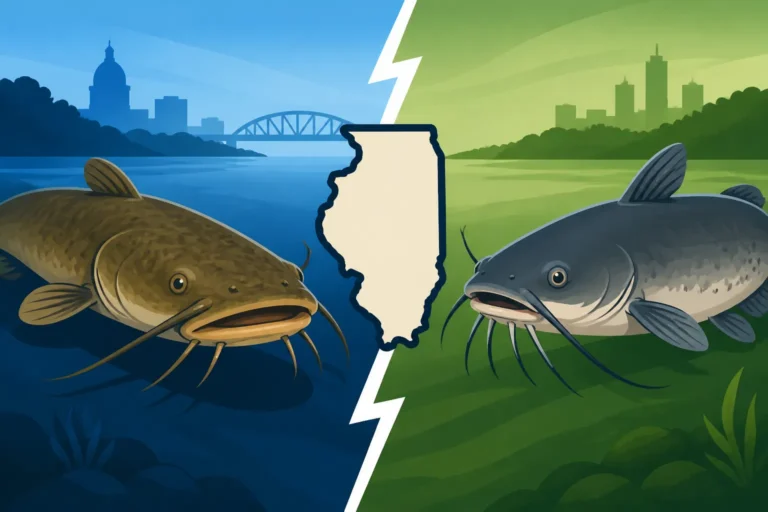
Flathead catfish ( Pylodictis olivaris) are easily distinguished from their whiskered cousins, the channel catfish and blue catfish. Their name comes from their noticeably broad, flattened head and protruding lower jaw. Their bodies are typically mottled brown and yellow, offering excellent camouflage against rocky or muddy river bottoms. Unlike the forked tails of channel and blue catfish, flatheads have a square or slightly rounded tail, which further aids in identification.
Flatheads are primarily piscivores, meaning they prefer to eat live fish. This is a critical difference from channel cats, which are omnivores and will eat almost anything. Flatheads are also solitary and territorial, often holding to a specific log jam or deep hole, which is why you rarely catch multiple big flatheads from the exact same spot in quick succession. Their predatory nature makes them a thrilling catch, as they often strike bait with incredible force. To dive deeper into how they differ, take a look at Flathead Catfish vs Channel Catfish: Key Differences.
Growth Rates and Lifespan
Flathead catfish are slow-growing compared to many other sport fish, but they have the potential for an incredibly long lifespan, often living for 20 years or more in healthy environments. This slow growth, combined with their longevity, is what allows them to reach such immense sizes. A record-setting flathead in Illinois would have accumulated years, if not decades, of feeding and avoiding predators and anglers.
Their growth is heavily dependent on food availability and water temperatures. In a system rich with forage fish and with stable, productive warm seasons, flatheads can grow steadily. Conservation efforts and responsible angling practices, such as adhering to catch limits and practicing careful release of large, healthy fish, are vital to ensuring these magnificent creatures continue to populate our waters and have the opportunity to reach trophy sizes for future generations. Understanding Illinois Flathead Catfish Daily Limit Rules is paramount for sustainable fishing.
Here's a quick comparison of the three main catfish species you'll find in Illinois waters:
| Feature | Channel Catfish | Blue Catfish | Flathead Catfish |
|---|---|---|---|
| Appearance | Forked tail, dark spots (juveniles), olive-tan | Deeply forked tail, slate blue/gray, no spots | Square/slightly rounded tail, flattened head, mottled brown/yellow |
| Diet Preference | Omnivore (prepared baits, cut bait, live bait) | Carnivore (fish, mussels, crayfish) | Piscivore (live fish almost exclusively) |
| Habitat | Rivers, lakes, ponds; tolerant of various conditions | Large rivers, deep open channels, strong current | Large rivers, deep holes, heavy cover (snags, logs) |
| Social Behavior | Often schooling | Often schooling | Solitary, territorial |
| Growth Potential | Medium (up to 40-50 lbs, typically smaller) | Very Large (can exceed 100 lbs) | Very Large (can exceed 100 lbs) |
Remember, while the state record is an incredible benchmark, every big flathead you catch is a personal achievement. Enjoy the chase, respect these powerful fish, and always practice responsible angling.
Disclaimer
This article is for general informational purposes only and does not constitute professional advice. Laws, prices and regulations vary by location and change over time. Consult a qualified professional for guidance on your specific situation.