Bass Fishing Spots on Lake Shelbyville’s Rocky Points
It's incredibly frustrating when you're out on a beautiful body of water like Lake Shelbyville, rods at the ready, but the bass just aren't biting. You've heard about the incredible fishing, seen the photos, but finding those elusive largemouth and smallmouth can feel like searching for a needle in a haystack. This comprehensive guide is here to unravel the mystery, focusing on a highly consistent and often overlooked tactic: targeting bass on Lake Shelbyville's rocky points, ensuring your next trip is filled with strikes and successful catches.
Why Rocky Points Are Bass Magnets on Lake Shelbyville
Lake Shelbyville is a massive reservoir, over 11,000 acres, with a diverse topography that can be overwhelming. But for bass anglers, certain features consistently outperform others. Rocky points are at the top of that list, and understanding why these geological formations are so attractive to bass is key to unlocking their secrets. They're not just random piles of rocks; they're vital feeding and staging areas that provide everything a bass needs to thrive.
Understanding the Structure and Cover
Bass are creatures of structure, and rocky points offer an exceptional combination of both hard bottom and varied cover. Imagine a point extending out into the main lake or a major creek arm, composed of chunk rock, gravel, and sometimes even larger boulders. This isn't just a barren underwater landscape; it's a dynamic environment. The rocks themselves absorb and radiate heat from the sun, especially in cooler water temperatures. This slight increase in temperature can be enough to draw in baitfish, like shad and sunfish, which in turn attracts hungry bass.
Unlike soft, muddy, or sandy bottoms that offer little in the way of ambush points or thermal advantages, rocky points provide countless nooks and crannies for bass to hide. From a small crack between two football-sized rocks to a larger crevice under a boulder, these spots are perfect ambush locations. A bass can lie in wait, concealed from its prey, ready to dart out when a school of shad swims by. The density and variety of rock sizes create a complex underwater maze that baitfish navigate, often getting cornered, making them easy targets. It’s a perfect hunting ground, offering both refuge and a buffet line.
Current Breaks and Feeding Lanes
One of the most significant advantages of rocky points, particularly on a large reservoir like Lake Shelbyville, is their ability to create current breaks and define feeding lanes. Even on a lake without a strong river current, wind plays a huge role in creating subsurface currents and pushing baitfish around. A prominent rocky point acts like a natural barrier, deflecting these wind-driven currents.
On the "wind-beaten" side of the point, baitfish might be disoriented and pushed against the structure. On the "leeward" or calm side, a sheltered eddy forms, offering bass a low-effort place to rest while still having immediate access to prey being funneled around the point. Bass are incredibly efficient predators; they prefer to expend as little energy as possible while maximizing their feeding opportunities. A current break on a rocky point offers precisely that. They can sit in the calmer water, hidden from view, and pick off baitfish as they are swept past or take refuge in the turbulent water. Identifying these "sweet spots" on the point – where the current is most effectively broken or where baitfish are most concentrated – is crucial for consistent success. This phenomenon is a year-round occurrence, making these areas productive no matter the season.
Identifying Prime Rocky Points for Bass Fishing
Finding a rocky point on Lake Shelbyville isn't hard; the lake is full of them. The real challenge, and where experienced anglers gain their edge, is identifying the prime rocky points – the ones that consistently hold bass. This involves a combination of pre-trip research, on-the-water observation, and understanding how bass relate to these features throughout the year.
Interpreting Topographic Maps and Sonar
Before you even launch your boat, spend some time with detailed topographic maps of Lake Shelbyville. Digital maps, like those available through apps from companies like Navionics or often utilized within the mapping features of platforms like FishingBooker, are invaluable. Look for contour lines that indicate a point extending from the shoreline with a sharp drop-off. Points where contour lines are tightly packed suggest steep breaks, which are often excellent for bass, as they provide quick access to deep water. Also, look for submerged humps or secondary points adjacent to main lake points; these are often overlooked but can be goldmines.
Once you're on the water, your sonar unit becomes your best friend. Start by idling over potential points. Your 2D sonar will show you the depth, the bottom composition (hard returns indicate rock), and any fish arches. Crucially, use Side Imaging or Down Imaging to get a clearer picture. Side Imaging can reveal entire rock piles, individual boulders, or even baitfish schools that might be slightly off to the side of your boat. Down Imaging will give you a photographic-like view directly beneath, helping you discern the size and density of the rocks and identify any subtle ledges or transitions. Pay close attention to where a rocky point transitions into a different bottom type, like a sandy flat or a weed line, as these intersection points are often magnets for bass.
Seasonal Point Selection Strategies
Bass behavior on rocky points is highly seasonal, driven primarily by water temperature and their spawning cycle. What works in spring might not be effective in summer, so adapting your approach is critical.
In spring, particularly during the pre-spawn period, bass will stage on shallower rocky points that receive ample sunlight. These points warm up faster, signaling the bass that it's time to begin their journey toward spawning flats. They'll use these points as highways, moving up into shallower water to feed and then retreating to deeper water when cold fronts roll through. Focus on points closest to known spawning areas.
As summer heats up, bass will seek cooler, deeper water. This means focusing on main lake points that have access to significant depth, often dropping off into the old river channel. Here, they'll relate to the thermocline – the layer of water where the temperature rapidly changes. Fishing during dawn and dusk, or even at night, can be incredibly productive, as bass become more active when the sun isn't directly overhead. Look for points with submerged brush or timber in addition to the rock.
Fall sees bass becoming highly aggressive as they feed up for winter. They will follow baitfish onto points as the water temperature begins to cool. This is a time when active presentations often shine. Bass will be spread out, both shallow and deep on the points, chasing schools of shad.
Finally, in winter, bass activity slows significantly, but they can still be caught on deep, main lake points. They’ll often hold tight to the bottom, sometimes in large schools. A slow, methodical approach with subtle baits is usually the ticket during these colder months. Understanding these Illinois Fishing Seasons Guide and how they influence bass behavior will greatly improve your success.
| Season | Prime Point Location | Key Characteristics | Preferred Depths | Top Baits/Techniques |
|---|---|---|---|---|
| Spring | Sun-exposed, near spawning | Warms up faster, staging areas | 5-15 feet | Crankbaits, Jerkbaits, Jigs, Wacky Worms |
| Summer | Main lake, deep water access | Near thermocline, shade, current breaks | 15-30+ feet | Deep Diving Crankbaits, Jigs, Texas Rigs, Drop Shots |
| Fall | Main lake & creek arm points | Baitfish migrations, active feeding | 10-25 feet | Crankbaits, Spinnerbaits, Jigs, Swimbaits |
| Winter | Deep, main lake points | Less active bass, stable water temperature | 20-40+ feet | Vertical Jigs, Ned Rigs, Drop Shots, Blade Baits |
Effective Techniques and Baits for Rocky Point Bass
Once you've located a promising rocky point, the next step is to present the right bait in the right way. Bass on these points can be aggressive, actively feeding, or they might be hunkered down, requiring a more subtle approach. Having a versatile tackle box and knowing when to switch tactics is paramount.
Crankbaits and Jerkbaits for Aggressive Bass
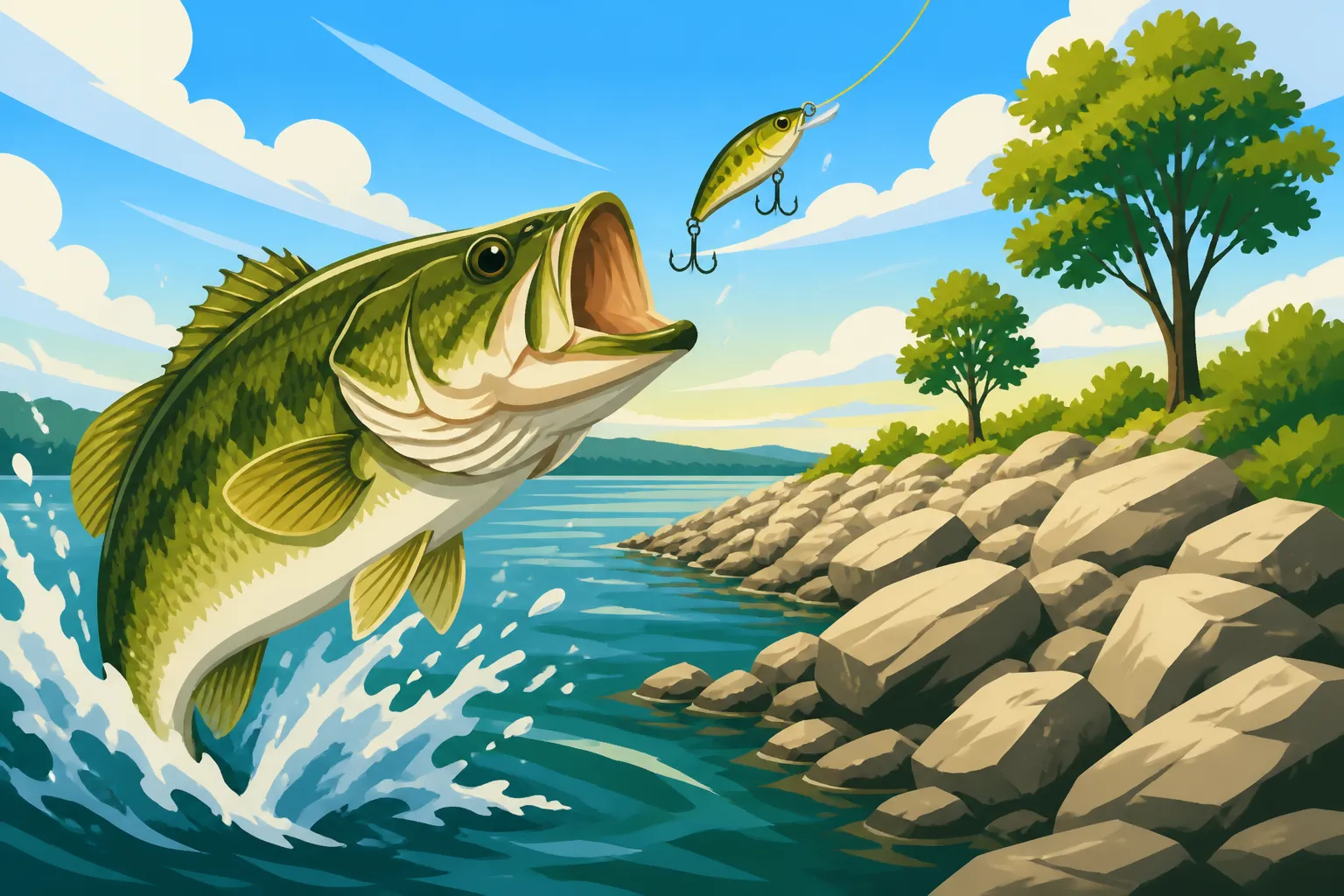
When the bass are aggressive and actively feeding on a rocky point, few baits are as effective as crankbaits and jerkbaits. These lures are designed to imitate fleeing baitfish and can cover water quickly, making them ideal for searching for active fish. For example, during the Illinois Bass Pre-Spawn Fishing Patterns or in the fall, bass will often smash a crankbait.
The key with crankbaits is to use models that dive to the appropriate depth for the point you're fishing. For shallower points, a squarebill crankbait that deflects off the rocks without snagging is incredibly effective. The erratic deflection often triggers a reaction strike from curious or territorial bass. For deeper main lake points, a deep-diving crankbait is necessary to reach the fish. Experiment with retrieve speeds; sometimes a steady retrieve works, other times a stop-and-go retrieve with pauses will be more enticing. Matching the baitfish color is often a good starting point, but don't be afraid to try some brighter "reaction" colors, especially in stained water.
Jerkbaits are another excellent choice, particularly when bass are suspended or slightly less aggressive but still willing to chase. A jerkbait's erratic, darting action, followed by a long pause, can be irresistible. Work it with a series of quick jerks, then let it sit motionless. The pause is when most strikes occur. For clear water conditions on Lake Shelbyville, natural baitfish patterns in shad or bluegill colors are usually best, mimicking the local forage.
Jigs and Soft Plastics for Finesse Presentations
When bass are not as aggressive, perhaps due to a cold front or heavy fishing pressure, or when they are holding tight to cover on a rocky point, jigs and soft plastics become your go-to options. These baits excel at finesse presentations, allowing you to thoroughly work an area and tempt even the most finicky fish.
Flipping and pitching jigs into the crevices and around individual boulders on a rocky point is a fantastic way to target bass that are tucked in tight. A football jig, designed to navigate rocky bottoms without getting snagged, is perfect for slowly dragging and hopping along the contours of the point. The jig's skirt and trailer mimic a crawfish or a bulky baitfish, making it an appealing meal. For even more subtle presentations, consider a Ned rig or a simple Texas-rigged worm. These setups allow you to fish slowly and methodically, giving the bass plenty of time to inspect and commit to the bait. Understanding How to Fish a Texas Rig for Bass can be a game-changer for working these rocky areas.
Soft plastic baits offer immense versatility. Wacky rigs, particularly with stick baits like a Yamamoto Senko, are incredibly effective when allowed to slowly fall and twitch over the rocks. Small paddle-tail swimbaits on a jig head can also be worked slowly, imitating a stunned baitfish. The key with all these presentations is patience. Allow the bait to fall naturally, feel for subtle bites, and work every inch of the point, paying close attention to any changes in depth or bottom composition that might hold a bass.
Adapting to Wind and Water Conditions
Lake Shelbyville is a large body of water, and conditions can change rapidly. Successfully fishing rocky points often comes down to how well you adapt to these variables. Wind is a major factor: a consistent breeze pushing across a point can concentrate baitfish and position bass on the wind-blown side, making them easier to target. However, too much wind can make boat control difficult and your presentation unnatural.
Water clarity also dictates bait choice. In clear water, common on many Shelbyville points, opt for more natural colors and smaller profiles. This is where knowing the Best Lures for Clear Water really pays off. If the water is stained or murky, brighter or darker colors and baits with more vibration or displacement can help bass find your offering. Keep an eye on the current, too. If there's a strong current, you might need heavier jigs or faster retrieves to keep your bait in the strike zone. If the current is slack, a slower retrieve might be more appropriate. Always be willing to experiment, whether it's changing retrieve speed, bait color, or even moving to a different side of the point until you find what the bass are reacting to.
Navigating and Safety Considerations on Lake Shelbyville's Rocky Terrain
While Lake Shelbyville offers incredible fishing, its rocky points and varied bottom structure also present unique navigation and safety challenges. Being prepared and respectful of the water and other anglers is just as important as your fishing technique.
Boating Safety and Navigation
The number one rule when approaching rocky points on Lake Shelbyville, especially if you’re unfamiliar with the area, is to exercise extreme caution. Submerged rocks are plentiful and can cause serious damage to your lower unit if you're not paying attention. This is particularly true during periods of lower water levels, where previously safe areas can become hazardous. Always consult your GPS and mapping software (like those integrated with many FishingBooker listings or available through standalone apps) and heed depth warnings.
It’s wise to idle into new areas and keep an eye on your depth finder. Learn your boat's draft – how much water it needs to float – and give yourself a generous buffer, especially when navigating close to shorelines or prominent points. Familiarize yourself with key boat ramps such as those near the Dam, Lithia Springs, or Findlay Marina, and understand their approach channels. During low light conditions, such as dawn or dusk, or when navigating at night (which can be great for fishing, but inherently more risky), slow down even further. Running lights are not just a recommendation; they are a legal requirement and a critical safety measure. Always have a clear view of your surroundings and be aware of other boaters who may not be as cautious.
Respecting the Ecosystem and Other Anglers
As anglers, we're stewards of the natural environment, and respecting Lake Shelbyville's ecosystem is crucial for its long-term health. While it's thrilling to catch a trophy bass from a rocky point, practicing catch and release, especially for larger breeding fish, helps maintain healthy populations. If you do plan to keep fish, always adhere to the Illinois Fishing Season and Catch Limit Rules for bass. Handle fish gently, minimizing their time out of water, and use proper dehooking tools.
Beyond fish handling, be mindful of your impact on the lake itself. This means "leave no trace" – pack out all your trash, including discarded fishing line, which can be harmful to wildlife. When fishing popular rocky points, remember that you're likely not the only angler who knows about their potential. Give other boats ample space, avoid cutting them off, and keep noise levels down, particularly early in the morning or late at night. A simple nod or wave goes a long way in fostering a positive angling community. By being considerate of both the fish and your fellow anglers, you contribute to a better experience for everyone on the water.
Important Disclaimer
Fishing involves inherent risks, including but not limited to adverse weather conditions, boating accidents, and personal injury. Always prioritize safety, wear a life jacket, and be aware of your surroundings. Adhere to all local, state, and federal fishing regulations, including licensing requirements and catch limits. The information provided in this guide is for educational purposes only and should not be considered a substitute for personal judgment, professional advice, or official regulations from the Illinois Department of Natural Resources.