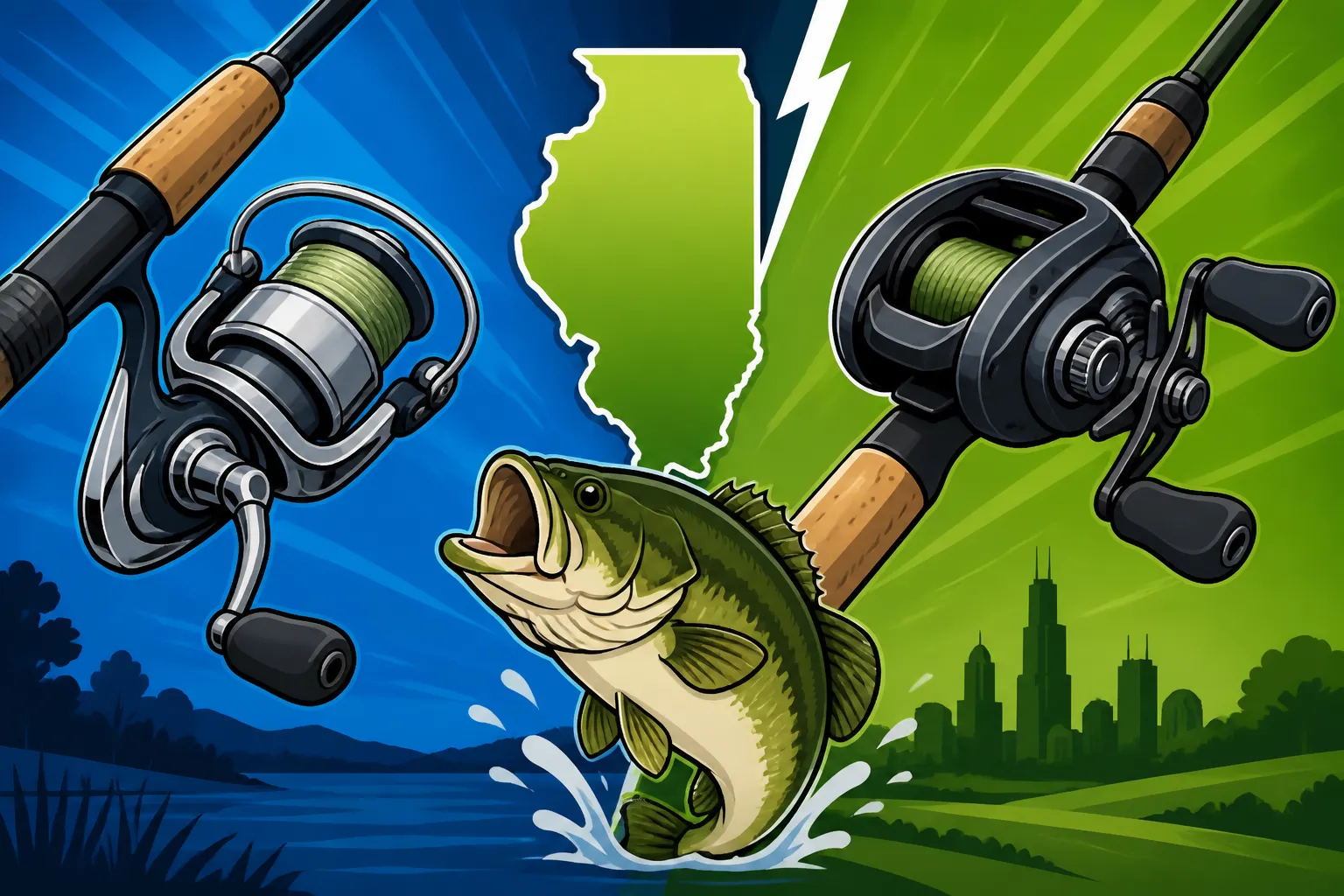
Spinning vs Baitcasting Reels for Bass Fishing
Ah, the age-old debate that keeps many an Illinois angler up at night! You've just spent a fantastic day on a local lake, maybe caught a few nice largemouth bass, but you can't shake the feeling that your gear isn't quite cutting it. Maybe your casts aren't as accurate as you'd like, or you're struggling to pull a lunker out of heavy cover. This guide is here to untangle the confusion between spinning and baitcasting reels, helping you understand which one is truly the hero for your particular style of bass fishing across the diverse waters of Illinois.
Understanding Spinning Reels for Illinois Bass Fishing
Spinning reels are often the first reel many of us learn to fish with, and for good reason. They're incredibly user-friendly, forgiving, and versatile, making them a fantastic choice for a wide array of fishing scenarios, especially when you're targeting bass that might be a little finicky. If you've ever felt intimidated by the idea of getting a bird's nest on your line, a spinning reel is likely your comfort zone, and there's absolutely no shame in that!
Pros of Spinning Reels for Bass
One of the biggest advantages of a spinning reel, hands down, is its ease of use. The open-face design means the line simply unspools from the stationary reel when you cast, reducing the chances of tangles and backlashes significantly. This makes them perfect for beginners or for those days when you just want to relax and not worry about constant adjustments. This forgiving nature is invaluable, especially when you're introducing kids to the joys of fishing or when you're trying to nail down a new technique without adding the stress of reel management.
Another massive plus is their performance with lighter lures and lines. When you're trying to present a delicate shaky head, a weightless wacky rig, or a tiny jig to hesitant bass in clear, pressured waters—think some of the smaller, clearer lakes in central Illinois—a spinning reel is your best friend. The lighter line flows off the spool with minimal resistance, allowing for longer, smoother casts with these subtle presentations. This is particularly crucial when bass are shallow and spooky, or when they're keying in on very small forage. You just can't get that same effortless cast with ultra-light baits on a baitcaster without a lot of headache.
Finally, spinning reels are excellent for certain finesse techniques where a slower retrieve or a subtle action is key. Drop-shotting, for instance, is almost exclusively done on spinning gear because it allows for such precise line control and the ability to detect the lightest bites. They also excel at skipping baits under docks or overhanging trees, a technique that requires a soft touch and can be surprisingly effective for hidden bass. The sensitivity you get with lighter lines on a spinning reel can make all the difference in detecting those subtle "thunks" or "ticks" that indicate a bass has picked up your bait.
Cons of Spinning Reels for Bass
While spinning reels are fantastic for many applications, they do have their limitations, especially when it comes to power and heavy-duty situations. One common issue anglers encounter is line twist. Because the bail rotates around a stationary spool to retrieve line, it can introduce twist, particularly if you're frequently fishing with lures that spin, or if you're not careful about how you spool your line. Over time, this twist can lead to tangles, knots, and ultimately, a weaker line. It's a common frustration that can interrupt an otherwise perfect day on the water.
Another significant drawback is their struggle with heavier lures and thick lines. While they excel with finesse presentations, trying to cast a large, heavy jig or a big swim bait on a spinning reel can feel awkward and severely limit your casting distance. The wider arc of the line coming off the spool creates more friction, reducing efficiency. Furthermore, spinning reels generally have less cranking power compared to baitcasters, which means pulling a big bass out of dense cover, like thick lily pads or submerged brush, can be a real struggle. You might feel like you're just not gaining enough ground on the fish, risking it wrapping you around structure.
Ideal Scenarios for Spinning Reels in Illinois Bass Fishing
So, when should you reach for that spinning reel when you're chasing Illinois bass? They truly shine in situations demanding subtlety and precision with lighter tackle. Imagine you're on a clear-water lake like Kinkaid Lake, famous for its big bass, and the fish are schooled up but hesitant. This is where a spinning reel, paired with a light fluorocarbon line and a small jig, can fool those wary giants. Finesse techniques like shaky heads, Neko rigs, or small jigs presented slowly and methodically are perfectly suited for spinning gear.
They're also fantastic for smaller ponds, especially those private waters where you know the bass are easily spooked. Being able to cast a lightweight finesse worm a long distance with minimal splash is critical in these environments. And, as mentioned, for beginner anglers or those just getting into bass fishing, a spinning reel offers a much gentler introduction to casting and retrieving, allowing them to focus on learning fish behavior and lure presentation without the added challenge of backlash management. It's a great entry point to build confidence before stepping up to more specialized gear.
Understanding Baitcasting Reels for Illinois Bass Fishing
Baitcasting reels are often seen as the "pro" option in bass fishing, and while they definitely have a steeper learning curve, they offer unparalleled control, power, and accuracy once mastered. If you're serious about targeting bigger bass, throwing bigger baits, or fishing in challenging cover, a baitcaster is an essential tool in your arsenal. Don't let the initial intimidation stop you; the rewards are truly worth the effort.
Pros of Baitcasting Reels for Bass
The power and control a baitcasting reel offers are its biggest selling points. Unlike a spinning reel where the spool is stationary, a baitcaster's spool rotates with the cast, delivering line directly off the top. This direct connection to the line means incredible sensitivity and the ability to feel even the slightest tap or change in lure action. This power also translates into superior fish-fighting capability; when you hook into a monster largemouth buried deep in a weed bed on Rend Lake, the winch-like power of a baitcaster gives you the leverage to pull that fish out before it can get tangled.
Accuracy is another huge advantage. With a baitcaster, your thumb is constantly on the spool, allowing you to feather the line and stop the cast precisely where you want it. This thumb control is critical for "pinpoint casting," letting you drop a jig right next to a submerged log or skip a frog into the tightest pockets of lily pads. When you're fishing dense cover, like the timber on Lake Shelbyville, being able to put your lure exactly where it needs to be, repeatedly, makes all the difference. This precision is difficult to replicate consistently with a spinning reel.
Furthermore, baitcasting reels are built for heavy lures and lines. If you're throwing big crankbaits, swimbaits, chatterbaits, or heavy jigs, a baitcaster handles them effortlessly, providing maximum casting distance and control. The larger gears and stronger drag systems are designed to withstand the stress of power fishing, giving you the confidence to throw stout braided line and wrestle big fish out of thick vegetation. This robustness is what makes them the go-to choice for aggressive presentations.
Cons of Baitcasting Reels for Bass
Let's not sugarcoat it: the primary drawback of baitcasting reels is the notorious "bird's nest," also known as a backlash. This happens when the spool spins faster than the line can unspool, creating a tangled mess of line that can take minutes, or even longer, to pick out. It's a rite of passage for every baitcaster user, and it can be incredibly frustrating, especially if you're new to the game. Learning to properly set your brakes, spool tension, and most importantly, use your thumb as a brake, takes practice and patience.
Another limitation is their less-than-stellar performance with very light lures. While some highly specialized, high-end baitcasters can handle lighter presentations, most standard baitcasting reels struggle to cast anything under a quarter-ounce effectively. The weight of the lure is needed to pull line smoothly from the spool, so without sufficient weight, you'll get short, inconsistent casts and a higher likelihood of backlashing. This means if your fishing primarily involves ultra-light finesse baits, a baitcaster might not be the best choice for that specific application.
Finally, baitcasting reels can sometimes be more expensive than their spinning counterparts, especially when you start looking at models with advanced braking systems and lighter components. While there are budget-friendly options, a really good, smooth casting baitcaster often comes with a higher price tag. This initial investment, coupled with the learning curve, can be a barrier for some anglers. However, many find that the increased performance and specialized capabilities justify the cost in the long run. Many anglers look to trusted retailers like Bass Pro Shops or even online marketplaces like Amazon for a wide selection of models.
Ideal Scenarios for Baitcasting Reels in Illinois Bass Fishing
When it comes to power fishing and heavy cover scenarios in Illinois, baitcasting reels are simply king. If you're flipping a jig into dense flooded timber on Carlyle Lake, pitching a plastic worm under a dock on the Illinois River, or slinging a frog across a matted weed bed, a baitcaster gives you the accuracy and power you need to get the job done. The ability to make short, precise casts into tight spots is unmatched.
They are also the preferred choice for throwing larger, reaction baits. Think about bombing a deep-diving crankbait across a rocky point, ripping a bladed jig through scattered grass, or burning a spinnerbait over submerged humps. These baits often weigh a half-ounce or more, and a baitcaster handles them with ease, allowing for long casts that cover a lot of water. The strong gears and powerful drag systems also help you manage powerful strikes from aggressive bass, especially when using braided line to cut through vegetation. Best Bass Fishing Lakes in Illinois often have sections that are perfectly suited for these power fishing techniques.
Direct Comparison: Spinning vs. Baitcasting for Illinois Bass
When you're standing in the aisle at a sporting goods store, or browsing online at Bass Pro Shops, the sheer variety of reels can be overwhelming. Understanding the fundamental differences in how spinning and baitcasting reels operate is key to making an informed decision that suits your specific bass fishing needs in Illinois. It’s not about one being inherently "better" than the other, but rather about choosing the right tool for the specific job at hand.
Key Differences in Casting and Control
The most fundamental difference lies in their casting mechanics. With a spinning reel, the line comes off the spool in coils as the lure pulls it. This "frictionless" release (relative to a baitcaster) is why they excel with lighter baits. You simply open the bail, hold the line with your finger, and release. The lack of spool rotation means fewer moving parts to manage during the cast, simplifying the process.
Baitcasting, on the other hand, involves the spool itself rotating to release line. This direct rotation allows for incredible precision, as your thumb acts as a crucial brake, feathering the spool to prevent overruns and backlashes. It’s like driving a manual car versus an automatic – more control, but more things to manage. This direct line of pull from the spool also translates to better sensitivity in feeling bites and lure action. When casting, a baitcaster typically provides a straighter, more direct line path, which can enhance accuracy, especially when targeting specific pieces of cover. Bass Fishing Techniques for Beginners often start with spinning gear for this very reason, before moving to the more nuanced control of a baitcaster.
Line Management and Power
Line management is a significant differentiator. Spinning reels are prone to line twist, especially with certain lures or if the line isn't spooled correctly. This can lead to annoying tangles, weakened line, and reduced casting distance over time. While modern spinning reels have improved anti-twist features, it's still a consideration. However, they handle lighter lines with ease, making them ideal for delicate presentations where visibility of the line is a concern.
Baitcasting reels, by their nature, do not induce line twist because the line spools on and off directly. They are designed to handle much heavier lines, including robust braided lines and heavy fluorocarbon, making them perfect for fishing in thick vegetation or around abrasive structure. Their larger gear ratios often translate to more cranking power, allowing anglers to quickly reel in slack line, set hooks firmly, and winch stubborn bass away from cover. This raw power is critical when dealing with powerful, hard-fighting fish in challenging environments.
Comfort and Learning Curve
For most anglers, the comfort and learning curve associated with each reel type are major factors. Spinning reels are almost universally easier to learn. The casting motion is straightforward, and backlashes are rare. This makes them ideal for casual anglers, beginners, or anyone who wants to focus on fishing rather than reel management. The ergonomics are generally simpler, with the reel hanging underneath the rod.
Baitcasting reels, however, have a steep learning curve. The initial frustration of backlashes is real, and it takes time and practice to master the thumb control, brake settings, and spool tension. Many anglers give up prematurely, but those who persist find a reel that becomes an extension of their hand. The reel sits on top of the rod, which some find more comfortable for certain casting motions and for palming the reel during retrieves. It becomes second nature for experienced anglers.
Here’s a quick overview of some key differences:
| Feature | Spinning Reel | Baitcasting Reel |
|---|---|---|
| Ease of Use | Very easy, great for beginners | Steep learning curve, prone to backlashes |
| Lure Weight | Best for light to medium lures (1/16 – 1/2 oz) | Best for medium to heavy lures (1/4 oz +) |
| Line Type | Handles monofilament, fluorocarbon, braid | Excels with heavy fluorocarbon and braid |
| Accuracy | Good for general casting, decent precision | Superior pinpoint accuracy, excellent control |
| Power | Less cranking power | High cranking power, good for heavy cover |
| Sensitivity | Good with light line | Excellent direct feel, high sensitivity |
| Cost | Generally more affordable | Can be more expensive, especially higher-end |
| Line Twist | Can be an issue | Not an issue |
| Best For | Finesse, open water, wary fish | Power fishing, heavy cover, large baits |
Choosing the Right Reel for Your Bass Fishing Style
Deciding between a spinning and baitcasting reel isn't about one being objectively "better" than the other for all situations. It’s about matching the reel to your personal fishing style, the techniques you prefer, the specific conditions you'll face, and your comfort level on the water. For many dedicated Illinois bass anglers, the ultimate solution isn't to choose one over the other, but to embrace both.
Matching Your Fishing Style
Your fishing style is perhaps the most critical factor in choosing the right reel. Are you a "finesse" angler, meticulously working small baits to tempt wary bass in clear water? Do you love the subtle twitch of a weightless worm or the slow drag of a shaky head? If so, a spinning reel is likely going to be your primary workhorse. It offers the sensitivity and light-line capability needed for these delicate presentations. Think about fishing for a Largemouth Bass Fishing in Illinois: The Complete Guide in heavily pressured ponds or clear-water reservoirs.
Or are you more of a "power" angler, preferring to cover a lot of water with aggressive, reaction baits, or punching through thick vegetation? Do you thrive on the violent strike of a bass inhaling a frog in the slop, or the heavy thud of a deep-diving crankbait? If this sounds more like you, a baitcasting reel will be indispensable. Its ability to handle heavy lures, strong lines, and provide the necessary backbone to pull big fish out of dense cover makes it the undisputed champion for these techniques. This is especially true on large reservoirs like Rend Lake or parts of the Mississippi River, where heavy cover abounds.
Considering Your Budget and Experience Level
For newcomers to bass fishing, or those on a tighter budget, starting with a good quality spinning reel is almost always the recommended path. They are more forgiving, allowing you to focus on learning casting mechanics, reading the water, and understanding bass behavior without the added frustration of constant backlashes. You can find excellent spinning reel setups at a very reasonable price, making the barrier to entry much lower. Retailers like Bass Pro Shops offer complete rod and reel combos that are perfect for beginners.
As you gain experience and perhaps want to explore more advanced techniques or tackle heavier conditions, then investing in a baitcasting reel makes sense. Don't feel pressured to jump into a baitcaster before you're ready; it’s a skill that develops over time. When you are ready, remember that a slightly higher initial investment in a quality baitcaster can save you a lot of headache in the long run, as cheaper models can be notoriously difficult to manage. You can often find good deals on reliable baitcasters through online retailers like Amazon, but be sure to read reviews.
Having Both: The Ultimate Illinois Bass Angler's Setup
For many seasoned Illinois bass anglers, the "either/or" question is a false dilemma. The truth is, the most effective setup often involves having both spinning and baitcasting reels rigged on different rods, ready for specific situations. Imagine you're out on Lake Shelbyville. You might start the morning fishing a topwater frog over a weed mat with your baitcaster. As the sun gets higher and the fish go deeper or become more cautious, you might switch to a spinning rod with a drop-shot or a Ned rig to target them in clearer, deeper water.
This versatility allows you to adapt to changing conditions and fish moods throughout the day, maximizing your chances of success. A true bass fishing enthusiast in Illinois will likely have several rod and reel combos in their boat or tackle bag: a couple of baitcasters for power applications (e.g., one for jigs, one for crankbaits) and at least one spinning setup for finesse work. This approach ensures you're always prepared for whatever the bass, or the lake, throws your way. Best Rods for Illinois Largemouth Bass also outlines how rods are often paired specifically with one reel type or the other. It's about building a comprehensive toolkit for every bass fishing scenario you might encounter in the diverse waters of our great state.
Disclaimer
This article is for general informational purposes only and does not constitute professional advice. Laws, prices and regulations vary by location and change over time. Consult a qualified professional for guidance on your specific situation.