Downrigger Setup for Lake Michigan Salmon Trolling
If you've ever found yourself on Lake Michigan, watching salmon or trout marks on your sonar screen at seemingly impossible depths, you know the frustration of trying to get your lure down to where the fish are. These powerful fish often hang out far beneath the surface, making traditional casting or even weighted lines ineffective. This guide is all about tackling that challenge head-on by walking you through a complete downrigger setup for successful Lake Michigan salmon and trout trolling.
What Exactly Is a Downrigger and Why Do You Need One on Lake Michigan?
Let's be honest, fishing some of the deeper, colder waters of Lake Michigan for salmon and trout can feel like trying to hit a moving target with a blindfold on. These incredible fish, especially species like Coho and Chinook salmon, as well as lake trout, often suspend themselves in the water column, sometimes hundreds of feet down, seeking specific temperature breaks and baitfish. Trying to get a lure to consistently run at, say, 70 feet in open water using just a heavy sinker is a losing battle. The current, your boat speed, and even the line's natural drag will constantly pull your offering shallower or deeper than intended.
The Deep-Water Challenge of Lake Michigan Salmon and Trout
Lake Michigan is a vast, deep, and ever-changing body of water. The temperature layers, known as thermoclines, shift with the seasons, and fish follow these preferred temperatures and their food sources. Early in the season, fish might be shallower, but come summer, it's not uncommon for them to be holding 50, 80, or even over 100 feet deep. Without a precise way to present your bait at these exact depths, you're essentially just dragging it through empty water. This is why many experienced Lake Michigan anglers rely heavily on specialized gear to ensure their lures are in the strike zone. You can learn more about specific seasonal patterns in our guide, Lake Michigan Salmon Season Timing in Illinois.
Imagine this: your sonar shows a dense school of baitfish at 65 feet, and you know the salmon are likely right there, staging for a feed. If your lure is only reaching 30 feet, you're missing the action entirely. The deep, clear waters of Lake Michigan require a level of precision that conventional fishing methods just can't provide when targeting these suspended predators. This is where the downrigger becomes not just a helpful tool, but an absolutely essential piece of equipment for consistent success.
How Downriggers Solve the Depth Dilemma
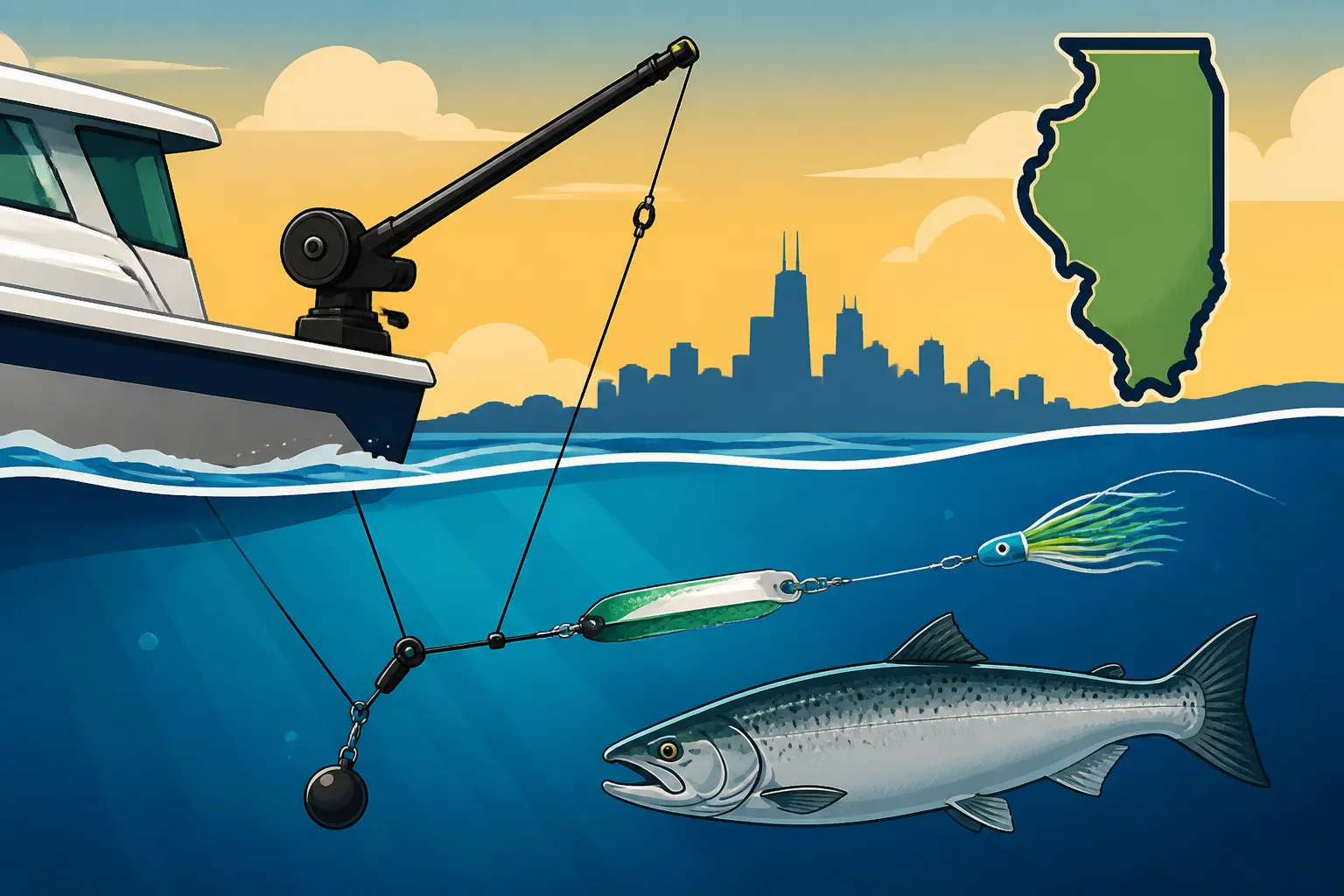
A downrigger is essentially a controlled weighting system that allows you to present your lures at an exact, predetermined depth while trolling. It uses a heavy weight (the downrigger ball) to pull your fishing line, with its attached lure, down to the desired depth. Your actual fishing line is connected to the downrigger cable via a special release clip. When a fish strikes, the clip releases, and you fight the fish directly on your rod and reel, without the heavy downrigger ball interfering.
This means you can target specific depths with incredible accuracy, placing your lures right in front of those deep-holding salmon and trout. It’s like having an elevator for your bait, taking it exactly where it needs to go. This precision is what makes the difference between a frustrating day of dragging lures through empty water and a successful trip with a cooler full of beautiful fish. Plus, by knowing exactly what depth you're fishing, you can replicate successful patterns or adjust quickly when the fish move. Understanding how to use these tools effectively is key to mastering Lake Michigan Salmon and Trout Fishing in Illinois.
Different Types of Downriggers: Manual vs. Electric
When it comes to downriggers, you generally have two main choices: manual or electric. Each has its pros and cons, and the best choice often depends on your budget, the size of your boat, and how frequently you plan to use them.
- Manual Downriggers: These are operated by a hand crank. You physically reel the downrigger ball up and down. They are typically less expensive, simpler in design, and easier to maintain. For anglers just getting started or those with smaller boats who might only run one or two downriggers, a manual unit can be a great entry point. However, constantly cranking up a heavy ball, especially when checking bait or after a release, can become tiring over a long day on the water, particularly if you're running multiple lines. They're a good budget-friendly option if you're outfitting your boat for the first time or want to test the waters of deep trolling without a huge upfront investment.
- Electric Downriggers: These units feature a motor that automatically raises and lowers the downrigger ball at the push of a button. They are significantly more convenient, especially when running multiple lines, frequently checking baits, or dealing with multiple hookups. Many electric models come with advanced features like auto-stop at the surface, depth counters, and even "bottom tracking" which automatically adjusts the ball's depth to follow the contours of the lakebed. While they come with a higher price tag and require a 12-volt power source on your boat, the ease of use and added features can make them well worth the investment for serious Lake Michigan anglers. Brands like Cannon and Scotty are popular choices for electric downriggers, often found at retailers like Bass Pro Shops.
Here's a quick comparison to help you decide:
| Feature | Manual Downrigger | Electric Downrigger |
|---|---|---|
| Cost | Lower | Higher |
| Ease of Use | Requires physical cranking | Push-button operation, motor does the work |
| Features | Basic depth control, manual retrieve | Auto-stop, depth counter, bottom tracking (some) |
| Maintenance | Simpler, fewer electronic components | More complex, requires power source |
| Best For | Beginners, smaller boats, fewer lines | Serious anglers, multiple lines, larger boats |
| Physical Effort | High, especially with heavy balls | Low, very convenient |
Essential Components for Your Downrigger Setup
Getting your downrigger system just right for Lake Michigan means understanding all the pieces of the puzzle. It's more than just the downrigger itself; it's about the synergy of the unit, the weight, the release, and even your fishing rod. Each component plays a critical role in getting your lure to the right depth and ensuring a successful hookup.
The Downrigger Unit Itself: Mounts, Booms, and Release Clips
Your downrigger unit needs to be securely mounted to your boat. Most units come with a sturdy base that bolts directly to the gunwale, transom, or a specialized downrigger track system. For the heavy weights and forces involved, especially when fighting a fish, a solid mount is non-negotiable. Don't skimp here; a wobbly downrigger is a recipe for disaster. Booms, which extend the downrigger cable away from the boat, come in various lengths. Longer booms help spread your lines out, reducing tangles and allowing you to run more rods. For a comprehensive setup, consider how you’ll integrate Downriggers and Planer Boards for Lake Michigan to cover even more water.
Then there are the release clips, arguably the most crucial component after the downrigger itself. These clips attach your fishing line to the downrigger cable, holding it in place until a fish strikes. There are various types of clips, from simple pinch clips to adjustable tension clips. The key is to find a clip that holds your line securely enough to prevent false releases from boat movement or currents, but releases cleanly and easily when a fish hits. Experiment with different clips and tension settings to find what works best for your setup and the size of fish you're targeting. A common mistake is setting the clip too tight, which can prevent it from releasing properly when a fish bites, or too loose, leading to constant false releases.
Balls, Cable, and Snubbers: The Depth Control System
The downrigger ball, also known as the weight, is what takes your lure down to the desired depth. These come in various weights, typically ranging from 8 to 15 pounds for Lake Michigan salmon and trout fishing. Heavier balls tend to run truer and are less affected by current or boat speed, which is a major advantage in deep water. You can find a wide selection of Downrigger Weights for Deep Water Salmon Trolling at any good tackle shop or online. The cable itself is usually stainless steel or braided wire, spooled onto the downrigger's drum. It needs to be strong and resistant to abrasion. Regular inspection for frays or kinks is vital for safety and performance.
Between the downrigger ball and the downrigger cable, many anglers use a "snubber." This is a short piece of strong, stretchy cord or heavy-duty rubber that absorbs shock. When a fish strikes and the clip releases, the sudden reduction in weight on the cable can put a lot of stress on the downrigger. A snubber acts as a shock absorber, protecting both your downrigger and the cable from damage. It also provides a bit of stretch, which can help prevent the downrigger ball from "bouncing" too much in rough water, keeping your lure at a more consistent depth.
Dedicated Rods, Reels, and Line for Downrigger Fishing
While you can use almost any rod with a downrigger, dedicated downrigger rods and reels make the experience much smoother and more effective. Downrigger rods are typically long (7-10 feet), with a soft, forgiving tip that allows the rod to load up under the tension of the downrigger ball. When a fish strikes and the clip releases, this "stored energy" in the rod helps to set the hook. The soft tip also helps to absorb the sudden jerk of the release, preventing break-offs. You'll find excellent options by searching for Best Trolling Rods for Lake Michigan Salmon.
For reels, a sturdy level-wind conventional reel with a reliable drag system is usually preferred. Line counter reels are a huge bonus, allowing you to precisely track how much line you have out, which is essential for replicating successful patterns or knowing how far back your lure is running behind the downrigger ball. As for line, many Lake Michigan anglers opt for monofilament in the 17-25 pound test range. While braid is strong, its lack of stretch can sometimes be a disadvantage when a fish hits a tight downrigger clip, potentially leading to pulled hooks or broken lines. The stretch of mono acts as another shock absorber in the system.
Rigging Your Lures for Downrigger Success
Once you have your downrigger setup dialed in, the next step is to rig your lures correctly. This isn't just about tying a knot; it's about choosing the right lure for the conditions, setting it up to run perfectly, and ensuring your presentation is as enticing as possible to those deep-dwelling salmon and trout.
Choosing the Right Lures: Spoons, Plugs, and Flies
Lake Michigan salmon and trout respond well to a variety of artificial lures, and what's "hot" can change day by day, or even hour by hour.
- Spoons: These are probably the most popular choice for trolling Lake Michigan. Their wobbling, flashing action mimics baitfish, and they come in an endless array of colors and sizes. Common spoon colors include bright metallics, oranges, greens, blues, and various combinations, often with intricate patterns. Experimentation is key here. Keep a wide selection in your Tackle Box Setup for Illinois Species.
- Plugs: Diving plugs, often called crankbaits, are another effective option. These lures have a bill that causes them to dive and wobble, mimicking larger baitfish or even smaller salmon. They can be particularly effective for Chinook salmon.
- Flies/J-Plugs: Often fished behind a "flasher" or "dodger" (an attractor that creates disturbance and flash), these are especially deadly for Coho salmon. The flasher draws attention, and the small fly or J-plug trailing behind looks like an easy meal.
It's smart to have a diverse tackle box, especially one stocked with options for different light conditions and water clarities. What works on a sunny day with clear water might be completely ignored on a cloudy day with stained water.
Leader Length, Attractors, and Setting Your Release Clip
The leader is the section of line connecting your main fishing line to your lure. For downrigger fishing, leader length is crucial. Generally, for spoons and plugs, a leader of 6 to 15 feet is common, allowing the lure enough freedom to swim naturally away from the disturbance of the downrigger ball and cable. When using flashers or dodgers with flies, the leader from the flasher to the fly will be shorter, typically 18 to 36 inches, as the fly needs to be close enough to benefit from the flasher's action.
Attractors like flashers and dodgers are designed to create flash, vibration, and a wounded baitfish impression, drawing fish to your spread. They are typically placed on the downrigger cable or on a separate mainline, ahead of your actual lure. If you're using an attractor, your lure will trail behind it on a leader. Lake Michigan Trolling Gear for Salmon and Trout delves deeper into these important additions.
As for your release clip, once your lure is deployed, you'll attach your fishing line into the clip. The clip itself is then attached to the downrigger cable, usually a few feet above the downrigger ball. The tension on the clip needs to be just right: enough to hold the line firmly without slipping due to trolling speed or wave action, but light enough to release when a fish bites. You want that rod tip to snap back and signal the strike clearly.
Importance of Stealth and Presentation at Depth
Even though you're trolling in a boat, stealth still matters. These Lake Michigan predators can be wary. A smooth, consistent troll is important. Jerky boat movements or sudden changes in speed can cause your lures to behave unnaturally or even foul. Your goal is to make your lure look like an easy, natural meal. This means checking your lures periodically to ensure they're running true – spoons shouldn't be spinning uncontrollably, and plugs should have their characteristic wobble.
Also, consider the "blowback" – how far back your lure is running behind the downrigger ball. This can be affected by trolling speed, line diameter, and lure type. Sometimes fish prefer a lure directly behind the ball; other times, they want it further back, away from the immediate disturbance. Experimentation with how far you let your line out from the rod tip to the release clip can reveal what the fish prefer on any given day. Remember, the deeper you fish, the more important a smooth and consistent presentation becomes.
Mastering Downrigger Deployment and Operation Techniques
Operating downriggers might seem complex at first, but with a bit of practice, it becomes second nature. The key is to be methodical, understand what your equipment is telling you, and make adjustments based on the conditions and fish behavior.
Deploying Your Downrigger: A Step-by-Step Guide
Getting your lure into the strike zone with a downrigger is a precise process. Here’s a typical deployment sequence:
- Prepare Your Lure: Attach your chosen spoon, plug, or flasher/fly combo to your leader and tie it to your main fishing line. Ensure your knots are secure.
- Let Out Line: Lower your lure into the water and let out a specific amount of fishing line, typically 20-50 feet, behind the boat. This is called the "setback." Using a line counter reel here is incredibly helpful for consistency.
- Attach to Release Clip: Take your fishing line and place it into the downrigger release clip. The clip should be attached to the downrigger cable, usually about 3-5 feet above the downrigger ball.
- Lower the Ball: Begin lowering the downrigger ball to your desired depth. If you have an electric downrigger, simply press the button. For a manual one, crank the handle. Watch your depth counter closely.
- Load the Rod: As the downrigger ball descends and pulls your fishing line down, the tip of your downrigger rod will bend, or "load up." This bend indicates that the system is under tension and ready. You want a nice, even curve in the rod.
- Repeat for Multiple Lines: If you're running multiple downriggers, repeat this process for each. Staggering your depths (e.g., one at 60 feet, one at 75 feet) and setbacks (e.g., one with 30 feet of line out, another with 50 feet) helps cover more water and prevent tangles. Remember to check out Illinois Lake Michigan Trolling Gear Checklist before you head out.
Reading Your Fish Finder and Adjusting Depth
Your fish finder is your eyes below the surface. Before deploying your downriggers, spend some time scouting. Look for baitfish schools, individual fish arches, and observe the thermocline (the distinct temperature break). Salmon and trout often hold just above, in, or below the thermocline, depending on the season and baitfish location. For a comprehensive look at how fish react to water temps, see Water Temperature and Fish Activity Guide.
Once you've identified a promising depth, set your downriggers accordingly. Don't be afraid to adjust. If you're not getting bites at 70 feet, try moving a downrigger up to 60 feet or down to 80 feet. Sometimes a change of just 5-10 feet can make all the difference. Electric downriggers with auto-tracking features can be particularly useful here, as they can be programmed to maintain a specific distance from the lakebed, ensuring your lure stays in the strike zone even over uneven bottom contours. Keep an eye on your boat speed too; generally, 2.0 to 3.5 mph is a good range for Lake Michigan trolling, but fish preferences can vary.
The Art of the "Strike" and Fighting a Fish Off the Clip
The most exciting part of downrigger fishing is the strike! When a salmon or trout hits your lure, the tension on the fishing line suddenly increases. This causes the release clip to open, and your rod tip will snap back from its loaded position to straight up. This sudden "pop" of the rod tip is often referred to as a "downrigger strike."
When you see that rod snap back, grab the rod quickly but smoothly. There's no need for a hard hookset as the fish has often already hooked itself with the force of the strike and the release. Just reel down quickly to take up any slack and begin fighting the fish. Remember, you're now fighting the fish directly on your main line, without the drag of the downrigger ball. This makes for an exhilarating fight! Have a net ready, and communicate with your boatmates, especially if you have multiple lines in the water, to avoid tangles while you're focused on landing that beautiful Lake Michigan salmon or trout.
| Downrigger Depth (feet) | Target Species (Common) | Typical Lure Types | General Seasonal Timing |
|---|---|---|---|
| 20-50 | Coho Salmon, Rainbow Trout | Small spoons, flies/dodgers, plugs | Spring, early Summer, Fall |
| 50-80 | Chinook Salmon, Lake Trout | Larger spoons, plugs, flies/flashers | Summer, Fall |
| 80-120+ | Lake Trout, Deep Chinook | Heavy spoons, large plugs, meat rigs | Mid-Summer, deep water areas |
It's important to remember that these are general guidelines, and fish behavior can change rapidly. Always pay attention to your sonar and adapt your depths accordingly. Knowing when to target specific species like Coho or Chinook is also part of the strategy, as discussed in When to Chase Salmon vs Trout on Illinois's Lake Michigan Shore.
No matter if you're pulling in a feisty Coho or a hard-fighting Chinook, a properly executed downrigger setup will maximize your chances of success on the mighty waters of Lake Michigan. Good luck out there!
Disclaimer
This article is for general informational purposes only and does not constitute professional advice. Laws, prices and regulations vary by location and change over time. Consult a qualified professional for guidance on your specific situation.